100 Degrees Fahrenheit in Celsius: 37.8°C and How to Convert
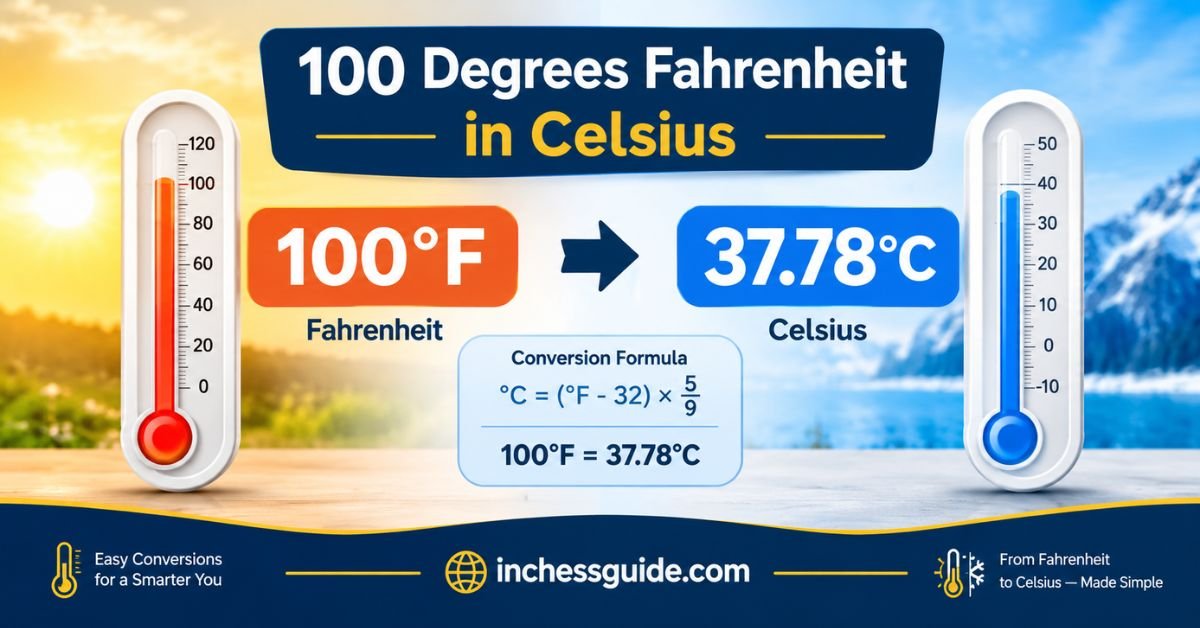
100 degrees Fahrenheit (100°F) equals exactly 340/9 degrees Celsius, which is 37.777…°C. Rounded to two decimal places, that is 37.78°C. Rounded to one decimal place, it is 37.8°C.
This page shows how the conversion works, gives you a quick way to check it in your head, and explains what a reading of 100°F means in everyday situations such as weather, body temperature, water and cooking.
Quick Answer
| Fahrenheit | Celsius (exact) | Celsius (rounded) |
|---|---|---|
| 100°F | 340/9 °C (37.777…°C) | 37.78°C, or 37.8°C to one decimal place |
- Formula: °C = (°F − 32) × 5/9
- Worked result: (100 − 32) × 5/9 = 68 × 5/9 = 37.78°C
- Fast estimate: halve (100 − 32) to get 34, then add about a ninth of that (roughly 3.8) to get about 37.8°C.
Note that 100°F is not the same as 100°C. A temperature of 100°C is the boiling point of water at standard sea-level pressure, which is 212°F.
How to Convert 100°F to Celsius
Fahrenheit and Celsius differ in two ways, and the formula has to handle both:
- Different zero points. Water freezes at 32°F but at 0°C, so you subtract 32 to line the scales up.
- Different degree sizes. A Celsius degree is larger than a Fahrenheit degree. The range from freezing to boiling is 180 steps on the Fahrenheit scale (32°F to 212°F) and 100 steps on the Celsius scale (0°C to 100°C). That makes one Fahrenheit degree equal to 100/180, or 5/9, of a Celsius degree.
Putting those together gives the formula:
°C = (°F − 32) × 5/9
Step-by-step for 100°F
- Start with the Fahrenheit reading: 100°F.
- Subtract 32: 100 − 32 = 68.
- Multiply by 5: 68 × 5 = 340.
- Divide by 9: 340 ÷ 9 = 37.777…
Result: 100°F = 37.78°C (rounded).
You can also write the formula with a decimal: °C = (°F − 32) ÷ 1.8. Here, 68 ÷ 1.8 = 37.78. The two versions are identical, because 5/9 and 1/1.8 are the same number.
Checking the result in reverse
To confirm a conversion, go back the other way with °F = °C × 9/5 + 32.
37.777… × 9/5 = 68, and 68 + 32 = 100. The reverse conversion returns exactly 100°F, so the answer holds.
If you use the rounded figure of 37.78, you get 37.78 × 1.8 + 32 = 100.004°F. That tiny difference is rounding error, not a mistake in the method.
Exact Value vs. Rounded Value
The fraction 340/9 does not terminate as a decimal. It repeats forever as 37.7777… The right level of rounding depends on what you are doing:
| Rounding | Value | Typical use |
|---|---|---|
| Exact fraction | 340/9 °C | Calculations where you want no rounding error |
| Two decimal places | 37.78°C | General reference and most conversion tools |
| One decimal place | 37.8°C | Digital thermometer readings, weather reports |
| Whole degree | 38°C | Casual conversation only |
Rounding to a whole degree matters more than it looks in one situation. The widely used fever threshold of 100.4°F is exactly 38.0°C. A reading of 100°F is 37.78°C, which is just below that line. If you round 37.78°C up to 38°C, it can look as though the reading has reached the fever threshold when it has not. For health-related readings, keep at least one decimal place.
100°F in Other Temperature Scales
Scientists and engineers often need the same temperature in kelvin, and a few older engineering texts use the Rankine scale. Here are all the values for 100°F:
| Scale | Value |
|---|---|
| Fahrenheit | 100°F |
| Celsius | 37.78°C |
| Kelvin | 310.93 K |
| Rankine | 559.67°R |
The kelvin figure comes from adding 273.15 to the Celsius value: 37.78 + 273.15 = 310.93 K. A kelvin has the same size as a Celsius degree, only with a different starting point. The Rankine figure comes from adding 459.67 to the Fahrenheit value.
Fahrenheit to Celsius Chart Around 100°F
A single number is rarely enough when you are reading a thermometer or a forecast. This chart covers the range most people look up around 100°F. Values are rounded to two decimal places.
| Fahrenheit | Celsius |
|---|---|
| 95°F | 35.00°C |
| 96°F | 35.56°C |
| 97°F | 36.11°C |
| 98°F | 36.67°C |
| 98.6°F | 37.00°C |
| 99°F | 37.22°C |
| 100°F | 37.78°C |
| 100.4°F | 38.00°C |
| 101°F | 38.33°C |
| 102°F | 38.89°C |
| 103°F | 39.44°C |
| 104°F | 40.00°C |
| 105°F | 40.56°C |
Each extra Fahrenheit degree adds about 0.56°C. Moving from 100°F to 101°F raises the Celsius reading from 37.78°C to 38.33°C, a difference of 0.56°C. That is why a one-degree Fahrenheit change on a body thermometer looks smaller than a one-degree Celsius change would.
A Mental-Math Shortcut for Fahrenheit to Celsius
You will not always have a calculator, so a reliable shortcut is useful. Because 5/9 is about 0.556, you can convert without much effort.
The “halve and add a ninth” method:
- Subtract 32 from the Fahrenheit value. For 100°F, that is 68.
- Halve the result: 68 ÷ 2 = 34.
- Add one ninth of that half: 34 ÷ 9 ≈ 3.8, so 34 + 3.8 = 37.8.
This works because 5/9 is the same as one half plus one half of one ninth. It is exact if you carry the fraction, and it gets you to 37.8°C by hand in a few seconds.
The even faster estimate: subtract 32, halve, then add 10% of the halved number. For 100°F, you get 34 + 3.4 = 37.4°C. This is about 0.4°C low, which is close enough for judging whether a day will be hot, but not for anything where accuracy matters.
Avoid the popular “subtract 30 and halve” trick for this temperature. It gives (100 − 30) ÷ 2 = 35°C, which is nearly 3°C below the real value. That trick is only reasonably close for mild temperatures in the 50s to 70s °F.
What Does 100°F (37.78°C) Mean in Real Life?
A temperature number only becomes useful when you know what it describes. The meaning of 100°F changes a lot depending on whether it is an air temperature, a body reading or the temperature of water or food.
As an air temperature
As a daytime air temperature, 100°F is very hot. In Celsius, a forecast of 37.8°C or “about 38°C” describes the same heat. In many parts of the world this is a typical summer extreme rather than a rare event, but it still calls for precautions such as shade, water and rest breaks, especially for outdoor work and exercise.
Humidity changes how that heat feels. National weather services publish a “heat index” that combines air temperature with relative humidity to estimate how hot it feels to the human body. At 100°F with high humidity, the feels-like temperature can be considerably higher than 100°F, because sweat evaporates more slowly. If you are planning around the heat, check the heat index or the “feels like” figure as well as the plain air temperature. Also check whether your phone or weather app is showing Fahrenheit or Celsius, because misreading the unit is a common source of confusion when travelling.
As a body temperature
The figure most people associate with body temperature is 98.6°F (37°C), but that is an average and not a fixed rule. Typical healthy readings fall roughly between 97°F and 99°F (about 36.1°C to 37.2°C), and they vary with the time of day, recent activity and the person.
A reading of 100°F (37.78°C) is above that typical range. It is also below 100.4°F (38°C), which the U.S. Centers for Disease Control and Prevention and many other health bodies use as the general threshold for a fever. So 100°F is often described as a slightly raised or low-grade temperature rather than a fever by that definition. Where you measure also matters:
- Oral, rectal, ear, forehead and armpit thermometers can give different readings for the same person at the same moment.
- Rectal readings are generally higher than oral readings, and armpit readings are generally lower.
- Fever thresholds for infants are stricter than the adult threshold, so a reading that is unremarkable for an adult can be a reason to call a doctor for a very young baby.
This site gives measurement information, not medical advice. If you are worried about a temperature reading, particularly in a baby, an older adult or someone who is unwell, contact a doctor or other qualified healthcare professional.
As a water temperature
Water at 100°F (37.78°C) feels pleasantly warm, close to body temperature, so it does not feel hot or cold to most people. It is below the 104°F (40°C) level that is commonly given as a maximum for hot tubs and spas, and well below the temperatures that cause scalds. Water-heater and bath-safety advice usually keeps household hot-water temperatures much higher than 100°F at the tap source and lower at the point of use, so always test water with a thermometer or your wrist before putting a child in it.
In the kitchen
Two kitchen situations come up often around 100°F:
- Yeast and bread dough. Many bread recipes ask for lukewarm water somewhere in the region of 100°F to 110°F (about 38°C to 43°C). That is warm enough to wake up yeast without harming it. Follow your own recipe, because ranges vary by yeast type.
- Food safety. The U.S. Department of Agriculture describes 40°F to 140°F (about 4.4°C to 60°C) as the “danger zone” where bacteria grow quickly. A temperature of 100°F sits in the middle of that range. Perishable food left at 100°F, for example in a hot car or on a sun-baked picnic table, can become unsafe far faster than food kept in a fridge.
5 Common Mistakes When Converting 100°F to Celsius
Confusing 100°F with 100°C. These are completely different temperatures. 100°C equals 212°F, the boiling point of water at standard pressure, while 100°F is 37.78°C, close to body temperature.
Forgetting to subtract 32 first. A common error is multiplying 100 by 5/9 and getting 55.56°C. That number is the size of a 100-degree Fahrenheit interval in Celsius, not the equivalent reading. The subtraction aligns the two zero points, and skipping it gives a result that is wrong by almost 18°C.
Mixing up temperature readings and temperature changes. A reading of 100°F is 37.78°C. A change of 100°F is 55.56°C. Intervals use only the 5/9 ratio and ignore the 32-degree offset. If a thermometer rises by 10°F, it has risen by about 5.56°C, not by (10 − 32) × 5/9.
Rounding too early. If you round an intermediate result such as 37.777… to 37.8 and then use that figure in another calculation, small errors build up. Keep the full value or at least the two-decimal figure until the final step.
Using the wrong formula direction. The Celsius-to-Fahrenheit formula is °F = °C × 9/5 + 32, which multiplies first and then adds. The Fahrenheit-to-Celsius formula subtracts first and then multiplies. Using one in place of the other produces numbers that are clearly off, so a quick sanity check against known reference points helps: 32°F is 0°C, 98.6°F is 37°C and 212°F is 100°C.
How to Measure Temperature Accurately
If you need to know whether something really is at 100°F, estimating by feel is not reliable. Human skin is a poor thermometer. It responds to heat flow rather than true temperature, so a metal handle and a wooden handle at the same temperature can feel very different.
Choose a tool that suits the job:
- Digital oral or ear thermometer for body temperature, following the manufacturer’s instructions for placement and waiting time.
- Infrared forehead thermometer for quick screening. These are convenient, but they can be affected by sweat, ambient temperature and distance, so a surprising result is worth confirming with another method.
- Probe or instant-read food thermometer for cooking, baking and checking water for bread dough.
- Outdoor thermometer in the shade for air temperature. A thermometer in direct sunlight can read much higher than the true air temperature, because the sensor absorbs radiant heat.
Most devices display either °F or °C and many can switch between them. Check the unit symbol before you act on a reading. If you convert a reading by hand, it is good practice to confirm it with a second method, such as a calculator or a reference chart, when the result affects health, food safety or equipment settings.
Why the Fahrenheit and Celsius Scales Feel So Different
Fahrenheit and Celsius were designed around different reference points, which is why 100°F lands near body temperature while 100°C is the boiling point of water. On the Celsius scale, 0°C is the freezing point of water and 100°C is its boiling point at standard atmospheric pressure, which makes the scale easy to use in science. On the Fahrenheit scale, those same points sit at 32°F and 212°F.
The two scales meet at one temperature, −40°, where −40°F equals −40°C. At every other temperature the numbers differ, and the gap grows as temperatures rise. That is why the difference at 100°F is a large 62.22 degrees (100 − 37.78), compared with only 8 degrees at −40°F’s neighbours.
Most of the world uses Celsius for weather and everyday temperatures, while the United States uses Fahrenheit. Anyone who travels, follows international forecasts or reads scientific material benefits from knowing a few anchor conversions by heart. Useful anchors are 32°F = 0°C, 50°F = 10°C, 68°F = 20°C, 86°F = 30°C and 100°F ≈ 37.8°C.
Frequently Asked Questions
1: Is 100°F a fever?
By the common adult definition, not quite. The CDC and many health organizations treat 100.4°F (38°C) or higher as a fever. A reading of 100°F is 37.78°C, which is slightly elevated but just under that threshold. Readings vary by thermometer type and body site, and infants have lower thresholds, so ask a healthcare professional if you are unsure.
2: What is 100 degrees Fahrenheit in Celsius, rounded to the nearest whole number?
It rounds to 38°C. For anything involving health, keep a decimal place (37.8°C) so that the reading is not mistaken for the 38.0°C fever threshold.
3: How do I convert 100°C to Fahrenheit?
Use °F = °C × 9/5 + 32. For 100°C, that is 100 × 1.8 + 32 = 212°F. This is a completely different temperature from 100°F, so always check which unit is shown.
4: Why is the answer a repeating decimal?
The conversion divides by 9, and 340 does not divide evenly by 9, so the decimal repeats (37.777…). The fraction 340/9 is exact. Any decimal version, such as 37.78, is a rounded approximation.
5: What is a quick way to estimate Fahrenheit in Celsius without a calculator?
Subtract 32, halve the result, then add about a ninth of the halved number. For 100°F, that gives 34 + 3.8 ≈ 37.8°C. The shortcut “subtract 30 and halve” is less accurate at high temperatures and gives 35°C for 100°F, which is almost 3°C too low.
6: Is 100°F hot for weather?
Yes. 100°F (about 38°C) is a very hot day. Humidity can make it feel hotter, so the heat index is worth checking before outdoor activity.
Explore More Continue Reading Our Guide on: 98 Degrees Fahrenheit in Celsius
99 Degrees Fahrenheit in Celsius
Conclusion
100 degrees Fahrenheit is 37.78°C, which comes from (100 − 32) × 5/9 and is exactly 340/9°C before rounding. For quick use, 37.8°C is accurate enough, but keep the decimal place when the reading is a body temperature, since 100°F sits just below the 38°C (100.4°F) fever line. Always check that a reading is in °F and not °C, because 100°C is 212°F.