
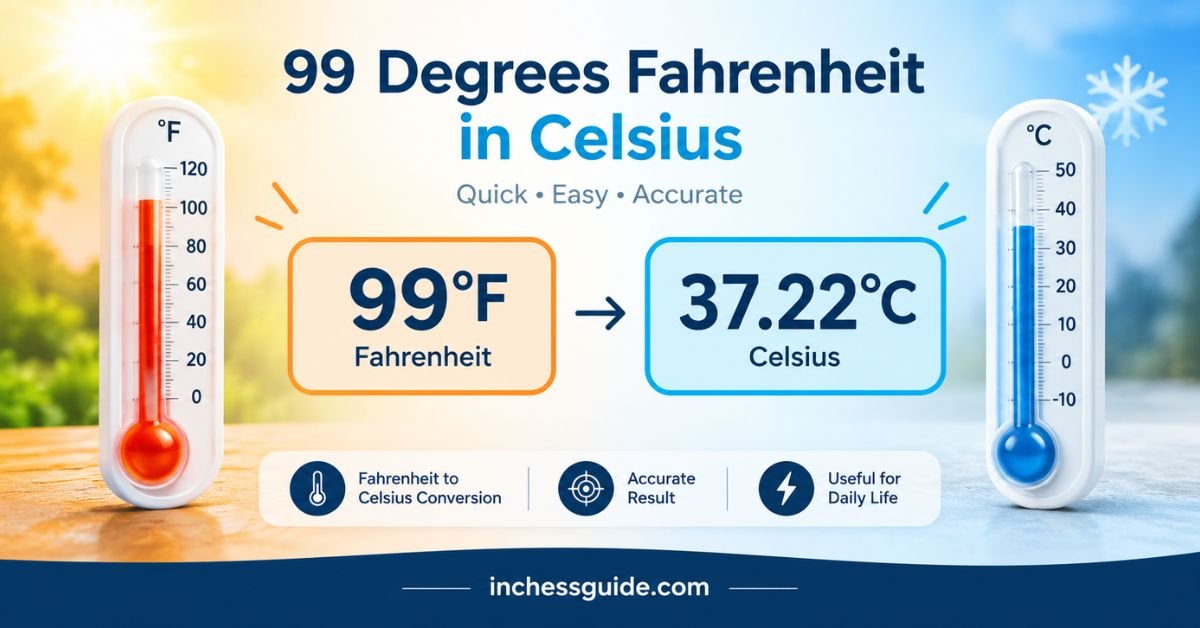
99 Degrees Fahrenheit in Celsius: = 37.2°C (Quick Conversion)
99°F equals 37.22°C (37.222… repeating), usually rounded to 37.2°C. In Kelvin, the same temperature is about 310.37 K.
Quick Answer
| Fahrenheit | Celsius (exact) | Celsius (rounded) |
|---|---|---|
| 99°F | 335/9 °C | 37.22°C (or 37.2°C) |
The formula is °C = (°F − 32) × 5/9, so (99 − 32) × 5/9 = 67 × 5/9 = 335/9 = 37.222…°C.
For everyday use, such as reading a weather forecast or a thermometer, 37.2°C is precise enough. If you are entering the value into a spreadsheet, lab record, or scientific calculation, keep more decimals and round only at the end.
How to Convert 99°F to Celsius, Step by Step
The Fahrenheit and Celsius scales differ in two ways. They do not start at the same zero point, and one Celsius degree is larger than one Fahrenheit degree. A correct conversion has to handle both differences.
- The offset: Water freezes at 32°F and at 0°C, so you subtract 32 from the Fahrenheit value to line up the zero points.
- The size of a degree: Between freezing (32°F, 0°C) and boiling (212°F, 100°C) at standard pressure, Fahrenheit covers 180 degrees and Celsius covers 100. One Fahrenheit degree is therefore 100/180, or 5/9, of a Celsius degree.
Step 1: Subtract 32.
99 − 32 = 67
Step 2: Multiply by 5.
67 × 5 = 335
Step 3: Divide by 9.
335 ÷ 9 = 37.2222…
The result is 37.22°C to two decimal places, or 37.2°C to one.
You can also use the decimal version of the formula. Dividing by 1.8 is the same as multiplying by 5/9:
(99 − 32) ÷ 1.8 = 67 ÷ 1.8 = 37.222…°C
Both versions give the same answer. Use whichever is easier on your calculator.
Check the Answer by Converting Back
To confirm the result, convert 37.2°C back to Fahrenheit with °F = (°C × 9/5) + 32:
- 37.2 × 1.8 = 66.96
- 66.96 + 32 = 98.96°F
The result is 98.96°F rather than exactly 99°F because 37.2 is a rounded value. Using the unrounded 37.222…°C gives 99°F exactly: 37.222… × 1.8 = 67, and 67 + 32 = 99. This is a small example of why rounding too early introduces tiny errors, which the accuracy section below covers.
Fahrenheit to Celsius Table Around 99°F
If you are reading a thermometer or comparing several readings, a table of nearby values is more useful than a single number. All Celsius values below are rounded to two decimal places.
| Fahrenheit | Celsius |
|---|---|
| 95°F | 35.00°C |
| 96°F | 35.56°C |
| 97°F | 36.11°C |
| 98°F | 36.67°C |
| 98.6°F | 37.00°C |
| 99°F | 37.22°C |
| 99.5°F | 37.50°C |
| 100°F | 37.78°C |
| 100.4°F | 38.00°C |
| 101°F | 38.33°C |
| 102°F | 38.89°C |
| 103°F | 39.44°C |
Two rows in this table are exact. 98.6°F is exactly 37°C, and 100.4°F is exactly 38°C. Those two Fahrenheit numbers look oddly specific because they are conversions of the round Celsius values 37°C and 38°C, which is how they became familiar in body-temperature discussions. The other values are rounded, and several have repeating decimals.
Each additional Fahrenheit degree adds about 0.56°C. That makes it easy to see where 99°F sits. It is about 0.22°C above 98.6°F (37°C) and about 1.2°C below 100.4°F (38°C).
What 99°F (37.2°C) Means in Everyday Life
The same number means very different things depending on what is being measured. A 99°F air temperature, a 99°F body reading, and 99°F water are three different situations.
99°F as a Body Temperature
Many people know 98.6°F (37°C) as “normal” body temperature. That figure is a convention based on historical averages. It is not a boundary, and individual temperatures vary from person to person, with the time of day, with activity, and with the place on the body where the reading is taken. Oral, ear, forehead, armpit, and rectal thermometers do not give identical readings for the same person.
Because of this variation, a reading of 99°F (37.2°C) is often within the ordinary range for many adults, especially later in the day or after activity. It is a small step above the conventional 98.6°F. It is not by itself a sign that something is wrong.
Fever is commonly defined by a higher threshold. Public health agencies such as the CDC describe a temperature of 100.4°F (38°C) or higher as a fever. A reading of 99°F is about 1.4°F (roughly 0.8°C) below that line.
Several cautions apply:
- The method matters. Compare readings taken the same way, such as oral with oral.
- The person matters. Infants, older adults, and people with certain medical conditions may need different guidance. A 99°F reading in a very young baby is a question for a pediatrician or a medical helpline, not for a conversion website.
- Symptoms matter more than one number. If you feel unwell, or are worried about someone else, consult a healthcare professional. This article explains the unit conversion. It does not provide medical advice.
99°F as an Outdoor Temperature
As an air temperature, 99°F (37.2°C) is a hot day. Most people experience it as strong heat, particularly in direct sun. If you are used to Celsius forecasts, 37°C is a very hot day.
Humidity changes how that heat feels. At the same air temperature, humid conditions make it harder for sweat to evaporate, so the day can feel more oppressive. Weather services publish a “heat index” or “feels-like” temperature for this reason. The conversion in this article applies only to the air temperature itself, not to the heat index. Sensible precautions on very hot days include drinking water, taking breaks in shade or air conditioning, and not leaving people or pets in parked vehicles.
99°F as a Water or Liquid Temperature
Water at 99°F (37.2°C) is close to body temperature. It feels barely warm, neither distinctly hot nor cool, because it is near the temperature of your skin and body. If you are following a recipe, a pet-care guide, or a craft instruction that calls for “body-temperature” liquid, 37°C is the usual target, and 99°F is a close match.
99°F in Incubators and Controlled Equipment
Some equipment is set by Fahrenheit or Celsius depending on where it was made. Many guides for hatching chicken eggs in forced-air incubators recommend about 99.5°F, which is 37.5°C. A setting of 99°F (37.2°C) is therefore only about 0.3°C lower. Small differences like that can matter in hatching, so follow the instructions for your specific incubator and check the display against a separate, reliable thermometer. Treat the figures here as typical values rather than universal requirements.
Quick Mental Estimates (and Their Limits)
A calculator gives the exact result, but sometimes you only need a quick sense of the number.
Method 1: Subtract 32, then roughly halve and add a little.
99 − 32 = 67. Half of 67 is 33.5. Adding about 10% of that (3.35) gives roughly 36.9°C. The true value is 37.2°C, so this shortcut is off by about 0.4°C.
Method 2: Use the 5/9 fraction more carefully.
67 × 5 = 335, and 335 ÷ 9 is a little over 37 (because 9 × 37 = 333). That leaves a remainder of 2, which adds about 0.22. This gets you to 37.2°C without a calculator.
Method 3: Anchor to a known pair.
You may remember that 98.6°F = 37°C. Since 99°F is 0.4°F higher, and each Fahrenheit degree is about 0.56°C, add roughly 0.4 × 0.56 ≈ 0.22°C. That gives about 37.2°C again.
Estimates like these are fine for conversation, travel, or deciding what to wear. They are not suitable when accuracy matters, such as in laboratory work, food safety, equipment calibration, or any decision based on a medical reading. In those cases, use the exact formula and a calibrated instrument.
Accuracy, Rounding, and Significant Figures
Because 335 divided by 9 never terminates, any decimal version of this result is rounded. Here is how the common roundings compare:
| Rounded to | Value |
|---|---|
| Whole degree | 37°C |
| One decimal | 37.2°C |
| Two decimals | 37.22°C |
| Three decimals | 37.222°C |
Which one you choose depends on the purpose.
- Everyday use: 37°C or 37.2°C is enough.
- Thermometer comparison: Many digital thermometers display one decimal place in Celsius, so 37.2°C is the natural match.
- Further calculation: Keep extra decimals, or keep the exact fraction 335/9, until the final step. Rounding early and then converting back can leave a small error, as the check above showed (98.96°F instead of 99°F).
Significant figures also matter. If the original measurement was “99°F” with two significant figures, then presenting the answer as 37.222°C implies much greater precision than you started with. Matching 37°C or 37.2°C to the precision of the original reading is more honest.
Finally, the reading itself has limits. A typical household thermometer is not accurate to a hundredth of a degree, so the extra digits in 37.22°C describe the mathematics of the conversion rather than any real measurement precision.
6 Common Mistakes When Converting 99°F to Celsius
1. Forgetting to subtract 32 first.
Multiplying 99 by 5/9 gives 55°C, which is wildly wrong. The offset has to come off before you scale.
2. Using the wrong fraction.
Multiplying by 9/5 is the formula for converting in the other direction (Celsius to Fahrenheit). Doing (99 − 32) × 9/5 gives 120.6, which is not a Celsius temperature in any plausible context here. A quick sanity check helps: Celsius numbers should be smaller than the matching Fahrenheit numbers in this range.
3. Dividing by 1.8 before subtracting 32.
99 ÷ 1.8 = 55, and 55 − 32 = 23. That is wrong, because the order of operations matters. Subtract first, then divide.
4. Treating the degree sizes as equal.
It is tempting to assume that 99°F is “about 67°C” after subtracting 32. The scales do not have the same degree size, so you must scale by 5/9 as well.
5. Rounding too early.
Rounding 37.222…°C to 37°C is fine for a casual answer. Rounding to 37°C and then using it in a follow-up calculation, such as converting to Kelvin or comparing against a threshold, can produce an error you did not intend.
6. Confusing Fahrenheit readings with Celsius readings on a thermometer.
Some thermometers can switch units. A reading of “37.2” is perfectly normal on a Celsius display, but the same digits would be alarming as Fahrenheit. Always check which unit is displayed.
Related Conversion: 99°F in Kelvin
The Kelvin scale is used in science and engineering. To convert Celsius to Kelvin, add 273.15:
37.222… + 273.15 = 310.372… K
So 99°F ≈ 310.37 K. Note that Kelvin has no degree symbol, so it is written K, not °K. Fahrenheit-to-Kelvin conversions follow the same two-step path: convert to Celsius first, then add 273.15.
Frequently Asked Questions
1: Is 99°F the same as 37°C?
Not exactly. 99°F is 37.22°C. The value 37°C corresponds to 98.6°F. The two are close, which is why 99°F is often described as “about 37°C”, but 99°F is slightly warmer.
2: Is 99 degrees Fahrenheit a fever?
By the commonly cited threshold of 100.4°F (38°C), 99°F is below fever level. Individual temperatures vary, and the right interpretation depends on the person, the thermometer type, and any symptoms. For infants or anyone with a health concern, ask a medical professional.
3: How do I convert 99°F to Celsius without a calculator?
Subtract 32 (giving 67), multiply by 5 (335), and divide by 9. Since 9 × 37 = 333, the answer is just over 37, specifically 37.22. If you are in a hurry, remember that 98.6°F is 37°C and that each Fahrenheit degree is about 0.56°C.
4: Why is the Celsius answer not a round number?
The Fahrenheit and Celsius scales are not aligned in a simple whole-number ratio. The conversion uses the fraction 5/9, so many Fahrenheit values produce repeating decimals in Celsius. Only a few values, such as 98.6°F and 100.4°F, land on round Celsius numbers.
5: What is 99.5°F in Celsius?
(99.5 − 32) × 5/9 = 67.5 × 5/9 = 37.5°C exactly.
6: How hot is 99°F outside?
It is a hot day, equal to about 37°C. Humidity and sun exposure can make it feel hotter, so check the heat index and take sensible precautions.
Explore More Continue Reading Our Guide on: 98 Degrees Fahrenheit in Celsius
Conclusion
99 degrees Fahrenheit is 37.22°C, normally rounded to 37.2°C, and it is found by subtracting 32 and multiplying by 5/9. That puts it just above 98.6°F (37°C) and clearly below the commonly cited fever threshold of 100.4°F (38°C). Keep the extra decimals for further calculations, and use a calibrated thermometer whenever the reading itself matters.
2 Comments