
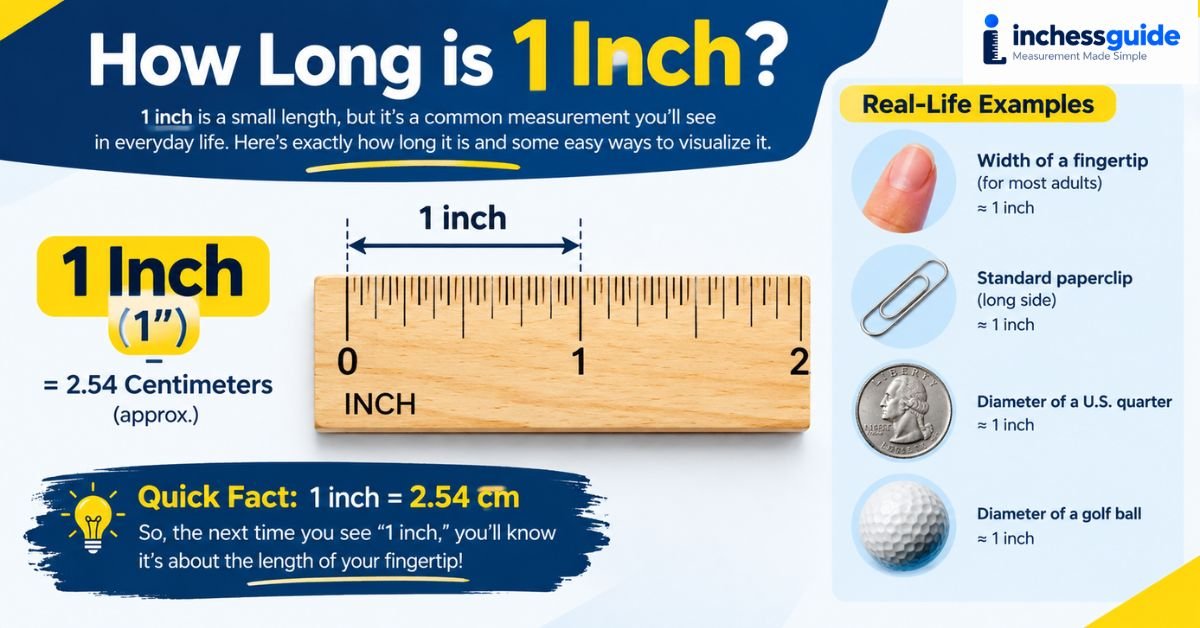
One inch is exactly 2.54 centimeters, or 25.4 millimeters. It is one-twelfth of a foot. In everyday terms, it is about the width of an adult’s thumb at the top joint, and a little longer than a US quarter is wide.
Quick Answer:
| Unit | Equivalent to 1 inch |
|---|---|
| Millimeters | 25.4 mm |
| Centimeters | 2.54 cm |
| Meters | 0.0254 m |
| Feet | 0.08333 ft (1/12 ft) |
| Yards | 0.02778 yd (1/36 yd) |
| Points (printing) | 72 pt |
The value of 2.54 cm is exact, not rounded. Since 1959, the international inch has been defined as exactly 2.54 centimeters, and the US, UK, Canada, and other countries use this same definition.
How to Convert Inches to Centimeters and Back
Multiply inches by 2.54 to get centimeters:
5 × 2.54 = 12.7 cm
Divide centimeters by 2.54 to get inches:
10 ÷ 2.54 = 3.937 inches (about 3.94)
For a quick mental estimate, treat 1 inch as 2.5 cm. That is close enough for casual use, but the error grows on longer lengths (40 inches is 101.6 cm exactly, versus 100 cm by the shortcut).
What Does 1 Inch Look Like? Real-World References
Real objects vary, so treat these as approximate references, not measuring tools. The coin sizes come from published US Mint specifications, so they are reliable to the thousandth of an inch.
| Reference | Approximate size | How it compares to 1 inch |
|---|---|---|
| US quarter (diameter) | 0.955 in (24.26 mm) | Just under 1 inch |
| US half dollar (diameter) | 1.205 in (30.61 mm) | A bit over 1 inch |
| US nickel (diameter) | 0.835 in (21.21 mm) | Noticeably under 1 inch |
| Adult thumb width at the top joint | Roughly 1 in, varies by person | Approximate only |
| AA battery (length) | About 2 in (50.5 mm) | Half its length is about 1 inch |
| Three LEGO stud spacings | 24 mm, about 0.94 in | Slightly under 1 inch |
| Standard credit card (short side) | 2.125 in (53.98 mm) | A little over 2 inches |
The quarter is the most useful coin reference: it is only about 0.045 inch short of a full inch. If you keep one in your pocket, you have a rough size guide.
Thumb width deserves a caution. Hand sizes differ a lot, so measure your own thumb against a ruler once. If it comes out close to 1 inch, you have a handy personal reference. If not, you at least know your offset.
Where 1 Inch Matters in Real Life
- Home improvement and carpentry: Screw and nail lengths, trim widths, and gaps are often specified in fractions of an inch.
- Sewing and crafts: Seam allowances, hems, and pattern pieces are commonly given in inches in US patterns.
- Printing and documents: A 1-inch page margin is a common default in word processors, and a US passport photo is 2 × 2 inches.
- Shipping and packaging: Carriers often price by package dimensions, so a difference of an inch can change a size tier.
- Screens and hardware: TV, phone, and monitor sizes are quoted in inches, measured diagonally.
Inches on a Ruler: Fractions and Millimeters
Most US rulers divide each inch into 16 parts, so the smallest marks are 1/16 inch apart.
| Fraction | Decimal (in) | Millimeters |
|---|---|---|
| 1/16 | 0.0625 | 1.5875 |
| 1/8 | 0.125 | 3.175 |
| 1/4 | 0.25 | 6.35 |
| 3/8 | 0.375 | 9.525 |
| 1/2 | 0.5 | 12.7 |
| 5/8 | 0.625 | 15.875 |
| 3/4 | 0.75 | 19.05 |
| 7/8 | 0.875 | 22.225 |
| 1 | 1.0 | 25.4 |
Longer marks usually indicate the half, quarter, and eighth positions, with the full-inch mark the longest. On a tape measure, the very end of the tape may be a movable hook. That looseness is deliberate, so the reading stays accurate whether you push the hook against a surface or pull it over an edge.
How 1 Inch Compares With Nearby Lengths
| Length | Equivalent in inches | Equivalent in cm |
|---|---|---|
| 1 millimeter | 0.03937 in | 0.1 cm |
| 1 centimeter | 0.3937 in | 1 cm |
| 1 inch | 1 in | 2.54 cm |
| 1 foot | 12 in | 30.48 cm |
| 1 yard | 36 in | 91.44 cm |
One inch is about two and a half times a centimeter. Twelve inches make a foot, and 36 make a yard. For longer distances, a mile is 63,360 inches (5,280 ft × 12).
When to Use a Real Measuring Tool
Everyday comparisons like a quarter or a thumb are fine for rough estimates, such as judging whether a snack will fit in a container. Use a ruler, tape measure, or calipers when precision matters: cutting materials, ordering parts, fitting furniture, or checking package dimensions. An estimate can easily be off by several millimeters, which is enough to ruin a tight fit.
5 Common Mistakes When Working With Inches
- Reading the wrong edge of the ruler. Many rulers have inches on one side and centimeters on the other, so check which scale you’re reading.
- Assuming nominal sizes are actual sizes. A lumber “1×4” board is not 1 inch thick. Its actual dimensions are about 3/4 × 3 1/2 inches.
- Measuring a screen with a ruler and expecting a match. Sizes on a screen depend on the device’s resolution and scaling, so an “inch” drawn on a webpage may not measure 1 inch when you hold a ruler to it.
- Rounding too early. Converting with 2.5 instead of 2.54 and then repeating the calculation across many measurements compounds the error.
- Confusing screen diagonals with width. A 55-inch TV is 55 inches diagonally, not across.
Frequently Asked Questions
1: Is 1 inch exactly 2.54 cm?
Yes. The international inch is defined as exactly 2.54 centimeters, which is 25.4 millimeters.
2: Is a US quarter exactly 1 inch wide?
No. A quarter is 0.955 inch in diameter, slightly under an inch. It works as a rough guide but not as a precise measuring tool.
3: How many 1/16-inch marks fit in an inch?
Sixteen. That is why 1/16 is the smallest division on most standard rulers.
4: How many inches are in a foot and a yard?
There are 12 inches in a foot and 36 inches in a yard.
5: Is the inch the same in the US and the UK?
Yes. Since the 1959 international agreement, the US and UK inches are identical, both exactly 2.54 cm.
6: Is my thumb width a reliable inch?
Only if you’ve checked it against a ruler. Thumb widths vary from person to person, so it is a personal estimate at best.
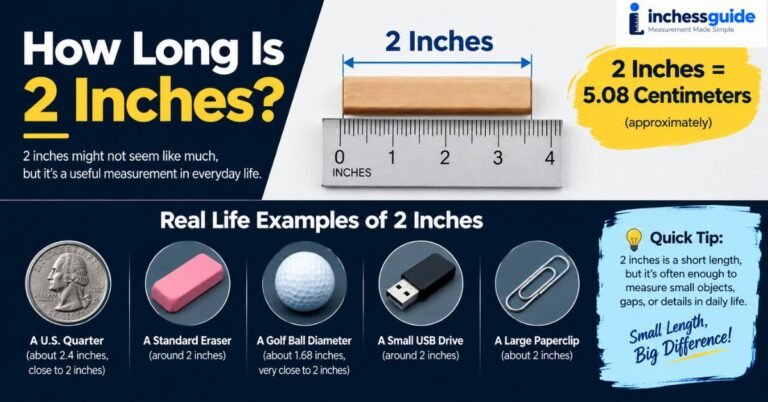
If you find this helpful and want more free guides here we have more for you: How Long Is 2 Inches?
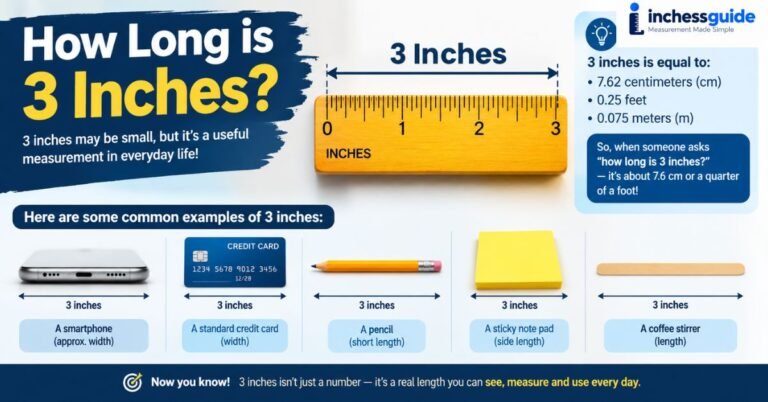
How Long Is 3 Inches?
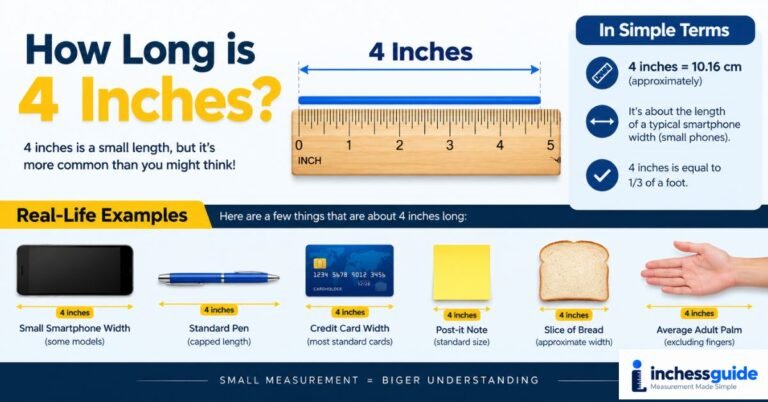
How Long Is 4 Inches?
Conclusion
One inch equals exactly 2.54 centimeters, or 25.4 millimeters, and 12 inches make a foot. For a rough mental picture, think of a US quarter’s width, which is just under an inch. When the measurement affects a purchase, a cut, or a fit, confirm it with a ruler or tape measure.
3 Comments