
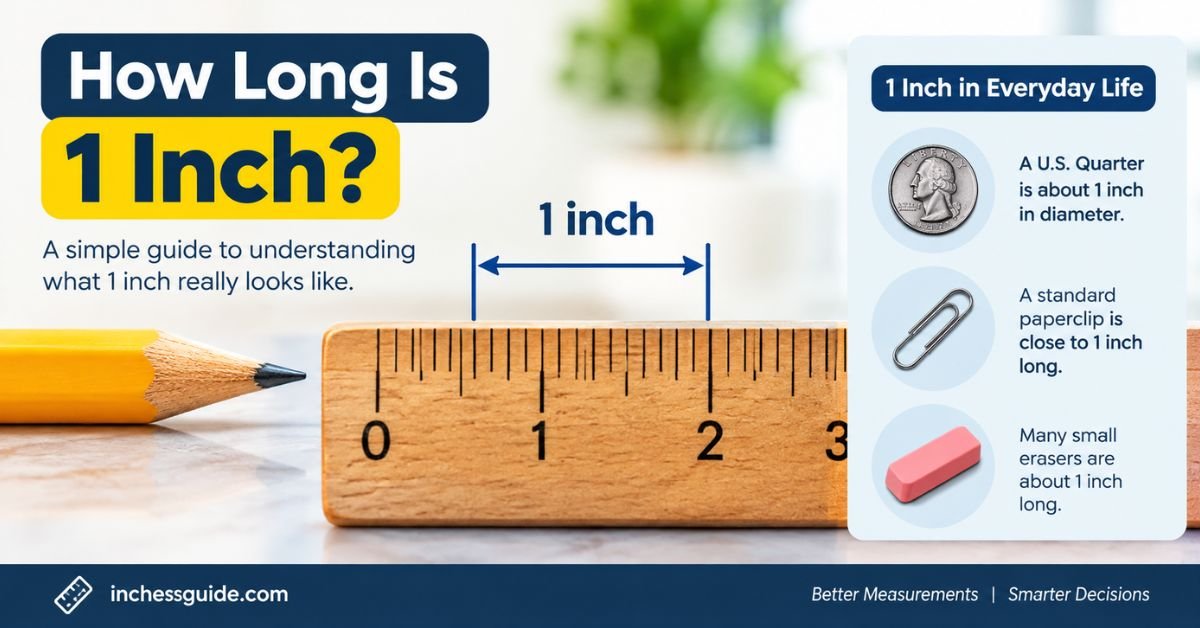
How Long Is 1 Inch? 16 Common Everyday Things Around 1 Inch
One inch is exactly 2.54 centimeters, or 25.4 millimeters. It is about the length of a US quarter’s diameter, a little longer than the width of a typical adult thumb joint, and one-twelfth of a foot. This guide shows what that looks like with 16 familiar objects, then covers conversions, ruler reading, and measuring accuracy.
Quick Answer
| Unit | Equivalent of 1 inch | Type of value |
|---|---|---|
| Millimeters | 25.4 mm | Exact |
| Centimeters | 2.54 cm | Exact |
| Meters | 0.0254 m | Exact |
| Feet | 1/12 ft (≈ 0.0833 ft) | Exact fraction, rounded decimal |
| Yards | 1/36 yd (≈ 0.0278 yd) | Exact fraction, rounded decimal |
Since 1959, the inch has been defined as exactly 25.4 millimeters. This international inch is the one used in everyday measurement in the United States and in the other countries that still use inches.
What 1 Inch Means in Everyday Terms
An inch is a small unit, roughly the length from the tip of your thumb to the first knuckle for many adults. That comparison is only a rough guide. Hand sizes differ a lot, so your thumb is a convenient reminder and never a measuring tool.
Inches are usually written as fractions, not decimals. On a standard ruler, one inch is divided into halves, quarters, eighths, and often sixteenths:
| Fraction of an inch | Millimeters | Centimeters |
|---|---|---|
| 1/2 inch | 12.7 mm | 1.27 cm |
| 1/4 inch | 6.35 mm | 0.635 cm |
| 1/8 inch | 3.175 mm | 0.3175 cm |
| 1/16 inch | 1.5875 mm | 0.15875 cm |
Many readers searching for “how long is 1 inch” simply want to picture the size, which the next section does.
16 Common Everyday Things That Are About 1 Inch Long
The dimensions below are typical or published values. Brands, models, and regions differ, so treat each as approximate unless it is a defined standard. For each object, the relevant dimension is the length or width that comes closest to 1 inch.
1. A US Quarter
A US quarter has a diameter of about 24.26 mm (0.955 in). It is slightly under 1 inch, and it is probably the most convenient pocket reference for the size.
2. A US Dollar Coin
The Sacagawea-style golden dollar coin has a diameter of about 26.5 mm (1.04 in). It is a touch over 1 inch, so it is useful for seeing the slightly-more-than side of the measurement.
3. A 2-Euro Coin
A 2-euro coin measures about 25.75 mm (1.01 in) across. Its diameter is almost exactly 1 inch, which makes it a very close match for readers outside the US.
4. A C-Cell Battery (Diameter)
A C battery is about 26.2 mm (1.03 in) in diameter, with a length of about 50 mm. The 1-inch comparison applies only to the width of the cylinder, not its length.
5. A Beer Bottle Crown Cap
The standard crown cap on a glass bottle is about 26 mm (1.02 in) across. If you have bottles at home, the cap is a handy comparison.
6. A Standard Wine Cork (Diameter)
Many standard wine corks have a diameter of about 24 mm (0.94 in), though sizes vary by bottle and producer. The cork is much longer than 1 inch, so only its width is the match.
7. An SD Memory Card (Width)
A full-size SD card is about 24 mm (0.94 in) wide and 32 mm long. The width is just under an inch, which is a good fit for people who handle cameras.
8. A Small Binder Clip
Binder clips are sold by the width of the clip, and the “small” size is commonly listed as 1 inch. Check the packaging, because manufacturers use slightly different size names.
9. A 1-Inch Pinback Button
Custom pinback buttons come in several standard sizes, and 1 inch is one of them. The face of the button is about 25 mm across, which makes it a neat circular picture of the measurement.
10. A 1-Inch Split Key Ring
Split key rings are sold by diameter, and 1 inch is a very common size. It is a good example of an everyday object where the stated size is the measurement itself.
11. A Domino (Width)
Many domino sets use tiles that are roughly 1 inch wide and about 2 inches long. The exact width varies between sets, so measure yours if you need the precise figure.
12. A Standard Guitar Pick
A standard teardrop-shaped pick is about 26 mm (1.02 in) at its widest, with a length of around 31 mm. Different pick shapes vary, so the widest point of a standard shape is the closest match.
13. A Three-Stud LEGO Brick (Length)
LEGO studs are spaced 8 mm apart, so a brick that is three studs long measures about 24 mm (0.94 in). It is a reliable reference if you have the bricks on hand, since the spacing is consistent across sets.
14. An Adult Thumb (Joint Width)
The width of an adult thumb is often compared to an inch, and many adults are in that general range. Because hands differ considerably, check your own thumb against a ruler once before relying on it for rough estimates.
15. A Flat Washer for a 1/2-Inch Bolt
A standard SAE flat washer made for a 1/2-inch bolt has an outer diameter of about 1 1/16 inches (about 27 mm). It is a hardware-store example, a little over an inch.
16. A Strip of 1-Inch Masking Tape
Rolls of masking tape and painter’s tape sold as “1 inch” are nominally 1 inch wide. Some brands use metric widths close to this, such as 24 mm, so the real width can be a little under.
How to Convert 1 Inch to Other Units
Because the conversion factor is exact, the arithmetic is simple.
Inches to centimeters: inches × 2.54 = centimeters
Example: 1 × 2.54 = 2.54 cm
Inches to millimeters: inches × 25.4 = millimeters
Example: 1 × 25.4 = 25.4 mm
Centimeters to inches: centimeters ÷ 2.54 = inches
Example: 10 ÷ 2.54 ≈ 3.937 in (rounded)
Inches to feet: inches ÷ 12 = feet
Example: 1 ÷ 12 ≈ 0.0833 ft (rounded)
The inch-to-centimeter conversion is exact. The values shown as “≈” are rounded, and the rounding level should match how precise you need to be. For woodworking, rounding to the nearest millimeter is usually enough. For machining, keep more decimal places or use the original fraction.
How to Measure 1 Inch Accurately
If you need a real measurement, use a tool rather than a comparison object. A few points help:
- Use a ruler with inch markings. Many rulers have inches on one edge and centimeters on the other, so confirm you are reading the right side.
- Read from the zero mark, not the edge. Some rulers start at the physical end, while others have a small gap before the zero line, and tape measures often have a movable hook at the end.
- Look straight down at the markings. Viewing at an angle shifts the apparent reading, which is called parallax error.
- Use calipers for small parts. A digital or dial caliper reads to a fraction of a millimeter, which is useful for items near 1 inch.
The object comparisons above are fine for building intuition. They are not accurate enough for construction, machining, or anything safety-related, where you should measure and verify.
4 Common Mistakes When Working With 1 Inch
- Confusing inches and centimeters on the ruler. An inch is more than twice as long as a centimeter, so mixing the two edges gives a large error.
- Misreading fractions. The small lines between whole inches are eighths or sixteenths. Count them carefully rather than guessing.
- Treating object sizes as exact. A coin diameter is defined by its mint, but items like corks, dominoes, and tape vary from brand to brand.
- Using decimal inches and fractions interchangeably. 1/8 inch is 0.125 in, not 0.18 in. Convert fractions before calculating.
Related Conversions Worth Knowing
If you can picture 1 inch, a few anchors make larger lengths easier:
- 12 inches = 1 foot = 30.48 cm
- 36 inches = 1 yard = 91.44 cm
- 2.54 cm = 1 inch, so about 4 inches is roughly 10 cm
Frequently Asked Questions
1: How many centimeters is 1 inch?
One inch is exactly 2.54 centimeters. This is a defined value, not a rounded one.
2: How many millimeters is 1 inch?
One inch is exactly 25.4 millimeters. This follows directly from the centimeter value, since there are 10 millimeters in a centimeter.
3: Is 1 inch the same as the width of a thumb?
Only roughly. The thumb was historically linked to the inch, but adult thumb widths vary, so it is a quick estimate and not a standard.
4: How many inches are in a foot?
There are 12 inches in 1 foot, so 1 inch is one-twelfth of a foot, or about 0.0833 ft when rounded.
5: What household item is closest to 1 inch?
A US quarter is about 0.955 inches across, and a 2-euro coin is about 1.01 inches. Either is a very close everyday match, but dimensions vary by country and coin.
6: Is “1 inch” or “1 inches” correct?
The correct form is “1 inch” because the number is exactly one. Use “inches” for any other number, such as 0.5 inches, 2 inches, or 1.5 inches.
Explore More Continue Reading Our Guide on: Inchessguide.com
Conclusion
One inch is exactly 2.54 centimeters (25.4 millimeters) and one-twelfth of a foot. The 16 examples above, from a US quarter to a 2-euro coin, give a practical picture of that length using objects you can hold. For quick estimates they work well, but any job where accuracy matters needs a ruler, tape measure, or caliper.
7 Comments