
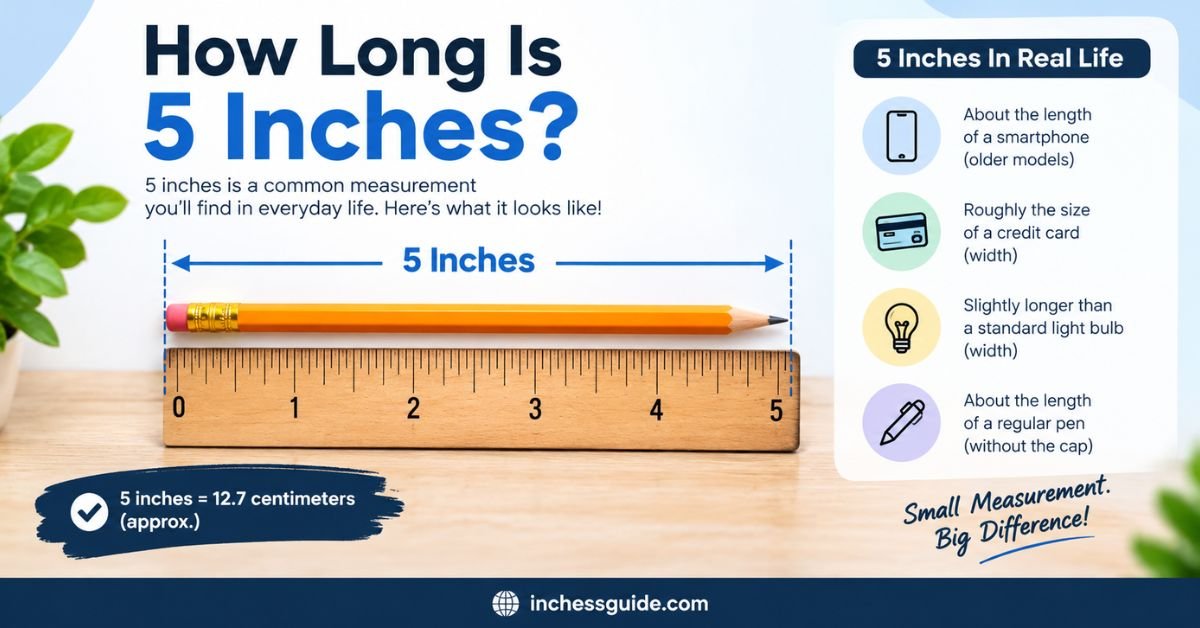
How Long Is 5 Inches? 16 Common Everyday Things That Match
Five inches is exactly 12.7 centimeters (127 millimeters). It is a little longer than the short side of a standard playing card pair laid end to end, and about the length of a standard 3 × 5 index card. Most adult hands are longer than 5 inches from wrist to fingertip, so it is a small, pocket-sized length.
This guide gives the exact conversions, then 16 familiar objects that are about 5 inches long in the dimension named, so you can picture the measurement without a ruler.
Quick Answer
| Unit | Length of 5 inches | Type of value |
|---|---|---|
| Millimeters | 127 mm | Exact |
| Centimeters | 12.7 cm | Exact |
| Meters | 0.127 m | Exact |
| Feet | 0.4167 ft (5⁄12 ft) | Rounded |
| Yards | 0.1389 yd (5⁄36 yd) | Rounded |
The conversion is exact because the international inch is defined as 2.54 centimeters. The feet and yard values repeat forever as decimals, so they are rounded here.
How to Convert 5 Inches to Other Units
Inches to centimeters: inches × 2.54 = centimeters
5 × 2.54 = 12.7 cm
Inches to millimeters: inches × 25.4 = millimeters
5 × 25.4 = 127 mm
Inches to feet: inches ÷ 12 = feet
5 ÷ 12 = 0.41667 ft, or about 0.42 ft
Inches to yards: inches ÷ 36 = yards
5 ÷ 36 = 0.13889 yd, or about 0.14 yd
To go the other way, divide centimeters by 2.54. For example, 12.7 ÷ 2.54 = 5 inches.
Nearby Lengths for Comparison
| Inches | Centimeters |
|---|---|
| 3 in | 7.62 cm |
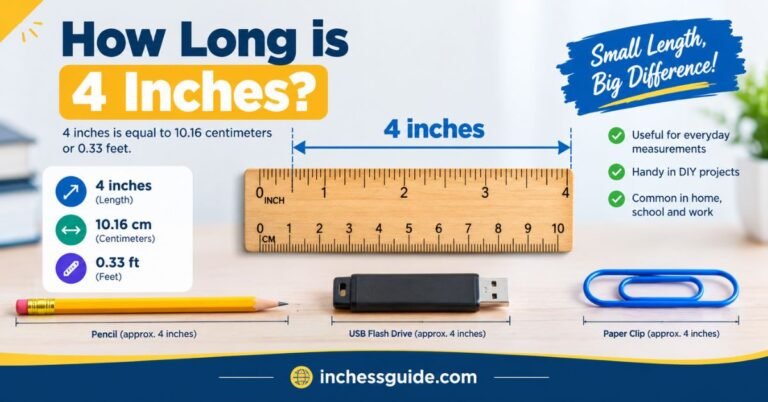
| 4 in | 10.16 cm |
| 5 in | 12.7 cm |
| 6 in | 15.24 cm |
| 7 in | 17.78 cm |
Note that 5 inches is not the same as 5 centimeters. Five centimeters is only about 1.97 inches, so 5 inches is more than two and a half times longer.
16 Common Things That Are About 5 Inches Long
Some of these are standardized and exact (an index card, a banknote, a nail size). Others are typical or nominal values that vary by brand, so each item is labeled. Each measurement refers to the dimension named, which is not always the object’s longest side.
1. A 3 × 5 Index Card (Long Side)
The long side of a standard US index card is exactly 5 inches (12.7 cm). It is one of the best everyday references because it is standardized and easy to find.
2. A 5 × 7 Photo Print (Short Side)
A 5 × 7 print is named for its dimensions, so its short side is exactly 5 inches. Hold one up to see how a 5-inch edge looks against a 7-inch edge.
3. A €10 Euro Banknote (Length)
The €10 note from the Europa series is 127 mm long, which is exactly 5 inches. It is also 67 mm wide.
4. A UK £5 Polymer Note (Length)
The Bank of England’s polymer £5 note is 125 mm long, or about 4.9 inches. It is a few millimeters shorter than 5 inches, so it makes a good “just under” reference.
5. A 40d Common Nail (Length)
In traditional US nail sizing, a “40-penny” (40d) common nail is 5 inches long. These large nails are used in heavy framing and are a handy benchmark for builders.
6. A 5-Inch Cabinet Pull (Hole Spacing)
Cabinet handles are often sold by the distance between their screw holes. A common size is 5 inches (about 127 mm, often sold as 128 mm in metric markets). This is the dimension to measure when replacing hardware.
7. A 12-Ounce Soda Can (Height)
A standard US 12 fl oz aluminum can is about 4.83 inches tall, which is roughly 5 inches. Stand a can next to a 5-inch gap and the match is close.
8. A CD or DVD (Diameter)
A compact disc or DVD is 120 mm across, or about 4.72 inches. That is a little under 5 inches.
9. A CD Jewel Case (Width)
A standard jewel case is about 125 mm (4.92 inches) wide and about 142 mm (5.6 inches) tall. Its width is a close match for 5 inches.
10. A First-Generation iPhone SE, iPhone 5, or iPhone 5s (Height)
These compact phones are about 123.8 mm (4.87 inches) tall. Many people still own one, and it is a good picture of 5 inches in the hand.
11. A 5-Inch Smartphone Screen (Diagonal)
Many phones from the early 2010s were sold with screens measuring about 5 inches on the diagonal. Screen size is measured corner to corner, not along the full phone, so the device itself is longer than 5 inches.
12. A 5¼-Inch Floppy Disk (Side)
The older “5¼-inch” floppy disk is about 5.25 inches on a side, slightly over 5 inches. The name is nominal, so exact dimensions varied slightly by manufacturer.
13. A Standard Roll of Toilet Paper (Width)
Many US rolls are roughly 4 to 4.5 inches wide, a little under 5 inches. This varies by brand, so treat it as a rough visual guide only.
14. Two D-Cell Batteries End to End (Combined Length)
A standard D battery is up to 61.5 mm tall. Two placed end to end measure about 123 mm, or roughly 4.84 inches.
15. A Black-Capped Chickadee (Body Length)
This common North American songbird is typically about 4.7 to 5.9 inches long from beak to tail tip, with 5 inches falling inside that range. Birds vary individually, so this is an approximate visual comparison.
16. Children’s Safety Scissors (Overall Length)
Many blunt-tip kids’ scissors are sold as “5-inch” models, measured by overall length. Brands differ, so check the packaging.
How to Use These Examples
The standardized items (the index card, the €10 note, the 40d nail, and the 5 × 7 print) are the most reliable for estimating 5 inches. The others are good for picturing the size, but their dimensions vary by brand, model, or region.
Visual comparison is fine for casual purposes such as picking a pot, planning a craft, or judging whether something fits in a bag. For tasks where a small error matters, such as cutting materials, buying hardware, or fitting furniture, use a ruler, tape measure, or caliper.
How to Measure 5 Inches Without a Ruler
- Use an index card. Its long side is exactly 5 inches.
- Use US quarters. One quarter is about 0.955 inches wide, so five lined up edge to edge measure about 4.78 inches, close but slightly short.
- Use a banknote. A €10 note is a precise 127 mm.
Avoid hand spans and finger widths for anything that needs precision, because they vary from person to person.
4 Common Measuring Mistakes
- Measuring from the end of the ruler. Some rulers have a blank margin before the zero mark. Start at the zero line, not the edge.
- Confusing 5 inches with 5 centimeters. Check the unit on your ruler, because many have both scales.
- Reading the diagonal as the length. A “5-inch screen” is a diagonal measurement and does not describe the device’s full size.
- Trusting nominal names. A “5-inch” product may be a rounded or traditional label, not a precise dimension.
Where 5 Inches Matters in Real Life
- Crafts and DIY: Spacing for buttons, trim, and cutouts is often given in inches.
- Hardware: Drawer pulls and long nails are commonly specified at 5 inches.
- Photography and printing: The 5 × 7 print is one of the most common frame sizes.
- Shopping: Phone, tablet, and screen sizes are quoted in diagonal inches, which affects how large a device feels.
Frequently Asked Questions
1: How many centimeters is 5 inches?
Five inches is exactly 12.7 centimeters, because 1 inch equals 2.54 cm.
2: How many millimeters is 5 inches?
It is exactly 127 millimeters (5 × 25.4).
3: Is 5 inches the same as half a foot?
No. Half a foot is 6 inches. Five inches is 5/12 of a foot, or about 0.42 feet.
4: How many inches is 5 centimeters?
Five centimeters is about 1.97 inches. To convert, divide centimeters by 2.54.
5: Is the width of my hand about 5 inches?
It depends on the person. Many adults’ palm widths are smaller than 5 inches, but hand sizes vary too widely to rely on as a measurement. Use a ruler or a standardized object like an index card.
Explore More Continue Reading Our Guide on: 16 Common Everyday Things That Are About 4 Inches Long
16 Common Everyday Things That Are About 3 Inches Long
16 Common Everyday Things That Are About 2 Inches Long
16 Common Everyday Things That Are About 1 Inch Long
Conclusion
Five inches equals exactly 12.7 cm or 127 mm, which is about the long side of a 3 × 5 index card or the length of a €10 note. The 16 examples above give you a range of familiar reference points for picturing the length, though only the standardized items are exact. For any task where accuracy matters, confirm the measurement with a ruler or tape measure.
6 Comments