
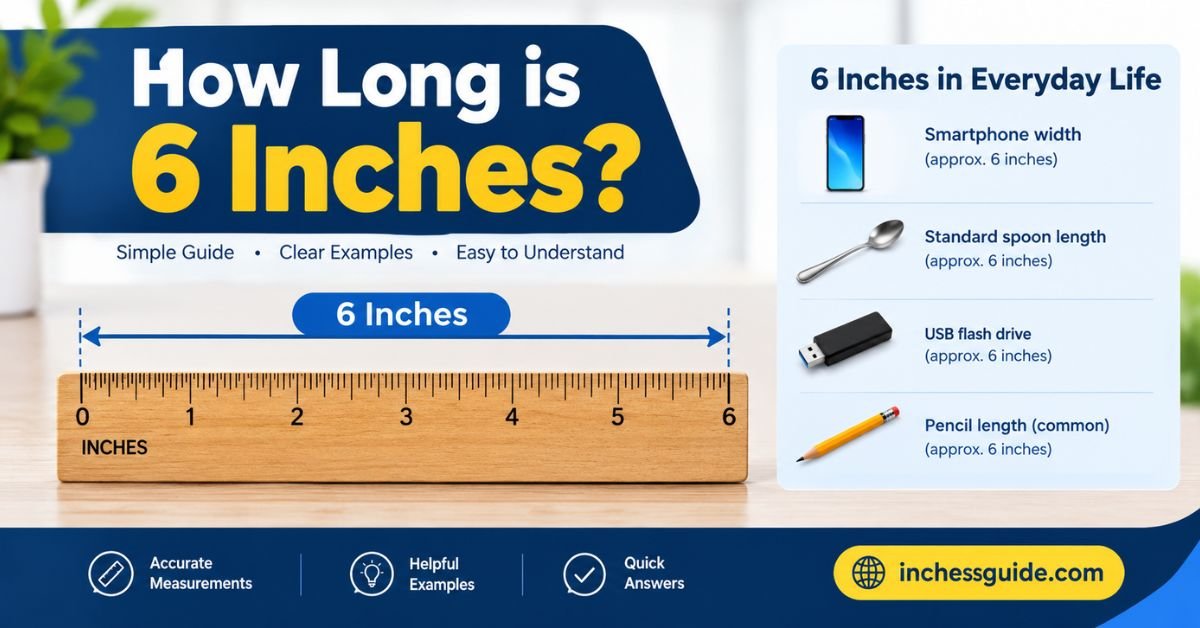
How Long Is 6 Inches? 16 Common Everyday Things That Match
Six inches is exactly 15.24 centimeters (152.4 millimeters), or half a foot. That is about the length of a US dollar bill, a small ruler, or a typical ballpoint pen.
This guide gives the exact conversions, shows how to calculate them, and then lists 16 familiar objects that help you picture 6 inches. It also covers how to measure it accurately.
Quick Answer
| Unit | Equivalent to 6 inches | Type of value |
|---|---|---|
| Centimeters (cm) | 15.24 cm | Exact |
| Millimeters (mm) | 152.4 mm | Exact |
| Meters (m) | 0.1524 m | Exact |
| Feet (ft) | 0.5 ft | Exact |
| Yards (yd) | 0.1667 yd | Rounded (1/6 yd) |
For a quick mental estimate, remember that 6 inches is a little over 15 cm. It is also about the length of your fingertip to your wrist for many adults, but body proportions vary, so use a ruler when accuracy matters.
What Does 6 Inches Mean?
An inch is a unit of length in the US customary and British imperial systems. Since the 1959 international agreement, one inch has been defined as exactly 2.54 centimeters.
Six inches is a short length. It is too small to be called a “foot” but larger than the width of most credit cards (about 3.4 inches). Because 12 inches make a foot, 6 inches is exactly half a foot. This makes it a handy reference length for small craft projects, kitchen measurements, and everyday objects.
How to Convert 6 Inches to Other Units
Inches to Centimeters
Inches × 2.54 = centimeters
6 × 2.54 = 15.24 cm
Inches to Millimeters
Inches × 25.4 = millimeters
6 × 25.4 = 152.4 mm
Inches to Feet
Inches ÷ 12 = feet
6 ÷ 12 = 0.5 ft
Inches to Yards
Inches ÷ 36 = yards
6 ÷ 36 = 0.1667 yd (rounded to four decimal places)
Inches to Meters
Centimeters ÷ 100 = meters
15.24 ÷ 100 = 0.1524 m
Nearby Lengths for Comparison
| Inches | Centimeters |
|---|---|
| 4 in | 10.16 cm |
| 5 in | 12.70 cm |
| 6 in | 15.24 cm |
| 7 in | 17.78 cm |
| 8 in | 20.32 cm |
Going the Other Way
To convert centimeters back to inches, divide by 2.54. For example, 15 cm ÷ 2.54 ≈ 5.91 inches, so 15 cm is slightly shorter than 6 inches. Exactly 15.24 cm is needed to make 6 inches.
16 Common Everyday Things That Are About 6 Inches Long
The dimensions below are typical or standard values. Manufacturers differ, so treat any object listed as “about” 6 inches as an approximation unless it is a defined standard size. For diameters, the 6-inch measurement is the distance straight across the widest point.
1. A US Dollar Bill
A US banknote is about 6.14 inches (15.6 cm) long. It is slightly over 6 inches, by roughly 0.14 inch (3.6 mm). If you have one in your wallet, you have a handy visual reference.
2. A Canadian Banknote
Canadian bank notes are 152.4 mm long, which is exactly 6 inches. They are a rare example of an everyday object that matches the measurement precisely.
3. A Small 6-Inch Ruler
Many school and desk rulers are sold in 6-inch (15 cm) sizes. These small rulers fit in a pencil case and are a convenient way to check short lengths. Note that some are marked as “15 cm,” which is just under 6 inches.
4. A 4 × 6 Inch Index Card
The long side of a standard 4 × 6 inch index card is exactly 6 inches (15.24 cm), according to its nominal size. Index cards are useful because they are flat and easy to lay beside other objects.
5. A 4 × 6 Inch Photo Print
A common photo print size has a long edge of 6 inches. Like the index card, it is a nominal standard size, so the cut edge may vary slightly by printer or lab.
6. A Jumbo Craft Stick
Jumbo craft sticks (often sold for projects and crafts) are commonly about 6 inches long and about 0.75 inch wide. They are a good reminder of how narrow a 6-inch object can be.
7. A 6-Inch Bamboo Skewer
Bamboo skewers are sold in several lengths, and 6 inches (about 15 cm) is one of the common sizes. Package labels list the nominal length, and individual skewers can differ a little.
8. A 60d Common Nail
In the US nail-size system, a 60d (sixty-penny) common nail is about 6 inches long, which makes it one of the longest standard nails. Builders sometimes call it a spike. It shows 6 inches in a heavy, metal form.
9. A Ballpoint Pen
Many standard ballpoint pens measure roughly 5.5 to 6 inches (about 14 to 15 cm). Models differ, so measure your own pen against a ruler before using it as a reference.
10. A Teaspoon
A typical household teaspoon is roughly 5.5 to 6.5 inches long, depending on the design. It is an approximate comparison, but a useful one because most kitchens have one within reach.
11. A Standard-Size Smartphone
Many standard-size smartphones are about 5.7 to 6.2 inches (roughly 145 to 157 mm) tall. A phone held upright is therefore a close visual match for 6 inches, though larger “Plus” or “Max” models are longer.
12. A “6-Inch” Sandwich
Sub sandwiches sold as 6-inch versions are named by their nominal length, which is half of a standard footlong. The actual length of a finished sandwich can vary with the bread and the preparation, so treat it as a rough visual guide.
13. A Hot Dog Bun
A standard hot dog bun is often around 6 inches long, though the size varies by brand and style. It is a familiar food comparison for picturing half a foot.
14. A Corn Street-Taco Tortilla
Small corn tortillas used for street tacos are commonly 6 inches (about 15 cm) across. The measurement here is the diameter, which is the distance across the widest part of the circle.
15. A 6-Inch Kitchen Knife Blade
Kitchen knives are usually sold by blade length, and 6 inches is a common size for boning and utility knives. The measurement refers to the blade from heel to tip and does not include the handle.
16. Three AA Batteries Placed End to End
One AA battery is about 50.5 mm (1.99 inches) long at most, so three placed end to end measure about 151.5 mm, or roughly 5.96 inches. This is a close and fairly reliable approximation of 6 inches using a very common item.
How to Measure 6 Inches Accurately
Visual comparisons are useful for getting a feel for the size, but they are estimates. When you need an accurate 6 inches, use a measuring tool.
- Use a ruler or tape measure. A metal ruler or tape with clear markings is more reliable than a worn or flexible one.
- Start from the zero mark. On some rulers and tape measures, the zero point is slightly inset from the end. Align the object with the actual zero line, not the edge, unless the tool states otherwise.
- Read at eye level. Looking from an angle can cause a reading error known as parallax.
- Use the right tool for the job. For woodworking or fitting parts, a steel rule, calipers, or a combination square gives more accurate results than a paper ruler.
Do not rely on visual estimates or object comparisons for safety-critical, engineering, or construction work. In those cases, always measure with a calibrated tool and verify the result.
4 Common Mistakes When Working With 6 Inches
- Confusing 6 inches with 6 centimeters. Six centimeters is only about 2.36 inches. Six inches is 15.24 cm.
- Rounding too early. Using 15 cm instead of 15.24 cm is fine for rough estimates but can cause errors in tight-fitting projects.
- Assuming product sizes are exact. A “6-inch” item may be a nominal size and may differ slightly from the real measurement.
- Mixing up length and diameter. A 6-inch circle is 6 inches across, but its distance around (the circumference) is about 18.85 inches.
Frequently Asked Questions
1: Is 6 inches the same as half a foot?
Yes. One foot has 12 inches, so 6 inches is exactly 0.5 foot.
2: How many centimeters are in 6 inches?
There are exactly 15.24 centimeters in 6 inches, calculated as 6 × 2.54.
3: Is a US dollar bill exactly 6 inches long?
No. A US dollar bill is about 6.14 inches long, so it is slightly longer than 6 inches. A Canadian banknote is a closer match at exactly 152.4 mm.
4: Is 15 cm the same as 6 inches?
Not exactly. 15 cm is about 5.91 inches, which is a little under 6 inches. Many “6-inch” rulers are actually marked 15 cm, which is why they can differ slightly.
5: How can I estimate 6 inches without a ruler?
You can use a dollar bill (and subtract about 0.14 inch), a 4 × 6 index card, or three AA batteries end to end. These are estimates, so use a ruler when accuracy matters.
Explore More Continue Reading Our Guide on: 16 Common Everyday Things That Are About 5 Inches Long
16 Common Everyday Things That Are About 4 Inches Long
16 Common Everyday Things That Are About 3 Inches Long
16 Common Everyday Things That Are About 2 Inches Long
16 Common Everyday Things That Are About 1 Inch Long
Conclusion
Six inches equals exactly 15.24 centimeters, 152.4 millimeters, or half a foot. The 16 everyday objects above, from a Canadian banknote to a 4 × 6 index card, give you a practical way to picture the length, though only the defined standard sizes are exact. When precision matters, check the length with a ruler or tape measure rather than relying on comparisons alone.
5 Comments