
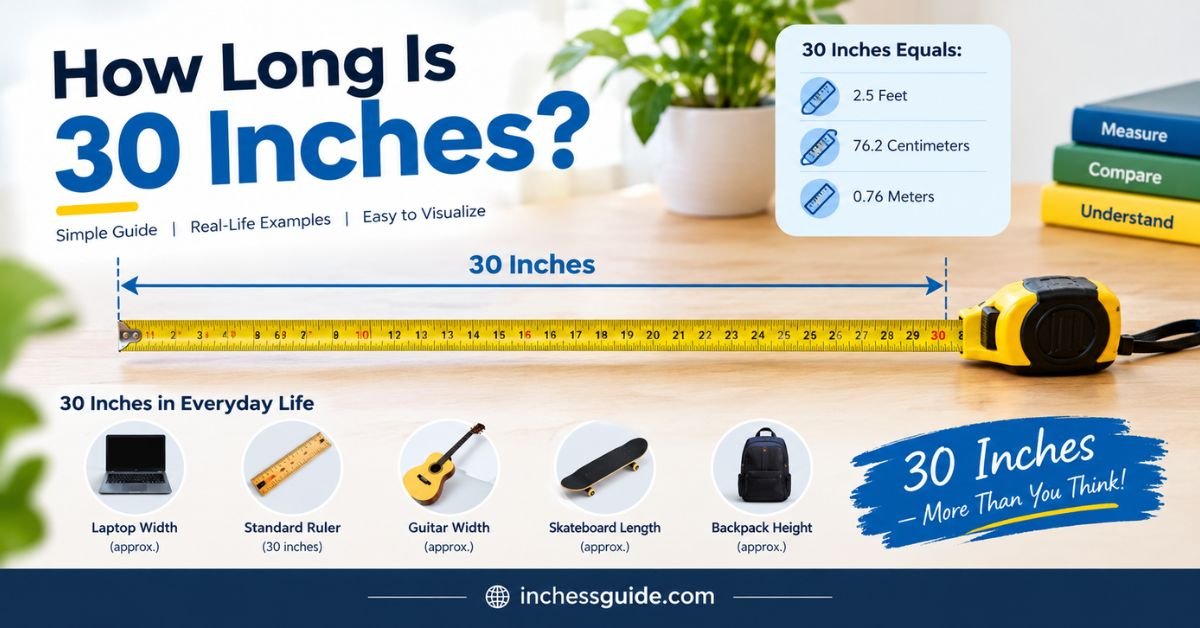
How Long Is 30 Inches? 12 Common Everyday Things Compared
30 inches is exactly 76.2 centimeters, or 2.5 feet (2 feet 6 inches). That makes it a little shorter than a yardstick, which measures 36 inches, and about three-quarters of a meter. If you are asking how long 30 inches is, the quickest way to picture it is the width of a standard bedroom door or the height of many desks.
This guide gives the exact conversions, shows how to calculate them, and describes 12 everyday things that measure about 30 inches. It also explains how to measure 30 inches without a tape measure and how to avoid common mistakes.
Quick Answer
| Unit | 30 inches equals |
|---|---|
| Millimeters (mm) | 762 mm |
| Centimeters (cm) | 76.2 cm |
| Meters (m) | 0.762 m |
| Feet (ft) | 2.5 ft (2 ft 6 in) |
| Yards (yd) | 0.8333 yd (5/6 yard) |
The centimeter, millimeter, and meter values are exact, because 1 inch is defined as exactly 2.54 centimeters. The yard value is a repeating decimal, so 0.8333 is rounded.
How to Convert 30 Inches
Each conversion uses one fixed factor.
Inches to centimeters: multiply by 2.54.
30 × 2.54 = 76.2 cm
Inches to meters: multiply by 0.0254.
30 × 0.0254 = 0.762 m
Inches to feet: divide by 12.
30 ÷ 12 = 2.5 ft. The whole number is 2 feet, and the remaining 0.5 foot is 6 inches, so the answer is 2 feet 6 inches.
Inches to yards: divide by 36.
30 ÷ 36 = 0.8333 yd
Centimeters back to inches: divide by 2.54.
76.2 ÷ 2.54 = 30 in
Do not confuse 30 inches with 30 centimeters. Thirty centimeters is only about 11.81 inches, which is the length of a standard ruler. Thirty inches is more than two and a half times longer.
Understanding the Scale of 30 Inches
At 2.5 feet, 30 inches sits between the height of a kitchen step stool and the height of a standard table. It is longer than a typical forearm-to-fingertip reach and shorter than the stride of a tall adult.
Three comparisons help set the scale:
- Against a ruler: it equals two and a half 12-inch rulers placed end to end.
- Against a yardstick: it reaches the 30-inch mark, 6 inches short of the end.
- Against a meter: 76.2 cm is about 76% of a meter stick, which is 100 cm (about 39.37 inches).
12 Everyday Things That Are About 30 Inches Long
Dimensions in this list are typical or standard values. Brands, models, and sizes vary, so treat each one as approximate unless it is a published standard.
1. A standard interior door’s width
Interior doors come in several widths, including 28, 30, and 32 inches. A 30-inch door is a common size for bedrooms and bathrooms. The door slab is about 30 inches wide, which is nearly the length of a yardstick minus a hand’s width.
2. A standard kitchen range
Freestanding kitchen ranges and slide-in stoves are commonly 30 inches wide, and cabinet cutouts are built around that standard. If you are replacing a stove, 30 inches is usually the number to match.
3. A typical desk height
Most desks sit about 29 to 30 inches above the floor. That height suits seated adults who keep their forearms roughly level with the keyboard. Adjustable desks go well beyond this range, but the fixed-height standard is close to 30 inches.
4. A dining table’s height
Standard dining tables are generally about 28 to 30 inches tall, and many measure close to 30. Picture the tabletop at roughly the level of a seated adult’s ribs, with enough clearance for the knees.
5. A bar stool’s seat height
Bar-height stools commonly have seats around 28 to 32 inches high, and many land near 30 inches. That is much taller than a standard dining chair, whose seat is typically about 17 to 19 inches high.
6. A youth baseball bat
Youth baseball and softball bats are sold in a range of lengths, and a 30-inch bat is a standard size. Professional adult bats are longer, with a maximum of 42 inches under major league rules, so a 30-inch bat is about 12 inches shorter than the longest legal adult bat.
7. A baritone ukulele
Ukulele sizes grow from soprano to baritone. A baritone ukulele measures roughly 30 inches from the top of the headstock to the bottom of the body. Lengths vary a little by manufacturer.
8. A large suitcase
Large checked suitcases are often about 28 to 30 inches tall, not counting the wheels and handle. Airlines usually limit checked bags by total dimensions (length plus width plus height) rather than by one side, so a bag this tall still needs to be checked against the airline’s limits.
9. A typical 12-month-old’s height
World Health Organization growth standards put the median length of a one-year-old at roughly 29 to 30 inches (about 74 to 76 cm). Individual children vary widely, so this is a rough picture, not a benchmark.
10. A skateboard deck (shorter styles)
Skateboard decks run from about 28 to 33 inches long. Mini and cruiser-style decks sit at the shorter end, close to 30 inches. A standard full-size deck is usually a little longer.
11. A 30-inch pants inseam
Trousers sold with a 30-inch inseam measure about 30 inches from the crotch seam to the hem. This is a common size for shorter and mid-height adult legs, and it is a useful body-based reference for 2.5 feet.
12. A 30-inch vanity
Bathroom vanity cabinets come in standard widths such as 24, 30, 36, and 48 inches. A 30-inch vanity is a common size for small to medium bathrooms, and it is about the width of the stove next to it in a kitchen.
How to Measure 30 Inches Without a Long Ruler
You do not always have a yardstick at hand. These shortcuts give a useful estimate.
- Use a tape measure: extend it to the 2-foot mark and then 6 more inches. On most tapes, 30 inches is the line halfway between the 2-foot and 3-foot marks.
- Use paper: a US Letter sheet is 11 inches long, so 30 inches is about 2.7 sheets laid end to end.
- Use money: a US dollar bill is about 6.14 inches long, so five bills in a row measure roughly 30.7 inches.
- Use a yardstick: measure to 30 inches, which is 6 inches short of the 36-inch end.
These shortcuts are fine for estimating. For cutting, fitting, or installing anything, use a tape measure and double-check the reading.
Practical Uses for a 30-Inch Measurement
Home and kitchen. Stoves, doors, and vanities in this size must fit existing openings exactly. A 30-inch range needs an opening that matches its width, and there are standard clearances on each side for safety and ventilation, so check the manufacturer’s installation guide.
Furniture. Table and desk heights near 30 inches affect posture. If a desk is much taller or shorter than your elbow height when seated, a keyboard tray or an adjustable chair can correct it.
Sewing and crafts. Fabric, ribbon, and trim are often sold by the yard. Since 30 inches is 0.8333 yard, you would need slightly less than one yard.
Travel. Knowing that a bag is about 30 inches tall helps when you are comparing luggage sizes. Always check the airline’s published size limits before flying.
Shipping. Packages are often limited by the longest side, so a 30-inch item might qualify for a standard rate with one carrier and cost more with another.
5 Common Mistakes With 30 Inches
Confusing diagonal and length. A “30-inch monitor” or TV is measured along the diagonal of the screen. A 30-inch diagonal on a 16:9 screen is about 26.1 inches wide and 14.7 inches tall, so it is not 30 inches across.
Mixing up centimeters and inches. Mixing the two can produce an answer that is off by more than a factor of two. Always check which unit a product label uses.
Rounding too early. If you convert 30 inches to meters, keep all the digits (0.762 m) until the final step. Rounding to 0.76 m drops a couple of millimeters, which is fine for estimating but not for fitting.
Treating all “30-inch” products as identical. A 30-inch door may be a nominal size. The actual slab, frame opening, and clearance can all differ by a fraction of an inch.
Confusing length with height or width. The same object can be 30 inches wide but a different height. State which dimension you mean.
Reference Chart: Inches Near 30
| Inches | Centimeters | Feet and inches |
|---|---|---|
| 25 in | 63.5 cm | 2 ft 1 in |
| 28 in | 71.12 cm | 2 ft 4 in |
| 29 in | 73.66 cm | 2 ft 5 in |
| 30 in | 76.2 cm | 2 ft 6 in |
| 31 in | 78.74 cm | 2 ft 7 in |
| 32 in | 81.28 cm | 2 ft 8 in |
| 35 in | 88.9 cm | 2 ft 11 in |
| 36 in | 91.44 cm | 3 ft |
Frequently Asked Questions
1: How long is 30 inches in feet?
Thirty inches is 2.5 feet, or 2 feet 6 inches. Divide 30 by 12 to get the answer.
2: How many centimeters is 30 inches?
Thirty inches equals exactly 76.2 centimeters, since 1 inch is 2.54 cm.
3: Is 30 inches longer than a yard?
No. A yard is 36 inches, so 30 inches is 6 inches shorter, or about 83% of a yard.
4: Is 30 inches the same as 2 feet?
No. Two feet is 24 inches. Thirty inches is 2 feet 6 inches, which is 6 inches more.
5: How many 12-inch rulers fit into 30 inches?
Two and a half. Two full rulers cover 24 inches, and half a ruler covers the remaining 6.
6: Is 30 inches an exact or approximate conversion to 76.2 cm?
It is exact. The inch has been defined as exactly 2.54 centimeters, so there is no rounding in 30 × 2.54 = 76.2.
7: What is 30 cm in inches?
About 11.81 inches. This is very different from 30 inches, so check the unit.
8: What is a good way to remember 30 inches?
Think of a standard interior door’s width, a desk’s height, or two and a half rulers end to end. For a precise check, use a tape measure and look for the halfway mark between 2 and 3 feet.
Explore More Continue Reading Our Guide on: 16 Common Things That Are About 29 Inches Long
16 Common Things That Are About 28 Inches Long
16 Common Things That Are About 27 Inches Long
16 Common Things That Are About 26 Inches Long
16 Common Things That Are About 25 Inches Long
16 Everyday Objects That Are About 24 Inches (2 Feet) Long
16 Common Everyday Things That Are About 23 Inches Long
16 Common Everyday Things That Are About 22 Inches Long
16 Common Everyday Things That Are About 21 Inches Long
Conclusion
Thirty inches equals exactly 76.2 centimeters, 0.762 meters, 2.5 feet (2 feet 6 inches), or about 0.83 yard. Doors, stoves, desks, and bar stools are everyday references for this length, and a few simple tricks, such as using paper or dollar bills, let you estimate it quickly. For anything that has to fit, such as an appliance cutout or a piece of furniture, measure with a tape and confirm the product’s exact dimensions.
One Comment