
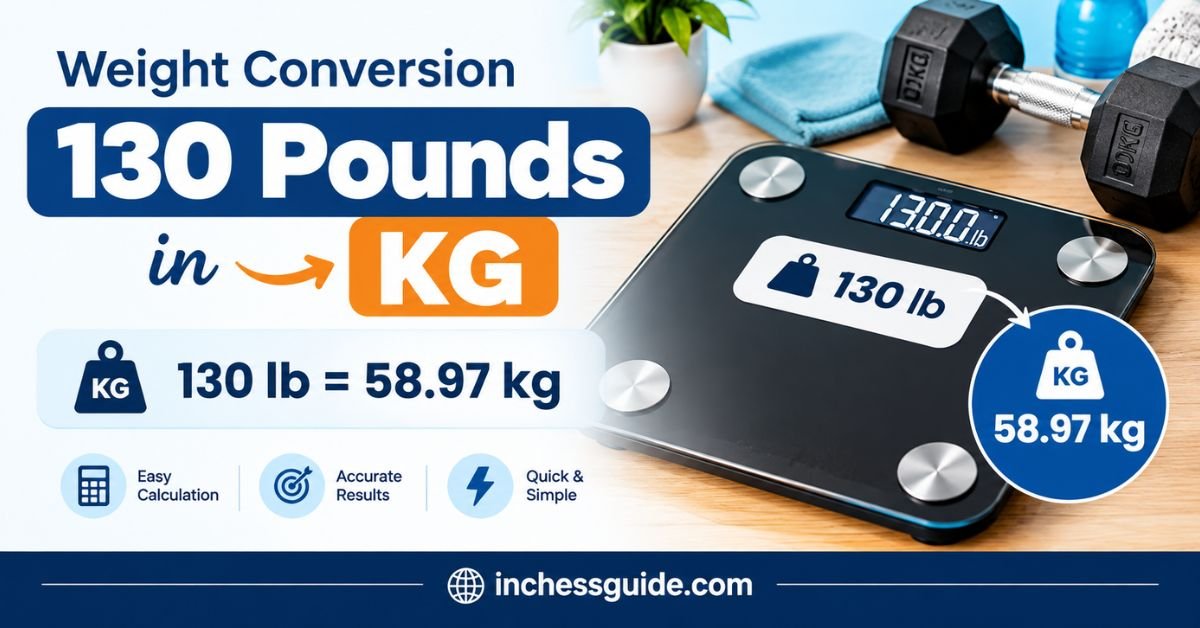
130 Pounds in KG: Exact Answer (58.97 kg) + Quick Formula
130 pounds equals 58.967 kilograms. Rounded to two decimal places, that is 58.97 kg. For everyday use, you can call it about 59 kg.
Quick Answer
- Exact value: 130 lb = 58.9670081 kg
- Rounded to two decimals: 58.97 kg
- Rounded to one decimal: 59.0 kg
- In grams: 58,967 g (rounded to the nearest gram)
- Formula: kilograms = pounds × 0.45359237
- Going back: 59 kg is about 130.07 lb, so 59 kg is very close to 130 lb but not exactly equal to it
How to Convert 130 Pounds to Kilograms
The pound is defined through the kilogram. Since the international agreement of 1959, one avoirdupois pound has been exactly 0.45359237 kg. That means the conversion factor is not an approximation, and any rounding is your own choice rather than a limit of the factor.
Formula:
Pounds × 0.45359237 = kilograms
Worked example:
130 × 0.45359237 = 58.9670081 kg
In plain English, each pound is a little less than half a kilogram, so 130 pounds comes out a little less than 65 kg. The calculation puts the result at just under 59 kg.
Step by step
- Write down the weight in pounds: 130 lb.
- Multiply by 0.45359237.
- Read the result: 58.9670081 kg.
- Round to the precision you need. For most purposes, 58.97 kg is plenty.
Dividing instead of multiplying
You can also use the reverse factor. One kilogram is about 2.20462262 pounds, so:
130 ÷ 2.20462262 ≈ 58.967 kg
Both methods give the same answer. Multiplying by 0.45359237 is cleaner because that factor is exact, while 2.20462262 is already a rounded decimal.
A sanity check
Whenever you convert pounds to kilograms, the number should get smaller. If you end up with something like 286, you have multiplied by 2.2 instead of dividing, and you have converted in the wrong direction. A kilogram is a larger unit than a pound, so you always need fewer kilograms than pounds.
Exact Value vs Rounded Value
A conversion like this can be displayed several ways, and they are not all equally precise. Here is how the common versions compare with the exact result of 58.9670081 kg.
| Version | Value | Difference from exact |
|---|---|---|
| Exact | 58.9670081 kg | none |
| Two decimals | 58.97 kg | about 3 g too high |
| One decimal | 59.0 kg | about 33 g too high |
| Whole number | 59 kg | about 33 g too high |
| Using 0.4536 | 58.968 kg | about 1 g too high |
| Dividing by 2.2 | 59.09 kg | about 124 g too high |
| Multiplying by 0.45 | 58.5 kg | about 467 g too low |
The practical lesson: 58.97 kg is accurate enough for almost any personal or household purpose. The shortcut of multiplying by 0.45 is convenient but can be off by nearly half a kilogram at this weight, which is worth knowing if the number matters.
Mental-Math Shortcuts for 130 lb
You do not always have a calculator handy. These methods are listed from most accurate to least.
Split into known pieces. Many people remember that 100 lb is about 45.36 kg. Then add the remaining 30 lb, which is about 13.61 kg:
45.36 + 13.61 = 58.97 kg
This lands on the correct two-decimal answer with simple addition.
Divide by 2.2. 130 ÷ 2.2 is about 59.1 kg. This is fast and good enough for a rough idea, though it runs slightly high.
Halve and trim. Half of 130 is 65. Taking away about 10% (6.5) gives 58.5 kg. This is quick but a bit low, so treat it as an estimate only.
If you are filling in a form, preparing a shipment, or recording a medical measurement, use the full calculation instead of a shortcut.
Pounds to Kilograms Conversion Table Near 130 lb
This table helps if your exact figure is slightly different from 130 lb. All kilogram values are rounded to two decimal places.
| Pounds (lb) | Kilograms (kg) |
|---|---|
| 120 | 54.43 |
| 125 | 56.70 |
| 128 | 58.06 |
| 129 | 58.51 |
| 130 | 58.97 |
| 131 | 59.42 |
| 132 | 59.87 |
| 135 | 61.23 |
| 140 | 63.50 |
Each additional pound adds roughly 0.45 kg, which is why consecutive rows rise by a little under half a kilogram.
The reverse direction: kilograms to pounds
| Kilograms (kg) | Pounds (lb) |
|---|---|
| 55 | 121.25 |
| 58 | 127.87 |
| 59 | 130.07 |
| 60 | 132.28 |
| 65 | 143.30 |
Notice that 59 kg is 130.07 lb. That is why the rounded kilogram value and the original pound value do not match perfectly when you convert back and forth.
130 Pounds in Other Units
Sometimes the kilogram is not the only unit you need. Here are the equivalents of 130 lb.
| Unit | Value |
|---|---|
| Kilograms | 58.9670081 kg |
| Grams | 58,967.0081 g |
| Metric tons | 0.0589670081 t |
| Ounces | 2,080 oz |
| Stone | 9 st 4 lb (about 9.29 st) |
The ounce figure is exact because there are 16 ounces in a pound: 130 × 16 = 2,080. The stone figure uses 14 pounds per stone: 130 ÷ 14 gives 9 with a remainder of 4, so 9 stone 4 pounds. The stone is used mainly in the UK and Ireland for body weight.
How to Visualize 130 Pounds (About 59 kg)
A number alone can be hard to picture. These comparisons are approximate and meant to give a feel for the size of the weight, not an exact match.
Water. One liter of fresh water has a mass of roughly 1 kg at room temperature. So 130 lb is about the mass of 59 liters of water, not counting the container. That is close to three 20-liter water jugs filled to the top.
Checked luggage. Many airlines set a standard checked-bag limit near 23 kg (about 50 lb), though limits differ by airline and fare. At that limit, 130 lb is about two and a half to two and three-fifths bags’ worth, or roughly 2.6 bags. Always check the specific airline rules before you travel.
One-pound packs. In the United States, a standard pack of butter is labeled as 1 lb. Picture 130 of them: that is the mass you are working with.
These comparisons are useful for building intuition. They are not substitutes for a scale when the exact weight matters.
Where 130 lb to kg Conversions Come Up
Body weight and health records. Many countries record body weight in kilograms, while the United States commonly uses pounds. If you are completing a medical form, filling in a fitness app, or discussing your weight with a clinician abroad, you may need the kilogram figure. For weight-based medication, never rely on a casual conversion. Doses are often calculated from weight in kilograms, and the figure should come from a measured weight and be confirmed by a doctor or pharmacist.
Gym and training. Some programs list targets in pounds, others in kilograms. If a plan calls for a 130 lb lift or body-weight target and your equipment is marked in kilograms, 58.97 kg tells you what to look for. Note that many gym plates are rounded to convenient values, so your loaded bar may differ slightly from the exact conversion.
Luggage and shipping. Freight and parcel carriers publish limits and pricing in either pounds or kilograms. For shipping, a few grams of rounding rarely matters, but pricing bands can, so use the carrier’s own stated unit and rounding rules where possible.
Sports weight classes. Competitions often publish limits in kilograms or pounds depending on the federation. If your weight is near a boundary, rely on an official weigh-in rather than a converted estimate.
Cooking and bulk purchases. Recipes and wholesale bags can list weights in either system, and 130 lb is a plausible total for large orders. In this case, 58.97 kg is a sound figure to plan around.
Mass vs Weight: A Short Note
In everyday language, “weight” and “mass” are used interchangeably, and a kilogram is a unit of mass. Strictly speaking, weight is the force gravity exerts on a mass. Bathroom scales and shop scales are calibrated to display mass, so when we say “130 lb” or “58.97 kg” we are in practice describing the same quantity in two units. For ordinary purposes on Earth, you do not need to worry about the distinction.
How to Measure Weight Accurately
If your goal is to find your own weight or the weight of an object in kilograms, the best approach is to weigh it directly rather than converting.
- Use a scale set to kilograms. Most digital scales have a unit button. This avoids conversion error entirely.
- Place the scale on a hard, flat surface. Carpet and uneven floors can distort readings.
- Zero the scale first. For objects in a container, use the tare function so the container is not counted.
- Be consistent. For body weight, weigh at the same time of day and in similar clothing so comparisons are fair.
- Know the scale’s resolution. A scale that displays to 0.1 kg cannot tell you anything about the second decimal place, so reporting 58.97 kg from such a scale would suggest false precision.
5 Common Mistakes When Converting 130 lb to kg
Multiplying by 2.2 instead of dividing. This produces 286 and shows the conversion went in the wrong direction.
Using 0.5 as the factor. Half of 130 is 65 kg, which is about 6 kg too high. The factor is closer to 0.45.
Rounding too early. If you round the factor to 0.45 before multiplying, the error grows. Keep the full factor and round only the final answer.
Assuming round trips are lossless. Converting 130 lb to 59 kg and back gives 130.07 lb, not 130. That small difference comes from rounding, not from a wrong formula.
Confusing “lb” with “lbs”. The standard symbol is “lb” for both singular and plural. “Lbs” is common informally, but “lb” is the recognized symbol.
Frequently Asked Questions
1: Is 130 pounds exactly 59 kilograms?
No. 130 pounds is 58.967 kg, which rounds to 59 kg. Conversely, 59 kg is about 130.07 lb. The two are very close, but not identical.
2: How many pounds is 60 kg, and how does that compare to 130 lb?
60 kg is about 132.28 lb, which is roughly 2.3 lb heavier than 130 lb.
3: Should I use 2.2 or 2.20462 when converting?
Use 2.2 only for quick estimates; it slightly overstates the result when dividing. Use 2.20462262, or better, multiply by the exact 0.45359237, whenever accuracy matters.
4: Is a US pound different from a UK pound?
No. Since 1959, the avoirdupois pound has been defined identically in the US, the UK, and other countries as exactly 0.45359237 kg. The UK stone is 14 of these pounds.
5: Why do some websites show 58.97 kg and others 58.967 kg?
They are rounding the same value differently. 58.9670081 kg is the exact result, 58.967 kg rounds to three decimals, and 58.97 kg rounds to two. All are correct to their stated precision.
Explore More Continue Reading Our Guide on: How Much Is 120 Pounds in Kg?
125 Pounds in kg
Conclusion
130 pounds is 58.967 kg, which most people write as 58.97 kg or about 59 kg. Multiplying by 0.45359237 gives the exact figure, while dividing by 2.2 gets you close to 59.1 kg for a quick check. Use the longer value when precision matters, such as on official forms, and keep in mind that 59 kg converts back to a little over 130 lb.
One Comment