
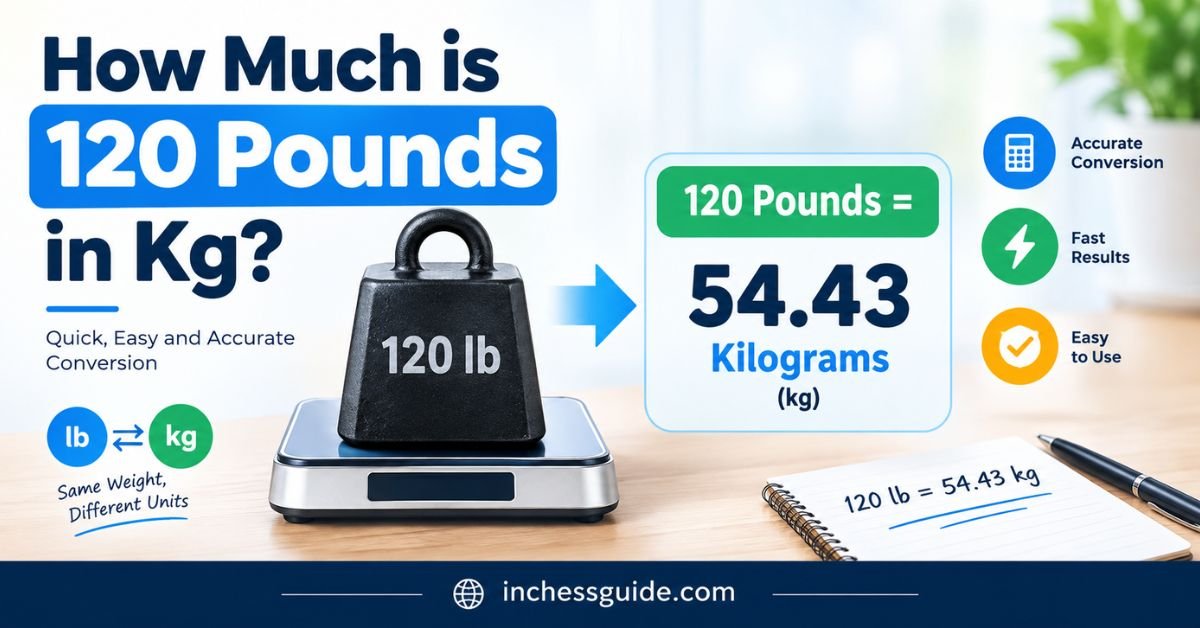
How Much Is 120 Pounds in Kg? 54.43 kg (Formula & Table)
120 pounds (lb) equals 54.43 kilograms (kg), rounded to two decimal places. The unrounded result is 54.4310844 kg. For everyday use, you can say 54.4 kg, or “about 54 kg” if you only need a rough figure.
This page covers the exact calculation, how to do it in your head, and how to avoid the mistakes people most often make when converting between pounds and kilograms. It also shows what 54.43 kg looks like in practical terms and how to get a trustworthy reading from a scale.
Quick Answer
| Measurement | Result |
|---|---|
| 120 lb in kilograms (exact) | 54.4310844 kg |
| 120 lb in kilograms (2 decimals) | 54.43 kg |
| 120 lb in kilograms (1 decimal) | 54.4 kg |
| 120 lb in kilograms (whole number) | 54 kg |
| 120 lb in grams | 54,431 g (rounded) |
The conversion uses the international avoirdupois pound, defined as exactly 0.45359237 kg. Every figure above comes from that single definition.
How to Convert 120 Pounds to Kilograms
The relationship between the two units is fixed by international agreement:
1 pound = 0.45359237 kilograms (exact)
To convert pounds to kilograms, multiply the number of pounds by 0.45359237:
Kilograms = Pounds × 0.45359237
Applied to 120 pounds:
120 × 0.45359237 = 54.4310844 kg
Rounded to two decimal places, the answer is 54.43 kg.
Step-by-step method
- Write down the weight in pounds: 120 lb.
- Multiply by 0.45359237.
- Read the result: 54.4310844 kg.
- Round to the precision you need. For most uses, one or two decimal places is enough.
Exact value versus rounded value
The factor 0.45359237 is exact. It is a definition, not a measured approximation. The result 54.4310844 kg is therefore mathematically exact, as long as the starting figure of 120 lb is treated as exactly 120.
Values such as 54.43 kg, 54.4 kg, and 54 kg are rounded representations. They are fine for most purposes but not identical to the exact value. If you use the shortened factor 0.454, you get 120 × 0.454 = 54.48 kg. That is about 0.05 kg higher than the exact result, which is harmless for casual use but worth knowing about when precision matters.
Pounds to Kilograms Conversion Table
This table shows common body-weight and package-weight values around 120 lb. All kilogram values are rounded to two decimal places from the exact factor.
| Pounds (lb) | Kilograms (kg) |
|---|---|
| 50 | 22.68 |
| 60 | 27.22 |
| 70 | 31.75 |
| 80 | 36.29 |
| 90 | 40.82 |
| 100 | 45.36 |
| 110 | 49.90 |
| 120 | 54.43 |
| 130 | 58.97 |
| 140 | 63.50 |
| 150 | 68.04 |
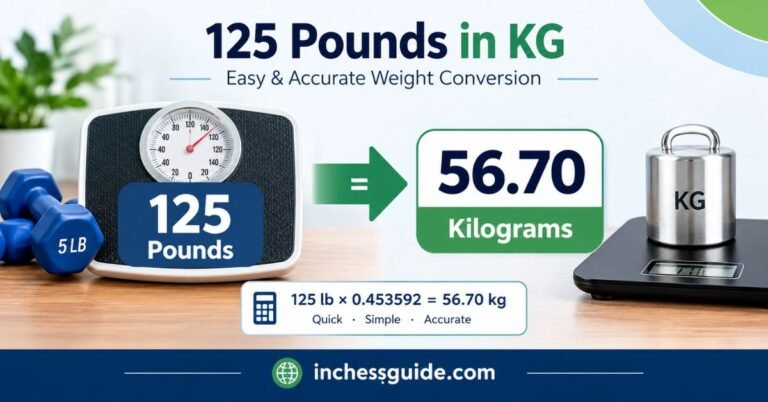
Each 10 lb step adds about 4.54 kg, so you can place any value between rows. For example, 125 lb falls midway between 54.43 kg and 58.97 kg, at roughly 56.70 kg.
How to Estimate 120 lb in Kg in Your Head
When you don’t have a calculator, these shortcuts get close. I’ve included each one’s error against the exact answer of 54.43 kg so you can judge which is good enough.
Shortcut 1: Divide by 2.2.
120 ÷ 2.2 ≈ 54.55 kg. This is off by about 0.12 kg and is the most accurate of the simple methods.
Shortcut 2: Multiply by 0.45.
120 × 0.45 = 54 kg. This is off by about 0.43 kg. It is easy because 0.45 is just “half minus a tenth of the half.”
Shortcut 3: Halve it, then subtract 10 percent.
Half of 120 is 60. Ten percent of 60 is 6. So 60 − 6 = 54 kg. This is the same arithmetic as Shortcut 2, written the way many people do it mentally.
These shortcuts are fine for travel planning, casual conversation, or sanity-checking a result. They are not appropriate when you need a documented or technical value.
120 Pounds in Other Units
People who search for this conversion are sometimes also trying to move between systems more broadly. Here is 120 lb expressed in other units:
| Unit | 120 lb equals |
|---|---|
| Kilograms (kg) | 54.4310844 kg |
| Grams (g) | 54,431.0844 g |
| Ounces (oz) | 1,920 oz (exact, since 1 lb = 16 oz) |
| Stone and pounds | 8 st 8 lb (exact, since 1 st = 14 lb) |
| Metric tonnes (t) | 0.0544 t (rounded) |
The ounce and stone figures are exact because they depend only on the whole-number relationships between imperial and US customary units. The metric figures follow from the 0.45359237 definition.
A note on mass versus weight
In everyday speech, “weight” and “mass” are used interchangeably, and this conversion treats them that way. Technically, kilograms and pounds both measure mass. Weight is the force gravity exerts on that mass, measured in newtons. A 54.43 kg mass experiences a gravitational force of roughly 533.8 N under standard gravity (9.80665 m/s²). Unless you are working in physics or engineering, you can ignore the distinction and treat pounds and kilograms as measures of “how heavy something is.”
What Does 54.43 kg (120 lb) Look Like?
A number on its own can be hard to feel. These comparisons use defensible approximations, and they are labeled where real-world objects vary.
Water. One litre of water has a mass of very nearly 1 kg at room temperature. About 54.4 kg of water is therefore roughly 54.5 litres, or about 14.4 US gallons. This is a physical property rather than an object dimension, so it is the most reliable comparison here, though the density of water shifts slightly with temperature.
A standard Olympic barbell. The men’s Olympic bar is specified at 20 kg (about 44 lb), and a common gym bar is sold as a “45 lb” bar. 120 lb is about 2.7 times the weight of that 45 lb bar. Gym equipment varies, so treat this as a rough guide. Bars and plates should be checked against their markings.
Sacks of material. Many bagged goods, such as flour, feed, or cement, are sold in 25 kg sacks. Sack sizes differ by product and country, but if you have 25 kg sacks in mind, 54.43 kg is a little over two of them (about 2.2).
Airline luggage. Many airlines set checked-bag limits around 23 kg, though limits vary by airline, fare, and route. 54.43 kg is about 2.4 times that figure. If you are packing, check your airline’s published allowance rather than relying on a typical figure.
Keep in mind that lifting comparisons describe heaviness, not how hard something is to carry. The shape, grip, and balance of an object change how manageable the same mass feels.
Where the 120 lb to kg Conversion Is Useful
Body weight and fitness
Many scales, fitness apps, and health records use pounds in the United States and kilograms in most other countries. If you are tracking weight across systems or comparing against international guidelines, converting 120 lb to 54.43 kg lets you do it consistently. For ongoing tracking, pick one unit and stick with it. Repeated conversion and rounding can create small apparent changes that aren’t real.
Medical and dosing contexts
Some medicines and medical calculations are based on body weight in kilograms. Weight-based dosing should be calculated by a doctor, nurse, or pharmacist, who will use the exact figure and the correct protocol. Don’t use a rounded mental shortcut for anything health-related. If you’ve been given a weight in pounds for a medical purpose, ask the professional to do the conversion or confirm yours.
Shipping and freight
Carriers and customs documents often require weights in kilograms, while the item may be listed in pounds. A 120 lb package is 54.43 kg. If a carrier rounds up to the next whole kilogram, it may bill for 55 kg. Check how your carrier rounds, because it can affect cost.
Equipment and load limits
Furniture, shelving, ladders, trailers, and exercise equipment often list a maximum load in either unit. If a ladder or shelf shows a limit in kilograms and your load is 120 lb, compare it using the exact value of 54.43 kg, and leave a margin rather than loading to the limit.
Pets and animals
Veterinary information, feed packaging, and pet-travel rules may use different units. A dog weighing 120 lb is about 54.4 kg, which is useful for crate ratings, travel documents, and veterinary records.
6 Common Mistakes When Converting Pounds to Kilograms
Multiplying by 2.2 instead of dividing. The factor 2.2046 converts kilograms to pounds. If you multiply 120 lb by 2.2, you get 264, which is wrong. That number is roughly what you’d get converting 120 kg to pounds (about 264.55 lb). A quick check helps: a kilogram is heavier than a pound, so the kilogram number should always be smaller than the pound number.
Mixing up the direction of the formula. To go from pounds to kilograms, multiply by 0.45359237 or divide by 2.20462262. To go from kilograms to pounds, do the opposite.
Using a heavily rounded factor. Using 0.45 for a single casual conversion is fine. Using it repeatedly in a calculation can build up a visible error.
Confusing pounds and stone. In the UK and Ireland, body weight is often given in stone and pounds. 120 lb is 8 st 8 lb, not 120 stone. If you see a value like “8 st 8,” convert it to pounds first (8 × 14 + 8 = 120) and then to kilograms.
Rounding too early. Round at the end, not in the middle. If you convert, add other values, and round only the final total, the result will be more accurate.
Mixing up pounds-mass and pound-force. In engineering, “lbf” measures force, and “lb” or “lbm” measures mass. This page converts mass.
Accuracy, Rounding, and Getting a Reliable Weight
How much precision do you need?
A good rule is to match your rounding to the precision of the original measurement. If a home scale reads 120 lb, it usually means “somewhere around 120,” not exactly 120.000. If the true value could be anywhere from 119.5 lb to 120.5 lb, the corresponding range in kilograms is roughly 54.20 kg to 54.66 kg. Reporting 54.4 kg is therefore perfectly reasonable, and extra decimals don’t make the number more accurate.
Getting a trustworthy reading
- Use a scale rather than estimating by eye. Visual estimates of body or object weight are unreliable and should not be used for anything where accuracy matters.
- Place the scale on a flat, hard surface rather than carpet.
- Zero the scale before use, and check that its display is set to the unit you want.
- For tracking over time, weigh at a similar time of day under similar conditions.
- For shipping, medical, or technical purposes, use a calibrated scale and record the unit alongside the value.
Converting the other way
If you have 54.43 kg and want pounds, multiply by 2.20462262:
54.43 × 2.20462262 ≈ 120.00 lb
Here are some nearby kilogram values for reference:
| Kilograms (kg) | Pounds (lb) |
|---|---|
| 50 | 110.23 |
| 52 | 114.64 |
| 54 | 119.05 |
| 54.43 | 120.00 |
| 56 | 123.46 |
| 58 | 127.87 |
| 60 | 132.28 |
Frequently Asked Questions
1: Is 120 pounds more or less than 55 kg?
It is slightly less. 120 lb is 54.43 kg, so it is about 0.57 kg below 55 kg.
2: How many pounds are in one kilogram?
One kilogram is about 2.20462262 pounds. The exact relationship runs the other way: 1 lb is defined as 0.45359237 kg.
3: What is 120 lb in kg rounded to the nearest whole number?
54 kg. The exact value is 54.4310844 kg, which rounds down to 54.
4: What is 120 lb in stone?
120 lb is 8 stone 8 pounds, since one stone is 14 pounds. In decimal form, that is about 8.57 stone.
5: Can I use 2.2 as the conversion factor?
Yes, for a quick estimate. Dividing 120 by 2.2 gives 54.55 kg, which is about 0.12 kg above the exact value. For anything requiring precision, use 0.45359237.
6: Is a pound the same in the US and the UK?
Yes. Since the 1959 international agreement, the pound used in both countries is defined as exactly 0.45359237 kg.
Explore More Continue Reading Our Guide on: Inchessguide.com
Conclusion
120 pounds equals 54.43 kg, calculated by multiplying 120 by 0.45359237. For quick estimates, dividing by 2.2 gives about 54.5 kg, and halving then subtracting 10 percent gives about 54 kg. Remember that the kilogram figure should always be smaller than the pound figure, which makes it easy to spot a flipped formula.
2 Comments