
90 Minutes in Hours? It’s 1.5 Hours or 1 Hour 30 Minutes
Quick Answer
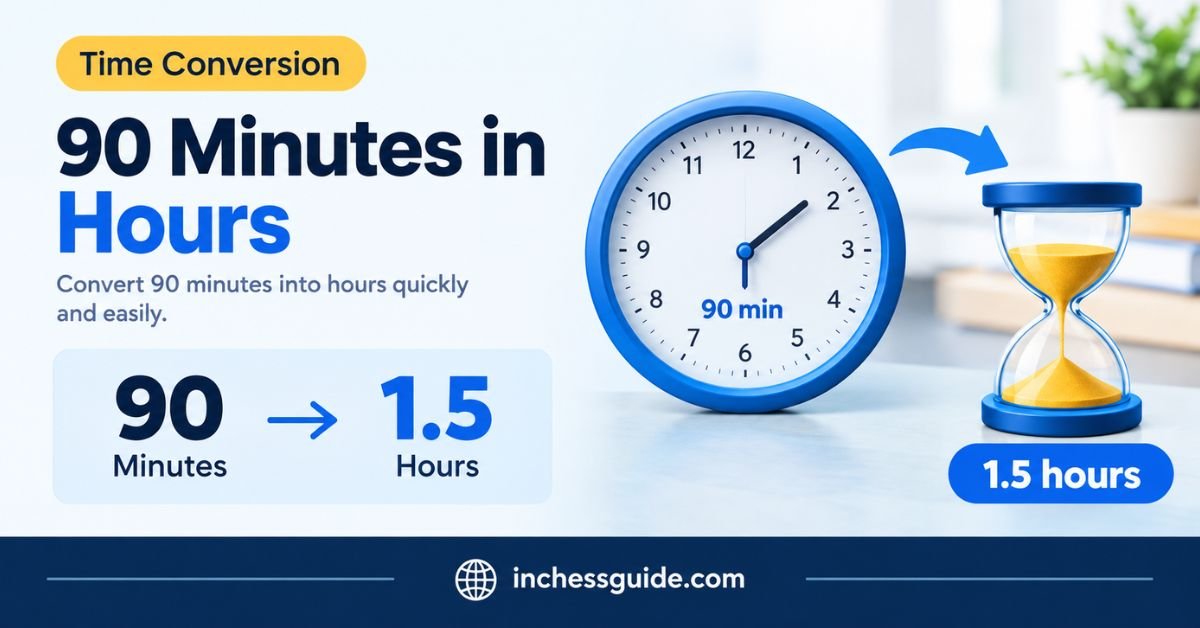
90 minutes is equal to 1.5 hours, which is also written as 1 hour and 30 minutes. This conversion is exact, so no rounding is involved.
| Minutes | Decimal hours | Hours and minutes |
|---|---|---|
| 90 min | 1.5 h | 1 h 30 min |
The formula is hours = minutes ÷ 60, so 90 ÷ 60 = 1.5.
Both answers are correct, but they suit different situations. Use “1 hour 30 minutes” when you are reading a clock, setting a timer, or scheduling something. Use “1.5 hours” when you are multiplying, such as calculating pay, distance, or project time.
How to Convert 90 Minutes to Hours
An hour contains 60 minutes by definition, so converting minutes to hours means dividing by 60.
Formula:
Hours = Minutes ÷ 60
Worked example:
90 ÷ 60 = 1.5
The result means one full hour plus half of another hour. Half of 60 minutes is 30 minutes, so 1.5 hours is the same as 1 hour 30 minutes.
A second method: split the minutes
If you prefer to avoid division, break 90 into pieces you already know:
- 90 minutes = 60 minutes + 30 minutes
- 60 minutes = 1 hour
- 30 minutes = ½ hour = 0.5 hour
- 1 hour + 0.5 hour = 1.5 hours
This method works well for mental math. It also shows why the decimal part is .5 and not .30, which is the most common mistake with this conversion (covered below).
Converting back: hours to minutes
To check the result or reverse the conversion, multiply by 60:
Minutes = Hours × 60
1.5 × 60 = 90 minutes ✓
Why 1.5 Hours Is Not 1 Hour 50 Minutes
The most frequent error with this conversion comes from mixing two ways of writing time.
Clock time is based on 60, so there are 60 minutes in an hour. Decimal numbers are based on 10. The digits after the decimal point in “1.5 hours” are a fraction of one hour, not a count of minutes.
- 1.5 hours means 1 hour plus 0.5 of an hour. Since 0.5 × 60 = 30, that is 1 hour 30 minutes.
- 1.30 hours (a common mistake) means 1 hour plus 0.30 of an hour. Since 0.30 × 60 = 18, that is only 1 hour 18 minutes.
- 1 hour 50 minutes equals 110 minutes, which is about 1.83 hours (110 ÷ 60 ≈ 1.8333).
So 1.5 hours, 1.30 hours, and 1:50 are three different durations. If a timesheet or form asks for decimal hours, enter 1.5 for 90 minutes. If it asks for hours and minutes, enter 1:30.
Minutes-to-Hours Conversion Table
This table covers common durations around 90 minutes. Values that do not divide evenly are rounded to two decimal places and marked with ≈.
| Minutes | Decimal hours | Hours and minutes |
|---|---|---|
| 10 | ≈ 0.17 | 0 h 10 min |
| 15 | 0.25 | 0 h 15 min |
| 20 | ≈ 0.33 | 0 h 20 min |
| 30 | 0.5 | 0 h 30 min |
| 45 | 0.75 | 0 h 45 min |
| 60 | 1 | 1 h 0 min |
| 75 | 1.25 | 1 h 15 min |
| 90 | 1.5 | 1 h 30 min |
| 105 | 1.75 | 1 h 45 min |
| 120 | 2 | 2 h 0 min |
| 135 | 2.25 | 2 h 15 min |
| 150 | 2.5 | 2 h 30 min |
| 180 | 3 | 3 h 0 min |
Notice that every 15 minutes adds 0.25 hour. That pattern makes quarter-hour conversions easy to remember: 15 min = 0.25 h, 30 min = 0.5 h, 45 min = 0.75 h.
90 Minutes in Other Time Units
Sometimes the useful answer is in a different unit.
| Unit | Value for 90 minutes | Calculation |
|---|---|---|
| Seconds | 5,400 s | 90 × 60 |
| Hours | 1.5 h | 90 ÷ 60 |
| Days | 0.0625 day (1/16 of a day) | 90 ÷ 1,440 |
There are 1,440 minutes in a standard 24-hour day (24 × 60), and 1,440 ÷ 90 = 16. This means exactly sixteen 90-minute blocks fit into one day. That fact is handy for spreadsheets, where times are stored as fractions of a day.
Using 90 Minutes in Everyday Calculations
Adding 90 minutes to a clock time
The simplest approach is to add 1 hour first, then 30 minutes.
- 2:15 PM + 90 minutes: 2:15 PM + 1 h = 3:15 PM; + 30 min = 3:45 PM
- 7:50 AM + 90 minutes: 7:50 AM + 1 h = 8:50 AM; + 30 min = 9:20 AM
- 10:45 AM + 90 minutes: 10:45 AM + 1 h = 11:45 AM; + 30 min = 12:15 PM
- 11:30 PM + 90 minutes: 11:30 PM + 1 h = 12:30 AM; + 30 min = 1:00 AM (next day)
When the minutes pass 60, subtract 60 and carry one hour. In the 7:50 AM example, 50 + 30 = 80 minutes, which is 1 hour 20 minutes. That turns 8:50 AM into 9:20 AM.
Pay and billing
Payroll and invoicing usually need decimal hours, because you multiply hours by a rate.
If a freelancer charges $40 per hour and works for 90 minutes:
1.5 h × $40/h = $60
You can reach the same answer without converting to hours first. Dividing the hourly rate by 60 gives $0.6667 per minute, and 90 × 0.6667 ≈ $60. Converting to hours is cleaner and avoids rounding.
Many workplaces round time entries to set increments. Ninety minutes divides evenly into 6-minute increments (15 increments, or 1.5 tenths-of-an-hour units) and into 15-minute increments (six quarters, or 1.50 hours). It therefore needs no rounding in either system. Rounding policies differ by employer and jurisdiction, so check the rules that apply to you rather than assuming.
Speed and distance
Speeds are usually given per hour, so minutes must be converted to hours before you multiply.
- At a steady 60 km/h, 90 minutes covers 60 × 1.5 = 90 km.
- At a steady 80 km/h, 90 minutes covers 80 × 1.5 = 120 km.
A common error is multiplying 60 km/h by 90 and getting 5,400, which is a distance in “km-minutes per hour” and has no meaning. Convert 90 minutes to 1.5 hours first.
Scheduling and planning
Ninety minutes divides neatly into smaller blocks:
- 3 blocks of 30 minutes
- 2 blocks of 45 minutes
- 6 blocks of 15 minutes
- 9 blocks of 10 minutes
This is one reason 90 minutes is a convenient length for classes, workshops, and meetings. An exam that starts at 9:15 AM and lasts 90 minutes ends at 10:45 AM.
Cooking and timers
Most kitchen timers count in hours and minutes, not decimal hours. For a recipe that says to roast for 1.5 hours, set the timer to 1:30 (or 90 minutes if the timer counts in minutes only). Entering “1.5” on a timer that expects hours and minutes could be read as 1 hour 5 minutes or something else entirely, depending on the device.
How to Visualize 90 Minutes
A number is easier to feel when you can link it to something familiar. The comparisons below are approximate unless noted.
- A soccer match (regulation time). Two halves of 45 minutes each total 90 minutes of regulation play. This is a defined part of the game’s laws. The real elapsed time is longer because of the halftime interval and added stoppage time.
- A typical feature film. Many films run somewhere around 90 minutes, but film lengths vary widely, so treat this as a rough benchmark, not a rule.
- A long class block. Some schools and universities schedule 90-minute periods or lectures. This is a common arrangement, not a universal standard.
- A sleep cycle. A full sleep cycle is often described as lasting about 90 minutes on average. Individual cycles differ between people and across the night, so this is a general estimate and not a precise figure for any one person.
- One-sixteenth of a day. If you divide a 24-hour day into sixteen equal parts, each part is exactly 90 minutes.
If you want a quick mental picture, think of 90 minutes as one hour plus a half-hour: roughly the time for a full match, a short movie, or a focused work session with a short break.
5 Common Mistakes to Avoid
- Writing 1.30 instead of 1.5. As explained above, 1.30 hours is 1 hour 18 minutes, not 1 hour 30 minutes.
- Dividing by 100. Dividing 90 by 100 gives 0.9, which is wrong. Time uses 60 minutes per hour, so divide by 60.
- Forgetting to convert before multiplying. Pay rates, speeds, and many scientific formulas expect hours. Convert first, then multiply.
- Entering 1.5 in a time-format cell. In a spreadsheet, a cell formatted as time interprets numbers as fractions of a day, so typing 1.5 may produce 36:00:00 (1.5 days). Enter 1:30 for a time value, or format the cell as a plain number if you want decimal hours.
- Mixing clock arithmetic with decimal arithmetic. If you add 90 minutes to 3:45 PM, work in hours and minutes (3:45 + 1:30 = 5:15 PM). Do not add 1.5 to 3.45.
Converting in a Spreadsheet
Spreadsheet programs such as Excel and Google Sheets store time as a fraction of a day. This explains the table of units above: 90 minutes is 0.0625 of a day.
- If a cell contains minutes as a plain number (for example 90): use
=A1/60to get 1.5 hours. - If a cell contains a time value such as 1:30: use
=A1*24to get 1.5 decimal hours. The check is 0.0625 × 24 = 1.5. - To go from decimal hours to a time value: use
=A1/24and format the result as time.
Check the cell format after each step, because a wrong format is the usual cause of unexpected results.
Accuracy and Precision
The conversion from 90 minutes to 1.5 hours is exact. The hour and the minute are units accepted for use alongside the International System of Units (SI), with 1 minute = 60 seconds and 1 hour = 3,600 seconds. These relationships are fixed, so 90 minutes is exactly 5,400 seconds and exactly 1.5 hours.
One practical point concerns clocks, not the unit itself. If a 90-minute period crosses a daylight saving time change, the clock reading at the end will not match a simple addition. The duration is still 90 minutes of elapsed time, but the wall-clock times differ by an hour from what you would otherwise expect. For events that span a clock change, use a scheduling tool that handles time zones, or work out the end time using the local rules for that date.
For everyday purposes such as cooking, classes, and meetings, a standard clock, phone, or kitchen timer is accurate enough. For activities where exact timing matters, such as lab procedures or timed competitions, use the instrument and method specified for that task.
Frequently Asked Questions
1: Is 90 minutes the same as 1.5 hours?
Yes. Dividing 90 by 60 gives exactly 1.5, so 90 minutes equals 1.5 hours or 1 hour 30 minutes.
2: How do I write 90 minutes in hours and minutes?
Write it as 1 hour 30 minutes, or 1:30 in clock format. In decimal form it is 1.5 hours.
3: What is 1.5 hours in minutes?
Multiply by 60: 1.5 × 60 = 90 minutes.
4: How many 90-minute periods are in a day?
A day has 1,440 minutes, and 1,440 ÷ 90 = 16, so there are exactly sixteen 90-minute periods in a 24-hour day.
5: What time is it 90 minutes after 4:40 PM?
Add 1 hour to get 5:40 PM, then add 30 minutes to get 6:10 PM. The minutes pass 60 (40 + 30 = 70), so you carry one hour and keep 10 minutes.
6: Should I enter 90 minutes as 1.5 or 1:30 on a timesheet?
It depends on the format the form requires. Use 1.5 if it asks for decimal hours and 1:30 if it asks for hours and minutes. Entering 1.30 in a decimal field would record only 1 hour 18 minutes.
Explore More Continue Reading Our Guide on: 120 Hours in Days
Conclusion
Ninety minutes is exactly 1.5 hours, or 1 hour 30 minutes, found by dividing 90 by 60. Use the decimal form for pay, speed, and other multiplication, and the hours-and-minutes form for clocks, timers, and schedules. Remember that the .5 in 1.5 stands for half an hour, not 50 minutes.

One Comment