175 mph to kmh: 281.64 km/h: Formula, Table & Examples
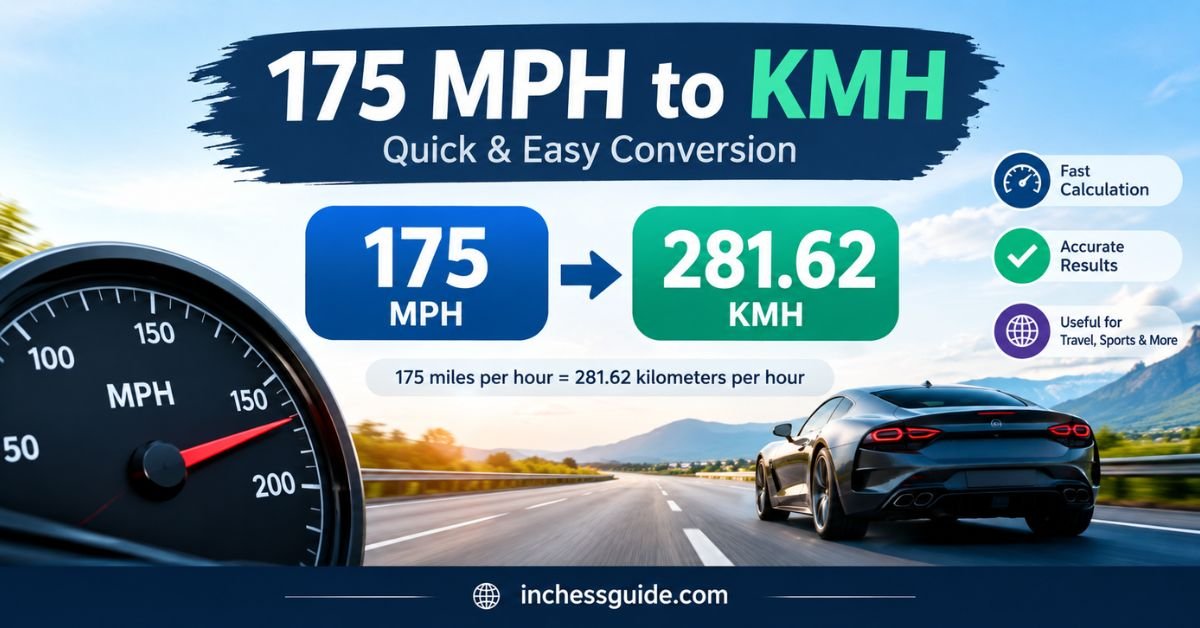
175 miles per hour (mph) is equal to 281.6352 kilometers per hour (km/h), or about 281.64 km/h when rounded to two decimal places. If you only need a quick figure, 175 mph is roughly 282 km/h.
This article gives you the exact conversion, shows how to calculate it yourself, and puts the speed in context with distances, time, and familiar comparisons. A speed this high is difficult to picture, so the later sections focus on what it means in practice.
Quick Answer
| Speed in mph | Speed in km/h (exact) | Rounded |
|---|---|---|
| 175 mph | 281.6352 km/h | 281.64 km/h |
- Formula: km/h = mph × 1.609344
- Quick mental estimate: multiply by 1.6, then add a little. 175 × 1.6 = 280, so the true value is slightly higher.
- Reverse check: 281.64 km/h is about 175 mph.
How to Convert 175 mph to km/h
Miles per hour and kilometers per hour both measure distance traveled in one hour. The only difference is the unit of distance: miles versus kilometers. To convert, you replace miles with their kilometer equivalent.
One international mile is defined as exactly 1.609344 kilometers. That means one mph is exactly 1.609344 km/h.
Formula:
km/h = mph × 1.609344
Worked example:
- Start with the speed: 175 mph
- Multiply by the conversion factor: 175 × 1.609344
- Calculate: 175 × 1.609344 = 281.6352
- Result: 175 mph = 281.6352 km/h
You can also break the multiplication into two parts to check it by hand. 100 × 1.609344 = 160.9344 and 75 × 1.609344 = 120.7008. Adding them gives 160.9344 + 120.7008 = 281.6352, which matches.
Exact Value vs Rounded Value
Because 1 mile equals exactly 1.609344 km, the result of 281.6352 km/h is mathematically exact for 175 mph. Any shorter figure is a rounded representation:
- 281.64 km/h (two decimal places)
- 281.6 km/h (one decimal place)
- 282 km/h (nearest whole number)
For everyday use, whole numbers are fine. For engineering, timing, or documentation, keep more decimal places and state how you rounded.
A Quick Mental Shortcut
You do not need a calculator to get close. Since 1 mph is a little over 1.6 km/h:
- Multiply the mph value by 1.6: 175 × 1.6 = 280 km/h
- Add about 0.6 percent to correct for the rounding: 280 + 1.6 ≈ 281.6 km/h
The shortcut is only an estimate, but it lands within a fraction of a km/h of the exact answer at this speed. Another common method is to multiply by 1.5 and add 10 percent of that result, but the 1.6 approach is simpler for most people.
Converting Back: km/h to mph
To go the other way, divide by 1.609344.
mph = km/h ÷ 1.609344
Using the exact figure: 281.6352 ÷ 1.609344 = 175 mph.
This direction is a common source of mix-ups. For example, 175 km/h is not 175 mph. It is about 108.74 mph, because kilometers are shorter than miles, so the same number in km/h is a slower speed.
mph to km/h Conversion Table Around 175 mph
This table shows nearby speeds so you can compare them with 175 mph. Values are rounded to two decimal places.
| mph | km/h |
|---|---|
| 100 | 160.93 |
| 120 | 193.12 |
| 140 | 225.31 |
| 150 | 241.40 |
| 160 | 257.50 |
| 170 | 273.59 |
| 175 | 281.64 |
| 180 | 289.68 |
| 190 | 305.78 |
| 200 | 321.87 |
Each additional 10 mph adds about 16.09 km/h, which is a handy pattern if you need to estimate a value that is not in the table.
175 mph in Other Speed Units
Different fields use different units. Pilots, sailors, engineers, and weather services often do not use mph or km/h alone. Here is 175 mph in other common units:
| Unit | 175 mph equals |
|---|---|
| Kilometers per hour (km/h) | 281.6352 |
| Meters per second (m/s) | 78.232 |
| Feet per second (ft/s) | 256.67 (rounded) |
| Knots (kn) | 152.07 (rounded) |
The meters-per-second figure comes from the exact definition that 1 mph equals 0.44704 m/s, so 175 × 0.44704 = 78.232 m/s. For knots, one knot is exactly 1.852 km/h, so 281.6352 ÷ 1.852 ≈ 152.07 knots.
How Far Do You Travel at 175 mph?
A speed is easier to grasp when you convert it into distance covered over time. At a constant 175 mph (281.6352 km/h):
| Time | Distance in kilometers | Distance in miles |
|---|---|---|
| 1 hour | 281.64 km | 175 mi |
| 1 minute | 4.69 km | 2.92 mi |
| 1 second | 78.23 m | about 256.7 ft |
A few more useful figures, all calculated from 78.232 m/s:
- You would cover 1 kilometer in about 46 seconds.
- You would cover 100 meters in roughly 1.28 seconds.
- You would cross the 91.44 meters (100 yards) between the goal lines of an American football field in about 1.17 seconds.
These numbers assume constant speed in a straight line, which is rarely true on real roads, tracks, or flight paths.
How to Visualize 175 mph (281.6 km/h)
Numbers like 281.6 km/h are abstract unless you compare them with something familiar. The comparisons below are approximate and are meant for visualization only.
Highway driving. Typical posted highway limits in most countries fall well below 175 mph. Germany’s recommended speed on the Autobahn is 130 km/h (about 81 mph), and 175 mph is more than double that. A car at 175 mph covers in about 46 seconds the distance that a car at 130 km/h covers in roughly 1 minute 17 seconds. The difference illustrates how quickly speed compounds over distance.
High-speed rail. Many of the fastest passenger trains operate at up to about 320 km/h on certain lines, depending on the country and route. At 281.6 km/h, 175 mph is in the same general range as high-speed rail, which gives you a sense of this speed as seen from a train window.
Aircraft takeoff. Commercial jets lift off at speeds that vary by aircraft type, weight, and conditions, but typical takeoff speeds are often in the range of roughly 240 to 290 km/h. That puts 175 mph close to what many airliners reach as they leave the runway. This is a rough range, not a figure for any single aircraft.
Auto racing. Top-level oval racing, such as IndyCar events at Indianapolis, produces lap speeds well above 175 mph, often exceeding 220 mph in qualifying. A speed of 175 mph would be fast for a road car but noticeably slower than a top race car on a superspeedway.
Severe weather. Wind speed is also measured in mph. Under the Saffir-Simpson scale, a hurricane with sustained winds of 157 mph (about 252 km/h) or more is Category 5. Sustained winds of 175 mph would therefore be in the Category 5 range. This is a wind speed, not a vehicle speed, but it helps explain why such winds are considered catastrophic.
Where 175 mph and 281.6 km/h Appear in Practice
This speed is not a normal operating speed for ordinary road travel, so most people encounter it in specific contexts:
- Vehicle specifications. Some high-performance sports cars list top speeds near or above 175 mph, and buyers compare mph figures from US or UK listings with km/h figures from European ones.
- Racing and motorsport coverage. Broadcast statistics and technical documents may switch between mph and km/h depending on the audience.
- Aviation and drones. Speeds may be listed in knots, mph, or km/h depending on the manufacturer or regulator.
- Weather reports. Storm wind speeds are commonly given in mph in the United States and km/h in most other countries.
- Gaming and simulation. Racing games often display speed in either unit, and converting helps you compare real-world references.
A Note on Safety and Legal Limits
175 mph far exceeds legal road limits in nearly every jurisdiction. This article explains the conversion for reference and comparison only. It is not a recommendation to drive at this speed on public roads.
Speedometers vs True Speed
If you are comparing a car’s speedometer reading with a conversion, remember that speedometers are not perfectly precise. Vehicle regulations in many regions require that a speedometer never reads lower than the true speed and allow it to read somewhat higher. For an accurate measurement of actual speed, GPS-based tools or professional timing equipment are more reliable than a dashboard gauge. The exact tolerances depend on the regulation that applies to the vehicle.
5 Common Mistakes When Converting mph to km/h
Dividing instead of multiplying. To go from mph to km/h, multiply by 1.609344. Dividing gives you a number that is too low (about 108.74), which is actually the answer for 175 km/h in mph.
Using 1.6 and treating it as exact. 1.6 is a convenient approximation. At 175 mph it produces 280 km/h, which is about 1.64 km/h short. That may be acceptable for casual use but not for technical work.
Mixing up the units. Writing “kmh” or “kph” is common in searches, but the standard symbol is km/h. Using clear unit symbols reduces confusion, especially in documentation.
Confusing speed with distance. 175 miles is a distance (281.6352 km), whereas 175 mph is a rate of travel. The numbers match in this case, but the units mean different things.
Rounding too early. If you round the conversion factor (for example, to 1.61) before multiplying, the error grows with the speed. 175 × 1.61 = 281.75, which differs from the exact 281.6352 by about 0.12 km/h. Keep the full factor until the final step.
Accuracy and Rounding Guidance
The relationship between miles and kilometers is exact by definition, so the conversion itself introduces no uncertainty. Any imprecision comes from how you round and how accurately the original speed was measured.
- For general reading or conversation, 282 km/h is sufficient.
- For comparisons in articles or specifications, 281.6 km/h or 281.64 km/h is more informative.
- For calculations that will be reused (such as converting to m/s), carry the full value 281.6352 km/h until the last step.
If the original 175 mph figure came from a measuring device, the result can only be as precise as that device. A reading of “175 mph” might represent anything from about 174.5 to 175.5 mph depending on rounding, which corresponds to roughly 280.8 to 282.4 km/h.
Frequently Asked Questions
1: Is 175 mph the same as 175 km/h?
No. 175 mph is about 281.64 km/h, while 175 km/h is about 108.74 mph. A mile is longer than a kilometer, so a given number of mph is always a larger number in km/h.
2: How many km/h is 175 mph exactly?
Exactly 281.6352 km/h, because 1 mph equals 1.609344 km/h by definition.
3: How many meters per second is 175 mph?
175 mph equals exactly 78.232 m/s, using the definition that 1 mph is 0.44704 m/s.
4: How long does it take to travel 100 kilometers at 175 mph?
At a constant 281.6352 km/h, 100 km takes about 0.355 hours, which is roughly 21 minutes and 18 seconds. Real trips would take longer because speed is rarely constant.
5: Why do some converters show slightly different answers?
Differences usually come from rounding. A converter that uses 1.61 instead of 1.609344 will give 281.75 km/h, while the exact factor gives 281.6352 km/h.
Explore More Continue Reading Our Guide on: 225 mph to kmh
Conclusion
175 mph equals 281.6352 km/h, which rounds to 281.64 km/h or about 282 km/h for everyday use. To convert any mph value, multiply by 1.609344, and remember that 175 km/h is a much slower speed of about 108.74 mph. In practical terms, 175 mph is about 78.2 meters every second, well beyond normal road speeds.