
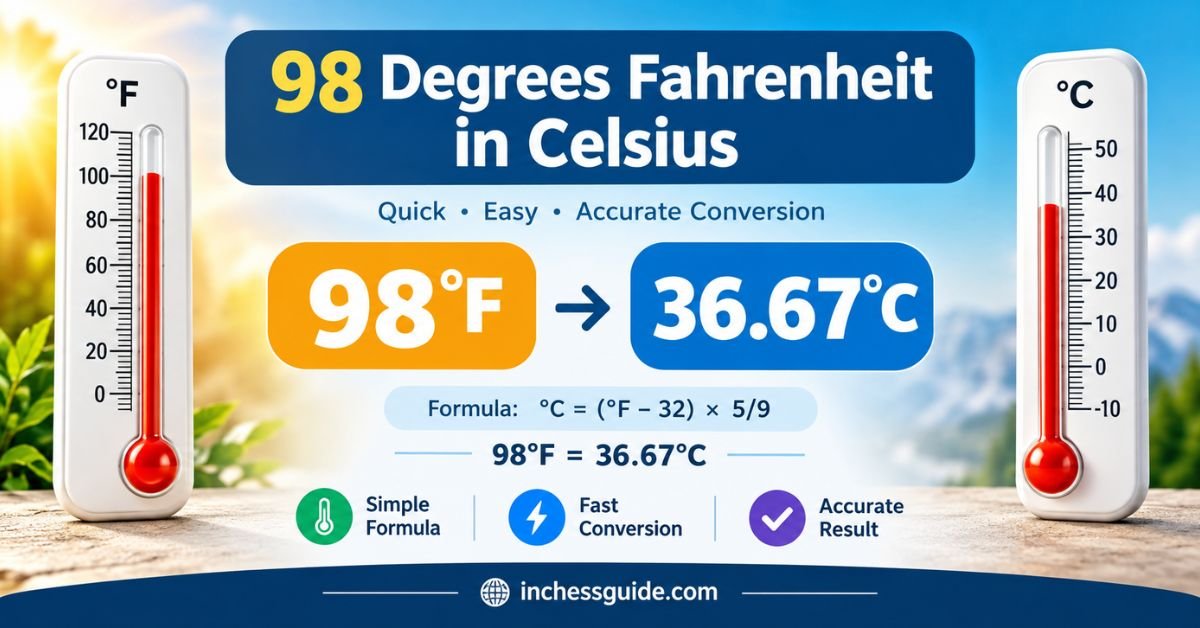
98 Degrees Fahrenheit in Celsius: 36.67°C (Quick Formula)
Quick Answer
98°F = 36.67°C (rounded to two decimal places).
The exact value is 36⅔°C, or 36.666…°C with the 6 repeating forever. Most people round it to 36.7°C. On a thermometer that shows one decimal place, that is the number you would expect to see.
The formula is:
°C = (°F − 32) × 5 ÷ 9
For 98°F: (98 − 32) × 5 ÷ 9 = 66 × 5 ÷ 9 = 330 ÷ 9 = 36.67°C.
How to Convert 98°F to Celsius Step by Step
The Fahrenheit and Celsius scales differ in two ways. Their zero points are in different places, and their degrees are different sizes. The formula handles both.
- Subtract 32. Water freezes at 32°F but at 0°C. Subtracting 32 shifts the Fahrenheit reading so both scales start from the same freezing point.
98 − 32 = 66 - Multiply by 5.
66 × 5 = 330 - Divide by 9. Between water’s freezing and boiling points there are 180 Fahrenheit degrees (32°F to 212°F) but only 100 Celsius degrees (0°C to 100°C). That gives a ratio of 100:180, which simplifies to 5:9.
330 ÷ 9 = 36.666…
Result: 98°F = 36.67°C, or about 36.7°C to one decimal place.
The same calculation with a decimal multiplier
You can also divide by 1.8, since 9 ÷ 5 = 1.8:
°C = (°F − 32) ÷ 1.8
(98 − 32) ÷ 1.8 = 66 ÷ 1.8 = 36.67°C
This version is easier on a basic calculator because it needs only two keystrokes after the subtraction.
Checking your answer by converting back
To confirm the result, convert Celsius back to Fahrenheit:
°F = (°C × 9 ÷ 5) + 32
(36.667 × 1.8) + 32 = 66 + 32 = 98°F
If you use the rounded figure of 36.67°C, the check gives 98.006°F. The tiny difference comes from rounding, not from an error in the conversion.
Rounded or Exact? How Much Precision You Need
The conversion of 98°F is not a terminating decimal. Which version you use depends on what you are doing.
| Format | Value | Best used for |
|---|---|---|
| Exact fraction | 36⅔°C (110/3) | Mathematics, where no precision may be lost |
| Two decimals | 36.67°C | Science homework, spreadsheets, general reference |
| One decimal | 36.7°C | Everyday use, most digital thermometers |
| Whole number | 37°C | Rough conversation only |
Rounding 36.67°C to 37°C is a difference of about 0.33°C, or roughly 0.6°F. That gap is harmless in casual talk about the weather. It matters when you track a health reading or follow a technical procedure, so keep the decimals in those cases.
98°F in Other Temperature Scales
Some readers need the result in a third scale, such as Kelvin for science classes.
- Kelvin: K = °C + 273.15, so 36.667 + 273.15 ≈ 309.82 K
- Celsius: 36.67°C
- Fahrenheit: 98°F
Kelvin uses the same size of degree as Celsius, so the only step is shifting the zero point. Kelvin values are written without a degree symbol.
Fahrenheit to Celsius Conversion Table Around 98°F
A table is useful here because temperatures near 98°F matter for body temperature, fever checks, and hot weather. All Celsius values below are rounded to two decimal places, except those that are exact.
| Fahrenheit (°F) | Celsius (°C) | Note |
|---|---|---|
| 95 | 35.00 | Exact |
| 96 | 35.56 | Rounded |
| 97 | 36.11 | Rounded |
| 97.7 | 36.50 | Exact |
| 98 | 36.67 | Rounded |
| 98.6 | 37.00 | Exact |
| 99 | 37.22 | Rounded |
| 100 | 37.78 | Rounded |
| 100.4 | 38.00 | Exact |
| 101 | 38.33 | Rounded |
| 102 | 38.89 | Rounded |
| 103 | 39.44 | Rounded |
Two patterns stand out. First, each 1°F step equals about 0.56°C, because a Fahrenheit degree is only 5/9 the size of a Celsius degree. Second, the exact whole-number matches are rare. Only temperatures that are 32°F plus a multiple of 9°F convert to a whole number of degrees Celsius, such as 95°F (35°C) and 104°F (40°C).
What Does 98°F Feel Like? Real-World Context
A number on its own does not say much, so here are the situations where 98°F usually comes up. All the comparisons below are approximate, and individual circumstances vary.
Human body temperature
This is the most common reason people search for this conversion. The long-quoted “normal” body temperature is 98.6°F, which is exactly 37°C. So 98°F (36.67°C) sits just below that traditional average.
Normal body temperature is a range, not a single number. It varies from person to person and during the day, and it depends on how you measure it (mouth, ear, forehead, armpit, or elsewhere). A reading of 98°F is within the range many healthy adults show on an oral thermometer. A fever is commonly defined as 100.4°F (38°C) or higher, but definitions vary by age and by guidance from health authorities. If you are concerned about a reading, or about a child or an older adult, talk to a doctor or pharmacist. A conversion table is not medical advice.
Outdoor weather
Outdoors, 98°F (36.67°C) is a very hot day by most standards. It is the sort of weather that brings heat warnings in many regions. Humidity matters a great deal here. The same air temperature feels much more oppressive in humid conditions because sweat evaporates more slowly, so a “feels like” or heat index figure can be considerably higher than the thermometer reading. If you are comparing a Fahrenheit forecast with a Celsius-based schedule, planning outdoor work, or travelling, remember that the reading comes from a thermometer in the shade and that direct sun can feel hotter.
Bath and pool water
Water at 98°F is close to body temperature, so it feels lukewarm to most people, neither cold nor hot. Many people find a warm bath more comfortable somewhat above this level. A bath that feels merely “pleasant” is often in the high 30s °C, though preferences differ, and children, older adults, and pregnant women should follow medical guidance about hot water. For hot tubs and spas, check the manufacturer’s instructions and any local safety guidance, and never rely on touch alone.
Heated rooms and enclosed spaces
Inside a closed car on a sunny day, a greenhouse, or a poorly ventilated attic, temperatures near 98°F are common and can climb higher. That is a reminder to use a real thermometer rather than guessing, especially where pets, children, or temperature-sensitive materials are involved.
How to Estimate Fahrenheit to Celsius in Your Head
Sometimes you do not have a calculator. These shortcuts help for quick estimates. They are not a substitute for the full formula when accuracy matters.
The “subtract 30 and halve” shortcut
Subtract 30 from the Fahrenheit number, then divide by 2.
(98 − 30) ÷ 2 = 34°C
The true answer is 36.67°C, so this shortcut is off by almost 2.7 degrees. It works better in the cool-to-mild range and gets worse as the temperature rises, which is why it is unreliable at 98°F.
A closer mental method
- Subtract 32: 98 − 32 = 66
- Halve it: 66 ÷ 2 = 33
- Add about 10% of that result: 33 + 3.3 = 36.3
This gives about 36.3°C, which is within roughly 0.4°C of the true value of 36.67°C. The method works because 5/9 is about 0.556, a little more than one half. The extra 10% of the halved value approximates that difference.
When not to estimate
Do not use shortcuts for health readings, laboratory work, cooking where food safety depends on a specific temperature, calibrating equipment, or any process with a specification. In those cases, use the exact formula, a calculator, or a thermometer that can display Celsius directly.
5 Common Mistakes When Converting 98°F
Multiplying before subtracting. Doing 98 × 5 ÷ 9 and then subtracting 32 gives a wrong answer. The subtraction must come first, inside the brackets. Done in the wrong order you get 54.44 − 32 = 22.44°C, which is badly wrong.
Using 9/5 instead of 5/9. The fraction 9/5 is for converting Celsius to Fahrenheit. Using it in the wrong direction gives 66 × 1.8 = 118.8, which is obviously too large for a Celsius value.
Rounding too early. If you round 36.666… to 36.6 partway through a longer calculation, errors can build up. Keep the full value until the end, then round.
Mixing up the scales for a reading. If a thermometer says 36.7 and you assume it is Fahrenheit, you will think someone is dangerously cold. Always check which unit a thermometer or appliance is using. Celsius body temperatures sit in the mid-to-high 30s, whereas Fahrenheit ones sit in the high 90s.
Treating temperature differences like temperatures. The offset of 32 applies only to temperature readings. A change of 98°F is not the same as a temperature of 98°F. A temperature change of 98 Fahrenheit degrees equals a change of 98 × 5/9 ≈ 54.44 Celsius degrees, with no subtraction of 32. This matters for questions like “how much did the temperature rise?”
Accuracy, Rounding and Reading Thermometers
A few practical points affect how you read and report this temperature:
- Scale size. One Fahrenheit degree is about 0.56°C. One Celsius degree is 1.8°F. A Fahrenheit thermometer therefore reports in finer steps than a whole-degree Celsius one.
- Display resolution. Many digital thermometers show Celsius to 0.1°C, which equals 0.18°F. A reading of 36.7°C and one of 36.6°C therefore differ by about 0.18°F, which is a bigger step than it looks.
- Instrument accuracy. A thermometer’s stated accuracy often has a tolerance of around a tenth of a degree or more. Showing two decimal places in a conversion does not mean the measurement itself is that precise.
- Measurement site. Oral, ear, forehead, and underarm readings are not interchangeable. Compare like with like, and follow the instructions for your device.
For anything where the reading has consequences, use a thermometer designed for the purpose, follow the manufacturer’s instructions, and let it settle for the specified time.
Related Conversions
The same formula applies across the whole scale. If you convert a few values around 98°F often, these are the ones people most commonly look up:
- 97°F is 36.11°C
- 99°F is 37.22°C
- 100°F is 37.78°C
- 98.6°F is exactly 37°C
If you often switch between the two scales, learn the anchor points: 32°F = 0°C, 68°F = 20°C, 98.6°F = 37°C, and 212°F = 100°C. Interpolating between them gives a quick sense check before you use the full formula.
Frequently Asked Questions
1: Is 98°F a normal body temperature?
For many healthy adults, yes. The traditional average is 98.6°F (37°C), but normal body temperature varies between people, throughout the day, and by measurement method. Seek medical advice if you are worried about a reading.
2: Is 98°F hot weather?
Yes. 98°F (36.67°C) is very hot air temperature in most places, and it can feel worse when humidity is high or when you are in direct sun.
3: Why is 98°F not a whole number in Celsius?
The Celsius and Fahrenheit scales use different degree sizes in a 5:9 ratio, so most Fahrenheit values convert to repeating decimals. 98°F gives 330 ÷ 9, which does not divide evenly.
4: How do I convert 98°F to Celsius on a calculator?
Type 98 − 32 = 66, then divide by 1.8. The answer is 36.67. Alternatively, multiply 66 by 5 and divide by 9 to get the same result.
5: What is 98°F in Kelvin?
About 309.82 K. Convert to Celsius first (36.67°C), then add 273.15.
6: Is 98°F the same as 37°C?
No, but they are close. 98°F is 36.67°C. The value that equals exactly 37°C is 98.6°F, so the two differ by 0.6°F, or about 0.33°C.
Explore More Continue Reading Our Guide on: Inchessguide.com
Conclusion
98 degrees Fahrenheit is 36.67°C, which most people round to 36.7°C. The conversion uses (°F − 32) × 5 ÷ 9, so always subtract 32 before multiplying. Remember that 98.6°F is the point that lands exactly on 37°C, so 98°F sits just under it.
3 Comments