101 Degrees Fahrenheit in Celsius: 38.3°C (Formula & Chart)
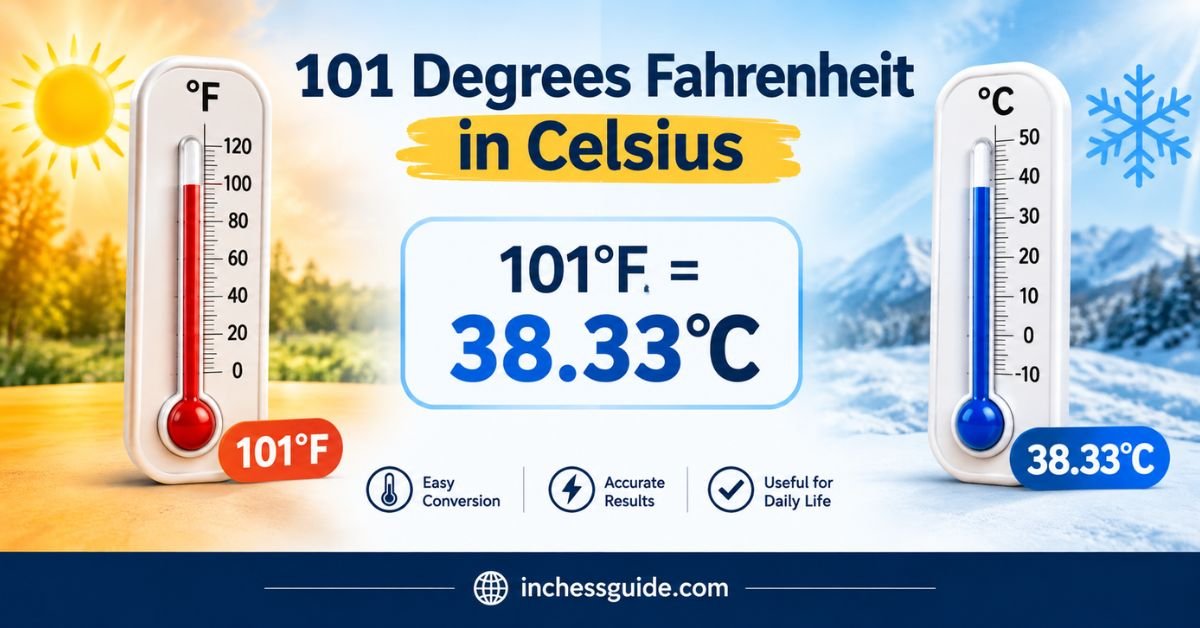
101°F is equal to 38.3°C when rounded to one decimal place. The exact value is 38.333…°C, with the 3 repeating forever. In everyday use, 38.3°C is the number you want.
On a thermometer, 101°F usually means one of two things. It is either a mild-to-moderate fever in a person or a hot summer day outdoors. This guide gives you the conversion, shows the arithmetic so you can repeat it, and explains how to round the result sensibly. It also covers what 101°F means in the situations where people most often look it up.
Quick Answer
| Fahrenheit | Celsius (exact) | Celsius (rounded) | Kelvin (rounded) |
|---|---|---|---|
| 101°F | 38.333…°C | 38.3°C | 311.48 K |
- Formula: °C = (°F − 32) × 5 ÷ 9
- Worked result: (101 − 32) × 5 ÷ 9 = 69 × 5 ÷ 9 = 345 ÷ 9 = 38.333…°C
- Rounded: 38.3°C is accurate enough for almost every practical purpose.
How to Convert 101°F to Celsius
The Fahrenheit and Celsius scales differ in two ways. Their zero points are in different places: water freezes at 32°F but at 0°C. Their degrees are also different sizes: 180 Fahrenheit degrees span the same range as 100 Celsius degrees, between freezing and boiling water at standard sea-level pressure. A correct conversion has to handle both differences, and the formula does that in two steps.
The formula in plain English
°C = (°F − 32) × 5 ÷ 9
- Subtract 32 to move the Fahrenheit reading onto a scale that starts at the freezing point of water.
- Multiply by 5 and divide by 9 to shrink the degrees to Celsius size. Each Celsius degree is 1.8 times larger than a Fahrenheit degree, so you scale by 5/9, which is the same as dividing by 1.8.
Step-by-step example
- Start with the Fahrenheit reading: 101°F
- Subtract 32: 101 − 32 = 69
- Multiply by 5: 69 × 5 = 345
- Divide by 9: 345 ÷ 9 = 38.333…
- Round if you need to: 38.3°C
Dividing by 1.8 instead gives the same answer: 69 ÷ 1.8 = 38.333…
Check your answer by converting back
Reversing the conversion is a quick way to catch mistakes. The Celsius-to-Fahrenheit formula is °F = °C × 9 ÷ 5 + 32 (equivalently, °C × 1.8 + 32).
- Using the exact value: 38.333… × 1.8 = 69, and 69 + 32 = 101°F ✓
- Using the rounded value: 38.3 × 1.8 = 68.94, and 68.94 + 32 = 100.94°F, which is 101°F to the nearest whole degree ✓
If a reverse check lands far from your starting number, one of the steps above went wrong.
Accuracy and Rounding
The Fahrenheit-to-Celsius relationship is defined by the formula above, so the result for exactly 101°F is exactly 345/9 °C. That value cannot be written as a finite decimal, which is why every decimal version is a rounded approximation.
How much rounding is acceptable depends on the task:
- 38.33°C (two decimals) suits scientific or technical notes.
- 38.3°C (one decimal) matches the precision of most household digital thermometers, which typically display a tenth of a degree.
- 38°C (whole number) is fine for weather talk but loses detail for health readings.
Rounding to the nearest whole degree matters more than it looks. 38°C is exactly 100.4°F, not 101°F. Rounding 38.3°C down to 38°C understates the reading by about 0.6°F. If a thermometer reading is being recorded or reported, keep the tenth of a degree.
101°F Conversion Chart: Nearby Temperatures
This chart helps when a reading is slightly above or below 101°F. All Celsius values are rounded to one decimal place.
| Fahrenheit | Celsius |
|---|---|
| 98.6°F | 37.0°C |
| 99°F | 37.2°C |
| 100°F | 37.8°C |
| 100.4°F | 38.0°C |
| 101°F | 38.3°C |
| 101.5°F | 38.6°C |
| 102°F | 38.9°C |
| 103°F | 39.4°C |
| 104°F | 40.0°C |
| 105°F | 40.6°C |
Each 1°F change corresponds to about 0.56°C, so each 0.1°F step is only about 0.06°C. That is why 101.0°F and 101.5°F differ by just 0.3°C.
What Does 101°F Mean? Fever and Body Temperature
Most people searching this conversion are checking a thermometer reading from a person who feels unwell. This is general information, not medical advice.
Is 101°F a fever?
Public health agencies commonly treat a temperature of 100.4°F (38°C) or higher as a fever. At 101°F (38.3°C), a person is above that line, so 101°F is generally considered a low-grade to moderate fever in adults and older children. The commonly cited average for normal body temperature is about 98.6°F (37°C). Individual baselines vary by a degree or so across people and times of day.
When it matters more
- Infants: Guidance for very young babies is stricter than for adults. A reading of 100.4°F (38°C) or higher in an infant under about three months is commonly advised to be reported to a healthcare provider promptly. Do not wait for it to reach 101°F.
- Adults: Many health organizations suggest seeking care if a fever reaches much higher levels (often cited around 103°F, or 39.4°C), lasts several days, or comes with severe symptoms. Details vary, so follow the advice of your own clinician or local health service.
- Existing conditions: If someone has a medical condition, a weakened immune system, or other risk factors, the threshold for calling a professional may be lower.
The number alone does not describe how sick someone is. Symptoms, age, and how long the fever lasts all matter, and a doctor or pharmacist can help interpret them.
Thermometer type changes the reading
The same person can show slightly different numbers depending on where and how the temperature is taken. Oral, ear, forehead, armpit, and rectal readings are not interchangeable, and rectal readings usually run a bit higher than armpit readings. Use the same method each time when tracking a fever, and follow the instructions that came with your thermometer.
101°F in Other Everyday Situations
Hot weather
An outdoor temperature of 101°F is 38.3°C, a very hot day in most places. Heat exposure at this level carries real risk, especially with humidity, direct sun, or physical effort. Hydration, shade, and breaks matter. If a forecast is given in Fahrenheit and you think in Celsius, 38.3°C is the number to compare against.
Water temperature
Water at 101°F is warm but not scalding. It is a few degrees above body temperature (about 37°C). Hot tubs are generally advised not to exceed 104°F (40°C), so 101°F falls below that common upper limit. If you are filling a tub for a child, an older adult, or someone with a health condition, check the water with a thermometer rather than by hand.
Pets
For dogs, a commonly cited normal temperature range is about 100.5–102.5°F (roughly 38.1–39.2°C). That means 101°F (38.3°C) is normal for a dog, whereas the same number is a fever in a person. Vets are the right source for temperature advice about a particular animal, since normal ranges vary by species and individual.
How to Visualize 101°F on the Celsius Scale
Reference points help you decide how hot a number really is. The values below are standard anchors; room temperature is a typical range rather than a single fixed figure.
| Reference point | °F | °C |
|---|---|---|
| Water freezes (standard pressure) | 32°F | 0°C |
| Typical comfortable room | about 68–72°F | about 20–22°C |
| Commonly cited average body temperature | 98.6°F | 37.0°C |
| This article’s temperature | 101°F | 38.3°C |
| Water boils (standard sea-level pressure) | 212°F | 100°C |
101°F sits about 1.3°C above average body temperature and roughly 17 to 18°C above a comfortable room. That gap explains why 101°F is noticeable as a fever and hot as a weather reading.
Converting a Temperature Change vs. a Temperature Reading
A common mistake appears when you convert how much a temperature changed rather than a temperature itself. A rise from 98.6°F to 101°F is 2.4°F. To express a difference in Celsius, do not subtract 32. Just multiply by 5/9:
2.4 × 5 ÷ 9 = 1.333…°C
That matches the difference between the two converted readings: 38.333… − 37.0 = 1.333…°C ✓
The 32-degree offset only applies to points on the scale, not to gaps between them.
5 Common Mistakes When Converting 101°F
- Skipping the subtraction. 101 × 5 ÷ 9 = 56.1, which is far too high. The 32 must come off first.
- Using the wrong fraction. Multiplying by 9/5 instead of 5/9 gives 124.2. That is the Celsius-to-Fahrenheit factor, not the one needed here.
- Wrong order of operations. Computing (101 × 5 ÷ 9) − 32 gives 24.1, which is also wrong. Subtract first, then scale.
- Using the “subtract 30 and halve” shortcut. This gives 35.5°C, which is more than 2.8°C off. It only works roughly near cool temperatures and should never be used for health readings.
- Rounding to 38°C. As covered above, that corresponds to 100.4°F, not 101°F.
Quick Mental Estimates
For a rough sense of a Fahrenheit temperature without a calculator, subtract 32, halve the result, then add about a tenth of that half:
- 101 − 32 = 69
- Half of 69 = 34.5
- A tenth of 34.5 ≈ 3.5
- Estimate: 34.5 + 3.5 = 38°C
The true value is 38.3°C, so the estimate is within half a degree. It is useful for judging weather or deciding whether a number sounds hot. It is not a substitute for the exact formula when you are recording a medical reading, calibrating equipment, or following a technical procedure.
Taking an Accurate Temperature Reading
If your 101°F figure came from a thermometer, a few habits help the reading be reliable:
- Use a thermometer meant for the purpose. Clinical digital thermometers are designed for body temperature, while kitchen and weather thermometers are not.
- Follow the placement instructions. Wait for the signal or beep before reading, and do not take a temperature right after a hot drink, exercise, or a hot bath.
- Stay consistent. Use the same thermometer and method when comparing readings over time.
- Keep it clean and calibrated. Clean it as instructed, and replace it if readings seem unreliable.
- Note the unit setting. Many digital thermometers can switch between °F and °C. Confirm which one is displayed before relying on the number.
A device that shows both units will do the conversion for you, but it helps to know the formula so you can sanity-check what it displays.
Frequently Asked Questions
1: What is 101°F in Kelvin?
101°F is about 311.48 K. First convert to Celsius (38.333…°C), then add 273.15: 38.333… + 273.15 = 311.483…
2: What are 101.3°F and 101.5°F in Celsius?
101.3°F is 38.5°C and 101.5°F is about 38.6°C. Each additional 0.1°F adds roughly 0.056°C.
3: Why is the Celsius number smaller than the Fahrenheit number?
Fahrenheit starts its scale lower, with freezing at 32°F rather than 0°C, and its degrees are smaller (1°C equals 1.8°F). For temperatures well above freezing, the Fahrenheit number is therefore larger.
4: Does the type of thermometer change what 101°F means?
It can. Oral, ear, forehead, armpit, and rectal methods typically produce slightly different readings for the same person, so use the method recommended by the thermometer’s maker and stay consistent.
5: Is 101°F too hot for a hot tub?
It is below the commonly advised hot tub limit of 104°F (40°C), but people with health conditions, young children, and pregnant women should follow medical guidance on water temperature and soak time.
Explore More Continue Reading Our Guide on: 98 Degrees Fahrenheit in Celsius
99 Degrees Fahrenheit in Celsius
100 Degrees Fahrenheit in Celsius
Conclusion
101°F converts to 38.3°C, from the exact calculation (101 − 32) × 5 ÷ 9 = 38.333…°C. Keep the tenth of a degree for health readings, because 38°C corresponds to 100.4°F, not 101°F. Remember to subtract 32 before scaling by 5/9, and use a proper thermometer rather than an estimate whenever the number matters.