120 Minutes in Hours: The Exact Answer, Formula and Examples
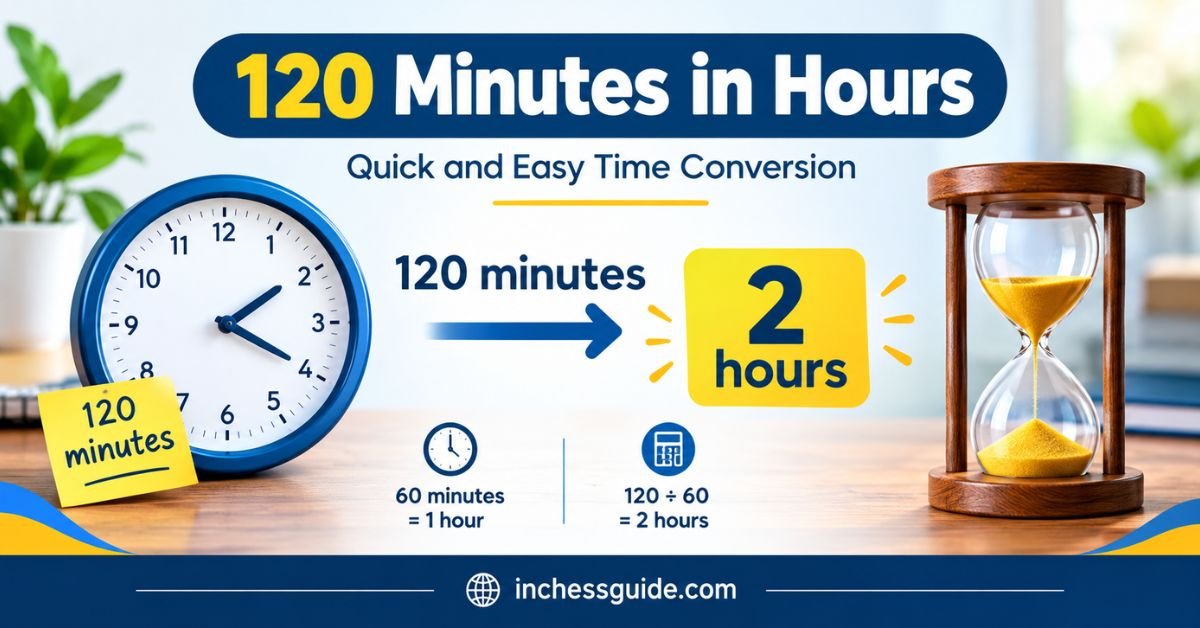
120 minutes is exactly 2 hours. The conversion is exact, not rounded, because an hour is defined as 60 minutes and 120 divided by 60 is a whole number.
Quick Answer
| Minutes | Hours |
|---|---|
| 120 min | 2 h |
Formula: hours = minutes ÷ 60
Calculation: 120 ÷ 60 = 2
So 120 minutes is 2 hours, 0 minutes, or 2.0 in decimal hours. It is also 7,200 seconds.
How to Convert Minutes to Hours
The conversion rests on one fact: 1 hour = 60 minutes. Time units are not decimal, so converting minutes to hours means dividing by 60, not by 10 or 100.
The formula
Hours = Minutes ÷ 60
The reverse is just as simple:
Minutes = Hours × 60
Step-by-step method
- Write down the number of minutes. Here it is 120.
- Divide by 60.
- Read the result. If it is a whole number, that is the number of hours. If it has a remainder, you can show it as leftover minutes or as a decimal.
For 120 minutes:
120 ÷ 60 = 2
There is no remainder, so the answer is exactly 2 hours.
A quick mental shortcut
Because 120 is double 60, you can see the answer without a calculator: 60 minutes is one hour, so 120 minutes is two hours. The same trick works for any multiple of 60. For example, 180 minutes is 3 hours and 240 minutes is 4 hours.
Common Minutes-to-Hours Conversions
This table shows the values readers most often look up near 120 minutes. Decimal values are rounded to four decimal places where they do not terminate, and the rounded ones are marked.
| Minutes | Hours and minutes | Decimal hours |
|---|---|---|
| 15 min | 0 h 15 min | 0.25 h |
| 30 min | 0 h 30 min | 0.5 h |
| 45 min | 0 h 45 min | 0.75 h |
| 60 min | 1 h 0 min | 1 h |
| 90 min | 1 h 30 min | 1.5 h |
| 105 min | 1 h 45 min | 1.75 h |
| 120 min | 2 h 0 min | 2 h |
| 135 min | 2 h 15 min | 2.25 h |
| 150 min | 2 h 30 min | 2.5 h |
| 180 min | 3 h 0 min | 3 h |
| 240 min | 4 h 0 min | 4 h |
Every value in this table is exact because each number of minutes divides evenly into hundredths of an hour. Not every conversion is this tidy, as the next section shows.
Hours and Minutes vs. Decimal Hours
Time can be written two ways, and mixing them up is the most common source of errors.
- Hours and minutes (such as 2 h 30 min) uses base-60 minutes.
- Decimal hours (such as 2.5 h) expresses the same time as a single base-10 number.
For 120 minutes the two formats give the same clean result, 2 hours, but they diverge for many other values.
Converting leftover minutes to a decimal
To turn minutes into decimal hours, divide by 60.
| Minutes | Calculation | Decimal hours |
|---|---|---|
| 5 min | 5 ÷ 60 | 0.0833 h (rounded) |
| 10 min | 10 ÷ 60 | 0.1667 h (rounded) |
| 12 min | 12 ÷ 60 | 0.2 h (exact) |
| 20 min | 20 ÷ 60 | 0.3333 h (rounded) |
| 40 min | 40 ÷ 60 | 0.6667 h (rounded) |
| 50 min | 50 ÷ 60 | 0.8333 h (rounded) |
A slightly harder example
Suppose you want to convert 275 minutes to hours.
- 275 ÷ 60 = 4 with a remainder of 35, so 275 minutes is 4 hours 35 minutes.
- For decimal hours, 35 ÷ 60 ≈ 0.5833, so 275 minutes ≈ 4.5833 hours (rounded).
Payroll and billing systems often round to two decimal places, so 4 hours 35 minutes is commonly recorded as 4.58 hours. If you are filling in a timesheet, check how your employer or client wants fractions of an hour rounded.
How to Visualize 120 Minutes
Two hours can feel abstract, so it helps to anchor it to familiar activities. These comparisons are approximate, because real durations vary.
- A feature-length film. Many films run roughly 90 to 150 minutes, so a 120-minute film is a typical length. Individual films vary widely.
- Two class periods. If a lesson lasts 60 minutes, 120 minutes covers two of them back to back. School and course schedules differ, so treat this as an illustration, not a standard.
- A short drive. At a steady 60 km/h, two hours covers 120 km. At 50 mph, it covers 100 miles. Real journeys change with traffic, stops, and road conditions, so this is a planning estimate only.
- A slow-cooked dish. Some braises, roasts, and baked dishes call for about two hours in the oven. Always follow the specific recipe, since times depend on the cut, size, and oven.
- A fitness benchmark. The World Health Organization’s general guidance for adults is 150 to 300 minutes of moderate-intensity physical activity per week, so 120 minutes is a little under the lower end of that weekly range.
These examples show scale. They are not rules about how long any given task must take.
Practical Uses of the 120 Minutes to 2 Hours Conversion
Scheduling and calendars
Calendar apps often show meeting lengths in minutes, while people plan their day in hours. A 120-minute workshop is a 2-hour block. If it starts at 3:15 PM, it ends at 5:15 PM. Simply add 2 hours to the start time.
Timesheets and billing
If you bill at an hourly rate, you need decimal hours. For 120 minutes the decimal is 2.0 h, so at a rate of 25 per hour the charge is 2 × 25 = 50 (in whatever currency applies). This case is easy because there is no fraction. For a 125-minute job, the time is 2 h 5 min ≈ 2.0833 h, and rounding rules start to matter.
Travel and speed
Speed is usually given per hour, so durations in minutes need converting before you multiply. The formula is:
Distance = Speed × Time (in hours)
If you travel at 80 km/h for 120 minutes, convert first: 120 min = 2 h, so distance = 80 × 2 = 160 km. Using 120 directly would wrongly give 9,600 km.
Study and work planning
Study sessions, exam durations, and focus blocks are often written in minutes. A 120-minute exam is a 2-hour exam. Converting helps when you want to compare it with a schedule that is written in hours.
Cooking and baking
Recipes mix units, such as “bake for 120 minutes” in one book and “bake for 2 hours” in another. They mean the same thing. For timing-sensitive cooking, use a timer rather than estimating, because a small error can change the result.
5 Common Mistakes to Avoid
1. Dividing by 100 instead of 60.
Time is not a decimal system. 120 ÷ 100 = 1.2, which is wrong. The correct figure is 120 ÷ 60 = 2.
2. Confusing 1.2 hours with 1 hour 20 minutes.
1.2 hours means 1 hour plus 0.2 of an hour, and 0.2 × 60 = 12 minutes, so 1.2 h = 1 h 12 min. It is not 1 h 20 min. This mistake appears in timesheets all the time.
3. Reading 2.5 hours as 2 hours 50 minutes.
The decimal part is a fraction of an hour. 0.5 × 60 = 30, so 2.5 hours is 2 hours 30 minutes.
4. Forgetting to convert before using a per-hour rate.
Whether it is speed, pay, or any other hourly rate, convert minutes to hours first.
5. Rounding too early.
For values like 10 minutes (0.1667 h), keep extra decimals during a calculation and round only the final answer.
Accuracy, Rounding, and Clock Time
The conversion from 120 minutes to 2 hours is exact. No rounding is involved, because the relationship between minutes and hours is fixed by definition.
Two practical points are worth knowing:
- Duration vs. clock time. 120 minutes is a length of time. Clock time is a position on the clock. If you start at 11:30 PM, 120 minutes later is 1:30 AM the next day.
- Daylight saving changes. On the days when clocks move forward or back, an interval of 2 hours elapsed time may not match a 2-hour difference on the clock face. For critical scheduling around those dates, use a calendar tool that handles time zones and daylight saving.
For measuring real elapsed time, such as timing an experiment or a workout, use a stopwatch or timer. A visual estimate of how much time has passed is not reliable enough for anything that depends on precision.
120 Minutes in Other Time Units
| Unit | Value | Calculation |
|---|---|---|
| Hours | 2 h | 120 ÷ 60 |
| Seconds | 7,200 s | 120 × 60 |
| Days | 0.0833 days (rounded; exactly 1/12) | 120 ÷ 1,440 |
There are 1,440 minutes in a day (24 × 60), which is why 120 minutes is one-twelfth of a day.
Frequently Asked Questions
1: Is 120 minutes exactly 2 hours?
Yes. Since 1 hour is 60 minutes, 120 ÷ 60 = 2 exactly, with no remainder and no rounding.
2: How do I convert any number of minutes to hours?
Divide the minutes by 60. If there is a remainder, it is the leftover minutes. For example, 150 ÷ 60 = 2 remainder 30, which is 2 hours 30 minutes, or 2.5 hours in decimal form.
3: What is 120 minutes in hours and minutes?
It is 2 hours and 0 minutes, usually written simply as 2 hours.
4: What is 2 hours in minutes?
Multiply by 60: 2 × 60 = 120 minutes.
5: Why is 1.2 hours not 120 minutes?
Because 1.2 is a decimal-hours figure. 1.2 hours equals 1 hour plus 0.2 × 60 = 12 minutes, which is 72 minutes in total. The number 120 in “120 minutes” is a count of minutes, not a decimal of an hour.
6: How many seconds are in 120 minutes?
There are 7,200 seconds (120 × 60).
Explore More Continue Reading Our Guide on: 90 Minutes in Hours?
Conclusion
120 minutes equals exactly 2 hours, found by dividing the minutes by 60. Because 120 is a clean multiple of 60, the answer needs no remainder or rounding, in either hours-and-minutes or decimal form. When converting other values, remember that time works in base 60, so a decimal such as 2.5 hours means 2 hours 30 minutes, not 2 hours 50 minutes.