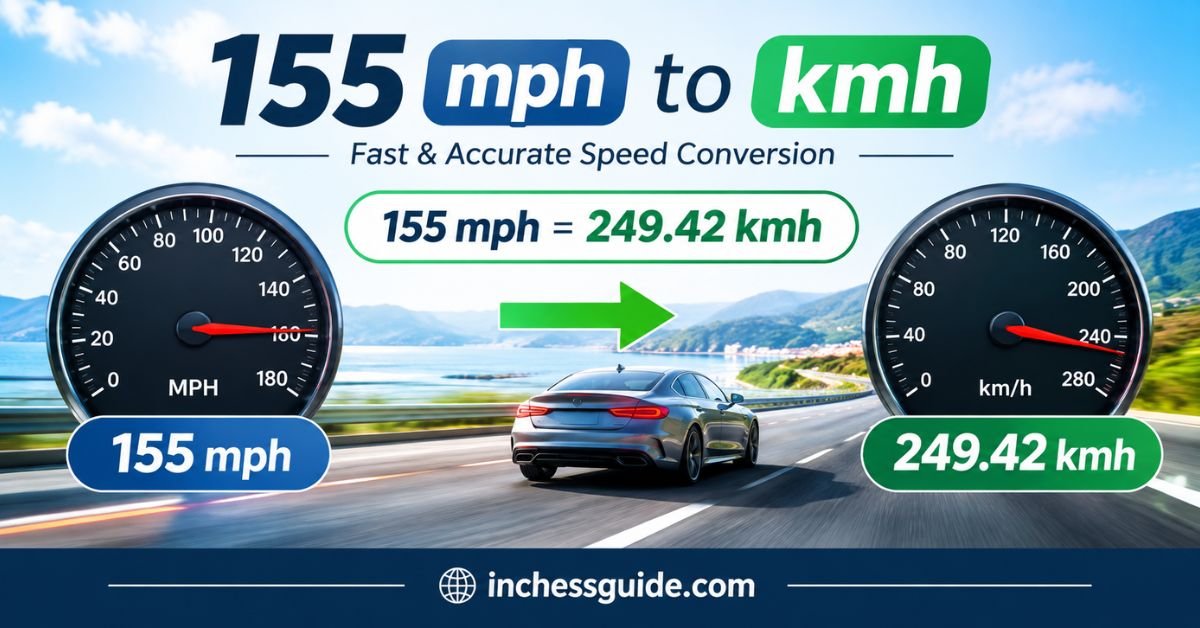
155 mph to kmh: = 249.45 km/h | Formula & Quick Conversion
Quick Answer
155 mph = 249.448 km/h (exactly 249.44832 km/h).
- Rounded to two decimals: 249.45 km/h
- Rounded to a whole number: 249 km/h
- Quick mental estimate: 155 × 1.6 ≈ 248 km/h
A speed of 155 miles per hour means covering 155 miles in one hour. In metric terms, that is about 249.45 kilometers in one hour.
The unit is usually written “km/h” (kilometers per hour). Searchers often type “kmh” or “kph”, but “km/h” is the standard symbol, and this article uses it throughout.
The Formula for Converting mph to km/h
The conversion rests on the definition of the international mile, which is exactly 1.609344 kilometers. Because an hour is the same length in both units, the time part cancels, and the factor applies directly to speed:
km/h = mph × 1.609344
Worked example for 155 mph:
- Start with the speed: 155 mph
- Multiply by the conversion factor: 155 × 1.609344
- Calculate: 155 × 1.609344 = 249.44832
- Attach the correct unit: 249.44832 km/h
Split into parts, the multiplication is easy to check:
- 155 × 1.6 = 248
- 155 × 0.009344 = 1.44832
- 248 + 1.44832 = 249.44832
The factor 1.609344 is exact by definition, so 249.44832 km/h is the exact value. The shorter forms (249.45 or 249) are rounded. For most uses, such as comparing speeds or reading a spec sheet, 249.45 km/h is more than precise enough.
Reversing the Conversion
To go from km/h back to mph, divide by 1.609344 or multiply by about 0.621371:
mph = km/h ÷ 1.609344
Check: 249.44832 ÷ 1.609344 = 155 mph.
Conversion Table: Speeds Around 155 mph
The table shows nearby speeds so you can see how 155 mph fits into the range. Values are rounded to two decimal places.
| Miles per hour (mph) | Kilometers per hour (km/h) |
|---|---|
| 100 | 160.93 |
| 120 | 193.12 |
| 140 | 225.31 |
| 150 | 241.40 |
| 155 | 249.45 |
| 160 | 257.50 |
| 175 | 281.64 |
| 200 | 321.87 |
Each extra 1 mph adds about 1.61 km/h. That is why 155 mph sits about 8 km/h above 150 mph (241.40 km/h), and why the gap between rows grows steadily rather than jumping.
Mental-Math Shortcuts
You do not always have a calculator to hand. These methods get close quickly.
Multiply by 1.6. Since 1.609344 is very close to 1.6, this is the simplest approach.
- 155 × 1.6 = 248 km/h
- The true answer is 249.45 km/h, so the shortcut is about 1.45 km/h low (roughly 0.6%).
Multiply by 8, then divide by 5. This is the same as multiplying by 1.6, but some people find it easier.
- 155 × 8 = 1,240
- 1,240 ÷ 5 = 248 km/h
Add 60% to the mph number. This is also the same idea.
- 60% of 155 = 93
- 155 + 93 = 248 km/h
Improve accuracy with a small correction. Because the shortcut runs about 0.6% low, add roughly 0.6% of the answer: 0.6% of 248 is about 1.5, giving about 249.5 km/h. That lands within a fraction of a km/h of the exact figure.
These shortcuts suit everyday estimation, such as reading a foreign car review or following a weather report. For engineering, regulatory or technical documents, use the full factor and state the rounding you applied.
155 mph in Other Speed Units
Different fields use different units. Here is 155 mph expressed in the most common alternatives (rounded):
| Unit | Value for 155 mph |
|---|---|
| Kilometers per hour (km/h) | 249.45 |
| Meters per second (m/s) | 69.29 |
| Feet per second (ft/s) | 227.33 |
| Knots (kn) | 134.69 |
How each was found:
- Meters per second: 155 × 0.44704 = 69.2912 m/s. The factor 0.44704 is exact. Equivalently, 249.44832 km/h ÷ 3.6 gives the same result.
- Feet per second: 155 × 5,280 ÷ 3,600 = 227.33 ft/s, since a mile is 5,280 feet and an hour is 3,600 seconds.
- Knots: One knot is exactly 1.852 km/h, so 249.44832 ÷ 1.852 ≈ 134.69 kn.
Knots are used in aviation and marine navigation, and meters per second appears in physics and meteorology. Mixing these units up is a common source of errors, which the mistakes section covers below.
How Fast Is 155 mph? Visualizing the Speed
A number like 249 km/h is hard to feel. Breaking it into distance per unit of time helps.
| Time | Distance at 155 mph |
|---|---|
| 1 second | about 69.3 m (227 ft) |
| 10 seconds | about 693 m |
| 1 minute | about 4.16 km (2.58 mi) |
| 1 hour | 155 miles (249.45 km) |
Going the other way:
- One mile takes about 23.2 seconds.
- One kilometer takes about 14.4 seconds.
- A 100-meter stretch passes in about 1.44 seconds.
Everyday Comparisons
These comparisons use approximate, commonly cited figures. Real values vary with conditions and equipment.
- Highway driving. A highway limit of 100 km/h is roughly 62 mph. At 155 mph you would be moving about 2.5 times faster. At 120 km/h (about 75 mph), you would be going roughly twice as fast.
- Sprinting. The fastest human sprinters reach peak speeds of roughly 44 km/h (about 27–28 mph) for brief moments. A vehicle at 155 mph moves more than five times faster.
- High-speed rail. Japan’s Tokaido Shinkansen operates at up to 285 km/h, which is about 177 mph. So 155 mph is slower than the fastest bullet trains but in the same general league as many intercity high-speed services.
- Airliners at takeoff. Many airliners lift off at roughly 250–290 km/h (about 155–180 mph), depending on aircraft type and weight. That means 155 mph is in the range of a jet’s takeoff run.
Why Speed Feels Different Than the Number Suggests
Distance covered is only part of the story. The energy of a moving object grows with the square of its speed. Compared with 70 mph, a vehicle at 155 mph is moving about 2.2 times as fast but carries nearly five times the kinetic energy: (155 ÷ 70)² ≈ 4.9. Braking distances rise by a similar squared relationship. This is one reason high speeds are far more demanding than a simple proportional increase suggests.
Where You Will See 155 mph
The 250 km/h Limiter on European Cars
One of the most common reasons people look up this conversion is car specifications. Many performance cars from German manufacturers are electronically limited to 250 km/h, a limit widely reported to come from a voluntary industry agreement. In mph, 250 km/h is 155.34 mph, which is why “155 mph” appears so often on spec sheets for these vehicles.
Note the small difference: 155 mph is 249.45 km/h, just under 250 km/h. If a car is listed as “limited to 155 mph,” it is typically referring to this same 250 km/h figure, rounded down.
Hurricane Wind Speeds
Under the Saffir-Simpson Hurricane Wind Scale, Category 4 covers sustained winds of 130–156 mph (about 209–251 km/h), and Category 5 begins at 157 mph (about 252 km/h). A storm with 155 mph sustained winds therefore sits at the top of Category 4, just 2 mph below Category 5. Agency advisories commonly report wind speeds in 5 mph increments, so 155 mph is a figure you may well see in storm coverage.
Motorsport
Top-level racing cars routinely exceed 155 mph on fast circuits, and some series exceed it by a wide margin on high-speed ovals. For fans reading international coverage, converting between mph and km/h is a regular task.
A Note on Public Roads
155 mph is far above legal speed limits on public roads in essentially every country, and limits differ by country and road type, so always check local rules. Speeds like this belong on closed tracks with appropriate safety equipment.
Accuracy, Rounding and Measuring Speed
Choose rounding to match the purpose. For a conversation or a news article, 249 km/h is clear. For a table, 249.45 km/h is neat. For technical documentation, keep 249.448 km/h or the full 249.44832 km/h, and say how many decimals you used.
Do not confuse a calculated conversion with a measured speed. The conversion from 155 mph to 249.44832 km/h is exact arithmetic. Measuring a real vehicle’s speed is a different matter, because instruments have tolerances.
- Speedometers are generally built to read slightly high rather than low under typical regulatory rules. At very high speeds, the displayed value can differ noticeably from true speed.
- GPS-based speed is usually closer to true ground speed because it derives speed from position changes, though signal quality and update rate matter.
- Radar and laser devices used by authorities are calibrated for the purpose, but they are separate instruments with their own tolerances.
If an exact figure matters, such as for a record attempt, a safety assessment or a regulatory test, use calibrated instruments rather than relying on a dashboard reading or a visual estimate. Visual estimation of speed is unreliable, especially at higher speeds.
6 Common Mistakes When Converting 155 mph to km/h
- Using 1.6 and treating the answer as exact. 248 km/h is a good estimate, but the exact answer is 249.448 km/h. The gap is small here but grows with larger speeds.
- Swapping the direction. Multiplying km/h by 1.609344 instead of dividing gives a number that is far too large. Remember that kilometers are shorter than miles, so a speed in km/h is a bigger number than the same speed in mph.
- Confusing km/h with m/s. 155 mph is about 69.29 m/s, not 249 m/s. To go from km/h to m/s, divide by 3.6.
- Mixing up mph and knots. A knot is a nautical mile per hour, and a nautical mile is 1.852 km, not 1.609 km. 155 knots would be about 287 km/h, not 249 km/h.
- Treating 155 km/h as 155 mph. They are different speeds. 155 km/h is about 96.31 mph, and 155 mph is about 249.45 km/h.
- Writing “kmh” in formal text. The correct symbol is km/h. “kph” is informal and can be misread.
Frequently Asked Questions
1: Is 155 mph the same as 155 km/h?
No. 155 mph is about 249.45 km/h, while 155 km/h is about 96.31 mph. Miles are longer than kilometers, so the same number in mph is a much higher speed.
2: How many meters per second is 155 mph?
About 69.29 m/s. Multiply 155 by 0.44704, or divide the km/h value (249.44832) by 3.6.
3: Is the 155 mph limit on some cars the same as 250 km/h?
It is essentially the same limit. 250 km/h equals 155.34 mph, which is usually rounded to 155 mph in specifications. The exact conversion of 155 mph is 249.45 km/h, slightly below 250 km/h.
4: How far do you travel in one hour at 155 mph?
You would cover 155 miles, which is 249.45 km, assuming a constant speed for the full hour.
5: How long does it take to travel one mile at 155 mph?
About 23.2 seconds. Divide 3,600 seconds by 155 to get 23.23 seconds per mile.
6: Which is more accurate: multiplying by 1.6 or by 1.609344?
Multiplying by 1.609344 is exact. Multiplying by 1.6 is a convenient estimate that runs about 0.6% low, which for 155 mph means 248 km/h instead of 249.45 km/h.
Explore More Continue Reading Our Guide on: 225 mph to kmh
175 mph to kmh
Conclusion
155 mph converts to 249.448 km/h, usually written as 249.45 km/h or about 249 km/h. The exact factor is 1.609344 km per mile, and multiplying by 1.6 gives a quick estimate of 248 km/h. Keep in mind that 155 mph sits just under the 250 km/h mark, and that 155 km/h is a very different speed of about 96 mph.