
How Much Is 6 Liters of Water in Gallons? (1.585 Gal Answer)
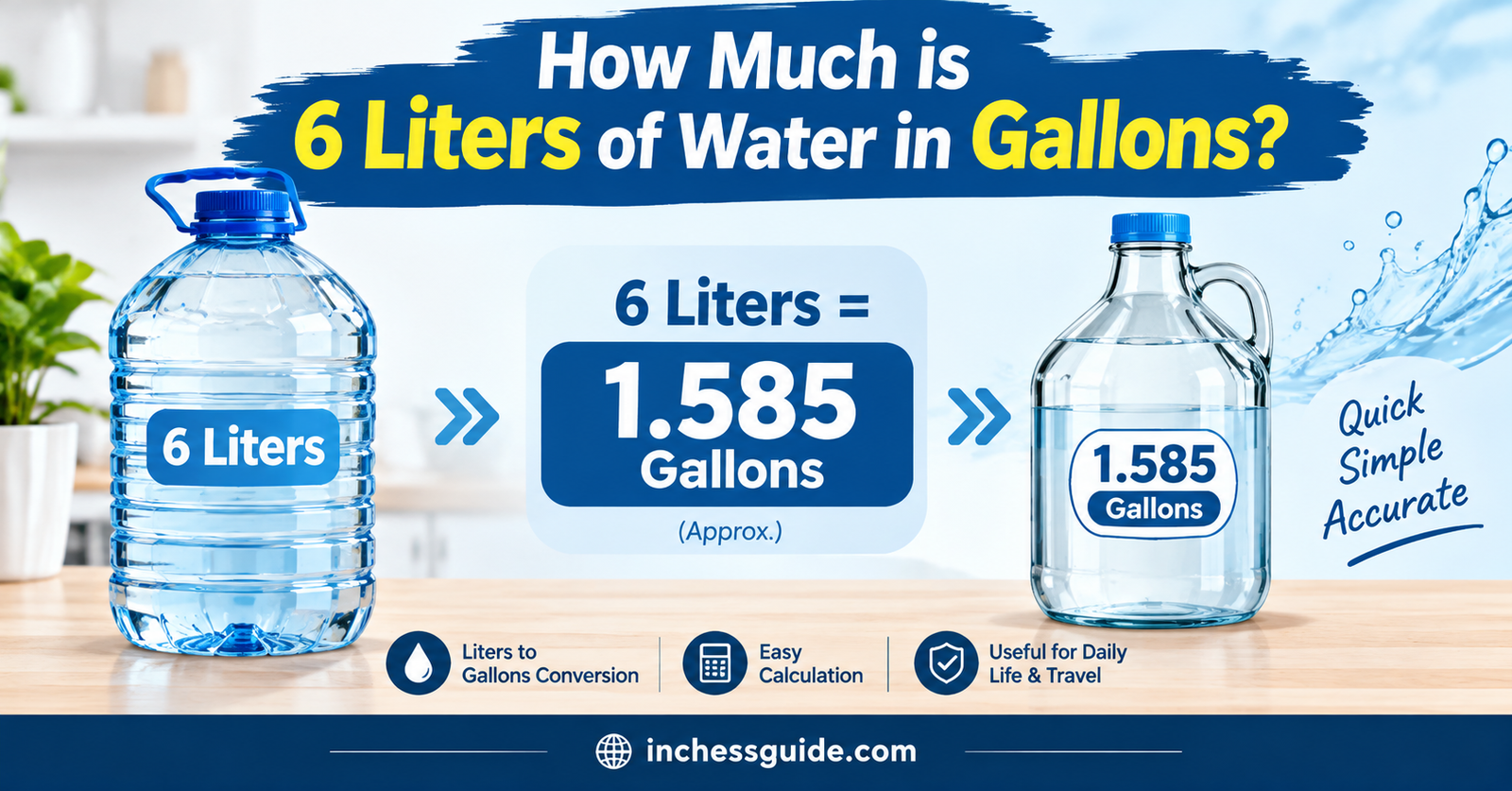
Six liters of water is about 1.585 US gallons. In imperial (UK) gallons, it is about 1.320 gallons.
Quick Answer
| Unit | 6 liters equals |
|---|---|
| US liquid gallons | 1.585 gal (rounded) |
| Imperial gallons | 1.320 gal (rounded) |
| US quarts | 6.340 qt |
| US cups | 25.36 cups |
| US fluid ounces | 202.9 fl oz |
| Milliliters | 6,000 mL (exact) |
All US values are rounded. The liter-to-gallon relationship is defined exactly, but the decimal results go on indefinitely, so some rounding is always needed.
For a quick mental estimate, 6 liters is a little under 1.6 US gallons. Put another way, it is one full gallon plus about 2.3 quarts.
What Does the Question Mean?
“How much is 6 liters of water in gallons?” is a volume conversion. It asks how much space 6 liters of water takes up, expressed in gallons. The word “water” does not change the math. A liter of milk, fuel, or paint also converts to the same number of gallons, because the conversion compares units of volume.
Water matters in one situation: if you want to know how heavy the water is. We cover that later, because weight and volume are different quantities.
How to Convert 6 Liters to Gallons
The US liquid gallon is defined as exactly 3.785411784 liters. To convert liters to US gallons, divide by that number:
Gallons = Liters ÷ 3.785411784
Applied to this question:
6 ÷ 3.785411784 = 1.58503… US gallons
You can also multiply by the reciprocal. One liter equals about 0.264172 US gallons:
6 × 0.264172 = 1.585032 US gallons
Both methods give 1.585 gallons when rounded to three decimal places.
Which Method Is Easier?
Use whichever your calculator handles best. Multiplying by 0.264172 takes one step and is easy to remember as “about a quarter gallon per liter.” Dividing by 3.7854 works well if you already think of a gallon as roughly 3.8 liters.
Converting to Imperial Gallons
The imperial gallon is a different, larger unit. It is defined as exactly 4.54609 liters:
6 ÷ 4.54609 = 1.3198… imperial gallons
That rounds to 1.320 imperial gallons. The imperial gallon is about 20% larger than the US gallon, so the same 6 liters gives a smaller number of imperial gallons.
A Handy Liters-to-Gallons Table
This table shows nearby values so you can scale the answer up or down. Values are rounded to four decimal places and use the US liquid gallon.
| Liters | US gallons |
|---|---|
| 1 L | 0.2642 gal |
| 2 L | 0.5283 gal |
| 3 L | 0.7925 gal |
| 4 L | 1.0567 gal |
| 5 L | 1.3209 gal |
| 6 L | 1.5850 gal |
| 7 L | 1.8492 gal |
| 8 L | 2.1134 gal |
| 10 L | 2.6417 gal |
You can also work backward. If a recipe, tank, or container is labeled in gallons, these values show the equivalent in liters:
| US gallons | Liters |
|---|---|
| 1 gal | 3.785 L |
| 1.5 gal | 5.678 L |
| 1.585 gal | 6.000 L (rounded) |
| 2 gal | 7.571 L |
How to Visualize 6 Liters of Water
Numbers like 1.585 gallons are accurate but hard to picture. These everyday comparisons make the volume easier to grasp. Container sizes vary by brand and region, so treat each one as approximate unless a label states the volume.
A US gallon milk jug. A standard US milk jug holds 1 gallon, or about 3.785 liters. Six liters is roughly one and a half of these jugs, with a little extra. If you fill a jug once, then fill it again about 60% of the way, you are close to 6 liters.
1.5-liter water bottles. Large bottled water is commonly sold in 1.5 L sizes. Four of them hold 6 liters. This is one of the easiest ways to check your estimate at home, since the volume is printed on the label.
2-liter soda bottles. Three 2 L bottles equal 6 liters exactly. If you have a few empty ones, you can use them as a simple measuring set.
500 mL bottles. The standard single-serve bottle in many countries holds 500 mL. It takes twelve of them to make 6 liters.
A 5-gallon water cooler bottle. A typical 5-gallon bottle holds about 18.9 liters. Six liters is a little under one third of it.
A 2-gallon bucket. A 2-gallon bucket holds about 7.57 liters when filled to the brim. Six liters would fill it to roughly 80% of its capacity. Bucket shapes and fill lines vary, so this works only as a rough guide.
6 Liters of Water in Other Units
Sometimes gallons are not the unit you need. Here is how the same 6 liters converts to other common measures.
US quarts: A gallon has 4 quarts, so 1.585032 × 4 = 6.340 quarts.
US pints: There are 8 pints in a gallon, so 1.585032 × 8 = 12.68 pints.
US cups: There are 16 cups in a gallon, so 1.585032 × 16 = 25.36 cups.
US fluid ounces: There are 128 fluid ounces in a gallon, so 1.585032 × 128 = 202.9 fl oz.
Watch for one common trap with fluid ounces. The US fluid ounce (about 29.57 mL) and the imperial fluid ounce (about 28.41 mL) are different sizes. Recipes and labels from the UK may use the imperial version.
How Much Does 6 Liters of Water Weigh?
Volume and weight are separate things, but water has a convenient relationship between them. Under the common reference conditions, one liter of water has a mass of about one kilogram. That makes 6 liters of water about 6 kg, or roughly 13.2 pounds.
This is an approximation because the density of water changes slightly with temperature. Near 4°C, water is at its densest. At about 20°C (room temperature), its density is slightly lower, so 6 liters has a mass of roughly 5.99 kg. For household purposes, 6 kg is accurate enough.
The same logic works for the US gallon. A US gallon of water weighs a little over 8.3 pounds, and 1.585 gallons comes to about 13.2 pounds. Keep in mind that this shortcut works for water only. Cooking oil, fuel, and syrup have different densities, so a liter of each weighs something different.
When Does This Conversion Matter?
The conversion turns up in everyday situations where metric and US measurements meet.
Aquariums and fish bowls. Small tanks and bowls are often sold in gallons, while water conditioners and guides may use liters. Knowing that 6 liters is about 1.6 gallons helps when you size a container for a small setup.
Camping and hiking. Water reservoirs and bags may be labeled in liters, while trip planning guides often use gallons. Because 6 liters weighs about 13 pounds, it is also a useful number to know when deciding how much water you can carry.
Cooking and food preparation. Large recipes, brining, and stock-making often involve several liters of liquid. Converting to gallons or quarts helps if your pots and containers are marked in US units.
Gardening and plant care. Watering cans and sprayers are sold in both liter and gallon sizes. Converting lets you follow instructions written for either system.
Travel and shopping. Imported containers, water filters, and dispensers may show liters only. A quick conversion helps you compare them with products labeled in gallons.
Estimate or Measure?
You can use the “about 1.6 gallons” estimate for casual tasks, such as filling a bucket for cleaning or watering plants. A small error will not matter there.
For anything that depends on precision, measure instead of estimating. Examples include mixing concentrated chemicals, preparing fertilizer, following a treatment guide for an aquarium or pond, or any process where the label specifies an exact ratio. In those cases, use a graduated measuring jug or a container with clearly marked volume lines. Check the manufacturer’s instructions as well. If the instructions are written in gallons, convert carefully and measure with a tool rather than judging the amount by eye.
Also remember that container fill lines are not always exact. A jug marked “1 gallon” may have a brim capacity slightly larger than its labeled volume, and bottles are often filled to a level below the very top.
5 Common Mistakes to Avoid
Mixing up US and imperial gallons. This is the most frequent source of error. If a UK source says “gallon,” it usually means the imperial gallon of 4.546 liters. Using the wrong one changes your answer by about 20%.
Rounding a gallon to 4 liters. Saying “4 liters per gallon” is a common shortcut, but it gives 1.5 gallons for 6 liters instead of 1.585. That is about a 5% error, which can matter for larger volumes. Using 3.785 gives a much closer result.
Confusing liquid and dry gallons. The US also has a dry gallon of about 4.405 liters, used historically for dry goods. For water and other liquids, always use the liquid gallon of 3.785 liters.
Treating liters and kilograms as the same thing. They are close for water, but they measure different things. Do not apply the one-liter-equals-one-kilogram rule to other liquids without checking their density.
Rounding too early. If your result feeds into further calculations, keep extra decimal places until the final step. Rounding 1.585 to 1.6 before multiplying can add noticeable error.
Accuracy and Rounding
The conversion factor 3.785411784 liters per US gallon is exact by definition. The result of 6 divided by that number is not a terminating decimal, so every written answer is rounded.
- 1.585 gallons is suitable for most practical purposes.
- 1.6 gallons works for a rough estimate.
- 1.58503 gallons is useful if you need more precision in a calculation.
The number you choose should match the purpose. A home cook filling a pot can use 1.6. Someone preparing a precisely measured solution should use a measuring tool rather than rely on a rounded gallon value.
Frequently Asked Questions
1: Is 6 liters more than a gallon?
Yes. A US gallon is about 3.785 liters, so 6 liters is roughly 1.585 gallons. Even the larger imperial gallon of 4.546 liters is smaller than 6 liters.
2: How many 16 oz bottles of water make 6 liters?
A 16 US fluid ounce bottle holds about 473 mL. Dividing 6,000 mL by 473.18 mL gives about 12.7 bottles. Because bottle labels are sometimes rounded, check the actual volume printed on the bottle.
3: Is 6 liters of water enough for a day?
That depends on the purpose, whether it is drinking, cooking, camping, or something else, and on the person, the climate, and activity level. This article covers the conversion only. For drinking water guidance, consult a health authority or medical professional.
4: How many gallons is 6 liters in the UK?
In the UK, a gallon usually means the imperial gallon of 4.54609 liters. Six liters is about 1.320 imperial gallons.
5: What is 6 liters in quarts?
Six liters equals about 6.34 US quarts, since a US quart is 0.946353 liters. In imperial quarts, it is about 5.28.
6: Can I use the same conversion for other liquids?
Yes for volume. Six liters of any liquid is about 1.585 US gallons. The weight will differ, though, because only water has the convenient one-kilogram-per-liter relationship.
Explore More Continue Reading Our Guide on: Inchessguide.com
Conclusion
Six liters of water equals about 1.585 US gallons, or about 1.320 imperial gallons. In everyday terms, that is a gallon jug plus roughly another 60% of a jug. For quick estimates, “about 1.6 gallons” works well, and for anything precise, measure with a marked container rather than relying on a rounded number.
2 Comments