4 Liters of Water in Gallons: 1.057 US Gallons (Easy Guide)
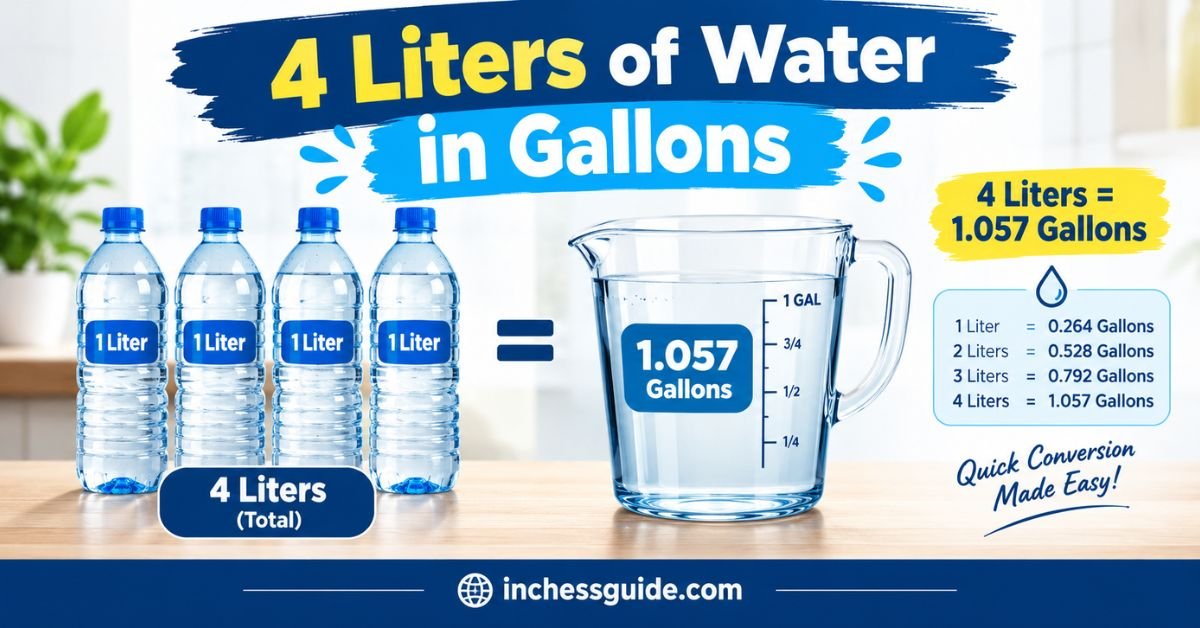
4 liters of water is about 1.057 US gallons, or about 0.880 imperial (UK) gallons. In US usage, 4 liters is slightly more than one gallon: it is one full gallon plus roughly 7.3 US fluid ounces.
The conversion is the same for any liquid, because liters and gallons both measure volume. Water only matters when you also want to know the weight, which is covered further down.
Quick Answer
- 4 L = 1.0567 US gallons (rounded to four decimal places)
- 4 L = 0.8799 imperial gallons (rounded to four decimal places)
- 4 L ≈ 1 US gallon + 7.26 US fluid ounces
- 4 L of water weighs about 4 kg (roughly 8.8 lb) at normal temperatures
For most everyday purposes, “a little over 1 gallon” or “about 1.06 gallons” is accurate enough. If you are following a recipe, dosing a product, or filling equipment where the amount matters, use the more precise figure and a proper measuring container.
How to Convert Liters to Gallons
The formula
The US liquid gallon is defined as exactly 231 cubic inches, which equals exactly 3.785411784 liters. The conversion therefore works in either direction:
Gallons = liters ÷ 3.785411784
or, using the reciprocal:
Gallons = liters × 0.264172052
Worked example for 4 liters
4 ÷ 3.785411784 = 1.056688…
Rounded, that is 1.0567 US gallons. Multiplying gives the same result:
4 × 0.264172052 = 1.056688…
In plain English, one gallon holds about 3.79 liters, so 4 liters is a little more than one gallon. The extra amount is 4 − 3.785412 = 0.214588 liters, or about 215 milliliters.
Checking the answer in reverse
A good habit is to convert back and see whether you land on the starting figure:
1.056688 gallons × 3.785411784 = 4.0000 liters
If your reverse result does not match, one of the steps contains an error. The most common cause is using the wrong gallon, which the next section explains.
A mental shortcut
If you need a quick estimate without a calculator, remember that 1 gallon is about 3.8 liters. Anything near 4 liters is therefore “about a gallon, plus a splash.” This shortcut slightly underestimates, because 4 liters is about 5.7% larger than a US gallon, so do not use it where precision matters.
4 Liters in US Gallons vs Imperial Gallons
“Gallon” does not mean the same thing everywhere. This is the single biggest source of confusion in liters-to-gallons conversions.
| Gallon type | Exact size in liters | 4 liters equals |
|---|---|---|
| US liquid gallon | 3.785411784 L | 1.0567 gal |
| Imperial (UK) gallon | 4.54609 L | 0.8799 gal |
The imperial gallon is about 20% larger than the US gallon. That is why 4 liters is more than one US gallon but less than one imperial gallon.
Which one should you use? If you are reading a US recipe, a US product label, or a US aquarium or water-cooler specification, use the US gallon. If the source is a UK document, an older Commonwealth specification, or a vehicle manual that mentions “imp. gal,” use the imperial gallon. When a source just says “gallon” and is American, assume the US liquid gallon.
The US system also has a separate dry gallon (about 4.405 liters), which is rarely used and is not relevant to water.
4 Liters Expressed in Other Common Units
Gallons are not always the most useful unit, especially in the kitchen or when comparing bottled water sizes. Here is what 4 liters equals in other common volume units, rounded for readability:
| Unit | 4 liters equals |
|---|---|
| US quarts | 4.2268 qt |
| US pints | 8.4535 pt |
| US cups | 16.907 cups |
| US fluid ounces | 135.26 fl oz |
| Milliliters | 4,000 mL |
| Imperial quarts | 3.5195 qt |
These values use the US customary cup of about 236.588 milliliters and the US fluid ounce of about 29.5735 milliliters. Note that a “cup” on a nutrition label (240 mL) or a metric cup (250 mL) is slightly different, so cup counts will vary a little depending on the standard used.
Because 1 US gallon equals exactly 128 US fluid ounces, you can see the split clearly: 135.26 − 128 = 7.26 fluid ounces more than one gallon.
Liters to US Gallons: Nearby Values
A short reference table helps if you are scaling a quantity up or down. All values are rounded to four decimal places.
| Liters | US gallons |
|---|---|
| 1 L | 0.2642 gal |
| 2 L | 0.5283 gal |
| 3 L | 0.7925 gal |
| 4 L | 1.0567 gal |
| 5 L | 1.3209 gal |
| 6 L | 1.5850 gal |
| 8 L | 2.1134 gal |
| 10 L | 2.6417 gal |
Every row follows the same pattern: multiply the number of liters by 0.264172 to get US gallons. The table is only a convenience, so for any other volume, use the formula above.
How to Picture 4 Liters of Water
Numbers like “1.0567 gallons” are hard to feel. These comparisons make the quantity concrete. They use standard container sizes, but real products vary by brand and country, so treat them as guides rather than guarantees.
- Four 1-liter bottles. This is the most direct comparison, because 4 × 1 L is exactly 4 L.
- Eight 500 mL bottles. The common half-liter water bottle is a nominal size of 500 mL, so eight of them hold a nominal 4 liters.
- Two 2-liter soda bottles. Many drinks are sold in 2-liter bottles, so two of them equal 4 liters. This is a handy way to picture the volume if you are used to buying drinks in that size.
- A US gallon milk jug, plus a glass. A standard US gallon jug holds 3.785 liters. To reach 4 liters, you would need to add about 215 mL, which is a bit less than a typical drinking glass. So 4 liters of water would slightly overfill a one-gallon jug.
- About 17 US cups. If you count measuring cups, 4 liters comes to just under 17 cups.
The gallon-jug comparison is the most useful for US readers. If your container is labeled “1 gallon,” 4 liters will not fit completely, and about 215 mL of water will be left over.
Volume vs Weight: How Much Does 4 Liters of Water Weigh?
Gallons and liters measure volume, not weight. Water is a convenient exception because its density is close to 1 kilogram per liter, so the volume and mass line up neatly.
Water reaches its maximum density at about 4 °C, where 1 liter has a mass of almost exactly 1 kilogram. At typical room temperature (around 20 °C), the density is slightly lower, about 0.998 kg per liter. For 4 liters:
- At about 4 °C: roughly 4.00 kg
- At about 20 °C: roughly 3.99 kg
In pounds, 4 kilograms equals about 8.82 lb. For everyday use, “4 liters of water weighs about 4 kg, or just under 9 lb” is a sound approximation. For comparison, a full US gallon of water weighs around 8.3 lb, so the extra 215 mL accounts for the small difference.
This shortcut works only for water. Oil, milk, syrup, and other liquids have different densities, so 4 liters of them will not weigh 4 kg. The volume conversion to gallons is unaffected, but you cannot assume the weight.
Where This Conversion Is Useful
You are most likely to meet a 4-liter quantity in situations like these:
- Cooking and brewing. A recipe may call for a gallon of water while your measuring jug is marked in liters. Since 4 L is slightly over a gallon, you can use 3.8 L for a US gallon without a noticeable difference in most stock, brine, or tea recipes.
- Bottled and bulk water. Large water jugs are often sold in 4-liter sizes in some markets, while US products use 1-gallon containers. Comparing them directly shows you are getting a little extra with the 4-liter jug.
- Aquariums and small tanks. Very small fish bowls and nano setups are often described in gallons in the US and in liters elsewhere, so converting between the two helps when following care guides.
- Gardening and watering. Product instructions for fertilizers and plant treatments are often written “per gallon.” If you measure water in liters, you need the exact conversion to dilute correctly.
- Travel and sports. Water-carrying guidance, hydration packs, and camping equipment often mix liters and gallons.
For products that require precise dilution, such as plant treatments, cleaning concentrates, or pool chemicals, follow the label and measure carefully. Do not rely on an eyeball estimate or a rounded figure when the ratio affects safety or results.
How to Measure 4 Liters of Water Accurately
If you need exactly 4 liters, the right tool depends on how accurate you must be.
- Use a marked measuring jug. A large graduated jug or container with clear liter markings is the simplest method. Place it on a level surface and read the liquid level at eye height, using the bottom of the curved surface (the meniscus).
- Use known bottle sizes. Pour in four 1-liter bottles or two 2-liter bottles. This is reliable if the bottles are sealed and labeled with their volume.
- Weigh it. On a kitchen scale, 4 liters of room-temperature water is about 3.99 kg. This works only for water and requires you to subtract the weight of the empty container (tare the scale first).
- Use a gallon jug and add the extra. If you only have a US gallon container, fill it, then add about 215 mL (a little under 7.3 fluid ounces).
A visual estimate is fine for casual use, such as watering a plant. It is not suitable when the volume affects a chemical mix, a medical preparation, or equipment that has a strict fill requirement.
5 Common Mistakes and Rounding
Mixing up US and imperial gallons. Using 4.546 liters instead of 3.785 liters will give you 0.88 gallons instead of 1.057 gallons, which is a large error. Always check which gallon your source uses.
Over-rounding. Calling 4 liters “exactly 1 gallon” overstates how close they are. The real difference is about 5.7%, or roughly 215 mL. That may not matter for watering plants, but it can in a recipe or a product mix.
Confusing volume with weight. 4 liters is a volume. Saying it “equals 4 kg” is only a good approximation for water, and it is not part of the volume-to-gallon conversion.
Inconsistent rounding. Decide how many decimals you need and stay consistent. In this article, 1.0567 gallons is shown to four decimal places, 1.057 to three, and 1.06 to two. They are all the same value expressed at different levels of precision.
Mixing cup standards. The number of cups in 4 liters changes slightly depending on whether you use the US customary cup, the 240 mL labeling cup, or the 250 mL metric cup.
Frequently Asked Questions
1: Is 4 liters more or less than a gallon?
In the US system, 4 liters is slightly more than 1 gallon (1.0567 gal). In the imperial system, it is less than a gallon (0.8799 gal).
2: How many 8-ounce glasses are in 4 liters?
4 liters is about 135.26 US fluid ounces, which equals about 16.9 glasses of 8 US fluid ounces each.
3: How many half-gallons is 4 liters?
A US half-gallon is about 1.893 liters, so 4 liters is roughly 2.11 half-gallons.
4: Does 4 liters of water weigh the same as 4 liters of other liquids?
No. Water is close to 1 kg per liter, but other liquids have different densities, so their weight will differ even though the volume is the same.
5: Does the conversion change for hot or cold water?
The volume conversion does not change, because a liter is a liter. The weight changes very slightly with temperature, but not enough to matter in everyday use.
6: What is the simplest way to remember this conversion?
Remember that 1 US gallon is about 3.8 liters. Then 4 liters is “a gallon plus a little more,” which is about 1.06 gallons.
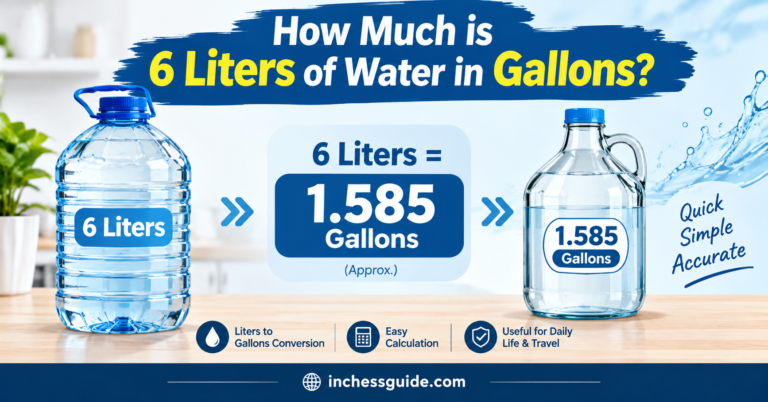
Explore More Continue Reading Our Guide on: How Much Is 6 Liters of Water in Gallons?
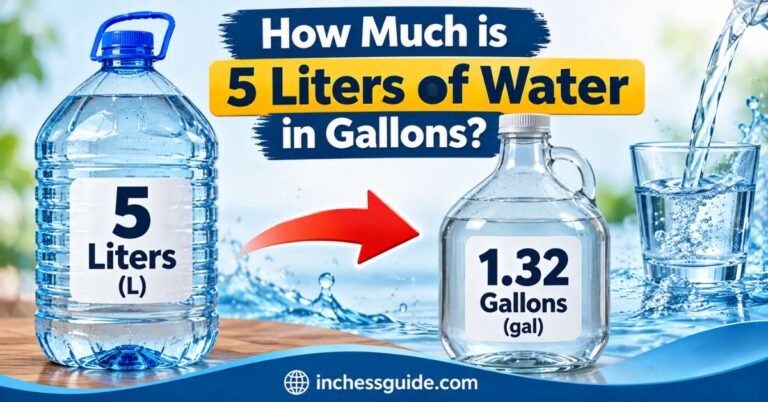
How Much Is 5 Liters of Water in Gallons?
Conclusion
4 liters of water equals about 1.057 US gallons, which is one gallon plus roughly 215 mL (about 7.3 fluid ounces). If your source uses imperial gallons, the same amount is about 0.88 gallons. For precise tasks, use a graduated container and the exact factor of 3.785411784 liters per US gallon.