
225 mph to kmh: 362.10 km/h (Formula and Examples)
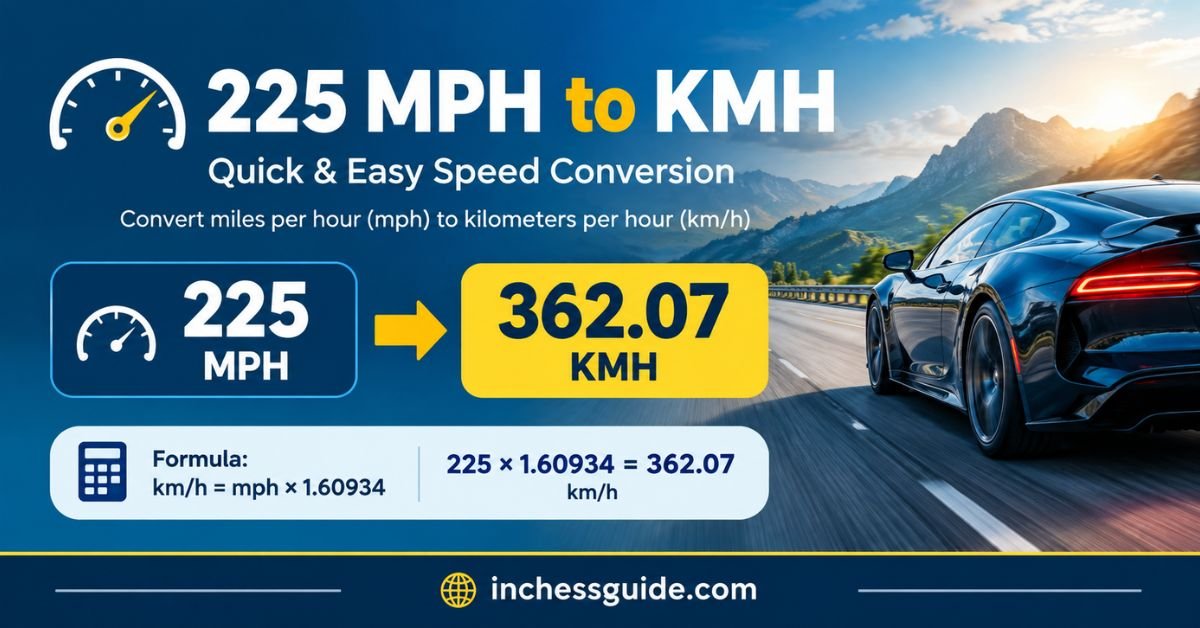
225 miles per hour (mph) equals 362.1024 kilometers per hour (km/h). Rounded to two decimal places, that is 362.10 km/h. For everyday use, “about 362 km/h” is accurate enough.
Quick Answer
| Speed in mph | Speed in km/h |
|---|---|
| 225 mph | 362.1024 km/h (exact) |
| 225 mph | 362.10 km/h (rounded to 2 decimals) |
| 225 mph | about 362 km/h (rounded to a whole number) |
This is a very high speed. At 225 mph you cover one mile in 16 seconds and one kilometer in just under 10 seconds.
Many people type this query as “225 mph to kmh”. The standard symbol is km/h, and that is the form used in this article.
How to Convert 225 mph to km/h
The conversion between miles and kilometers is exact by definition. The international mile is defined as exactly 1,609.344 meters, which is exactly 1.609344 kilometers. Because both mph and km/h are measured per hour, the time unit cancels out and you only need to convert the distance.
Formula:
km/h = mph × 1.609344
Worked example:
- Start with the speed: 225 mph.
- Multiply by the conversion factor: 225 × 1.609344.
- Split the multiplication to check it:
- 200 × 1.609344 = 321.8688
- 25 × 1.609344 = 40.2336
- 321.8688 + 40.2336 = 362.1024
- Result: 225 mph = 362.1024 km/h.
Because the factor 1.609344 is exact, 362.1024 is also exact. Only the shortened versions (362.10 or 362) are rounded.
Converting back from km/h to mph
To reverse the conversion, divide by 1.609344:
mph = km/h ÷ 1.609344
Check: 362.1024 ÷ 1.609344 = 225 mph.
You will often see the factor 0.621371 used instead (1 km/h ≈ 0.621371 mph). This is a rounded value. It works for quick calculations, but it can shift the last decimal places of a result, so use 1.609344 when precision matters.
A Quick Mental Shortcut
You do not always need a calculator. A good approximation is to multiply the mph value by 1.6, which is the same as multiplying by 8 and dividing by 5.
- 225 × 1.6 = 360 km/h
The true value is 362.1024 km/h, so the shortcut is about 0.6% low. If you want a closer estimate, take your result and add roughly one-half of one percent. For 360 km/h, that is about 2 km/h more, which gives 362 km/h.
This shortcut is fine for understanding a speed in conversation, comparing vehicles, or reading a news article. It is not appropriate for engineering, official records, or anything where the exact value matters.
mph to km/h Conversion Table Around 225 mph
The table below shows speeds near 225 mph so you can see where this value sits. Values are rounded to two decimal places.
| mph | km/h |
|---|---|
| 100 | 160.93 |
| 150 | 241.40 |
| 175 | 281.64 |
| 200 | 321.87 |
| 210 | 337.96 |
| 220 | 354.06 |
| 225 | 362.10 |
| 230 | 370.15 |
| 240 | 386.24 |
| 250 | 402.34 |
Each additional 10 mph adds about 16.09 km/h. That is why a speed that sounds only slightly higher in mph looks noticeably larger in km/h.
225 mph in Other Speed Units
Different fields use different units. Here is 225 mph expressed in the units you are most likely to meet:
| Unit | 225 mph equals |
|---|---|
| Kilometers per hour (km/h) | 362.1024 |
| Meters per second (m/s) | 100.584 |
| Feet per second (ft/s) | 330 |
| Knots (kn) | about 195.52 |
How these were calculated:
- Meters per second: 1 mph = 0.44704 m/s exactly, so 225 × 0.44704 = 100.584 m/s.
- Feet per second: there are 5,280 feet in a mile and 3,600 seconds in an hour, so 225 × 5,280 ÷ 3,600 = 330 ft/s exactly.
- Knots: 1 knot is exactly 1.852 km/h, so 362.1024 ÷ 1.852 ≈ 195.52 knots (rounded).
Knots measure nautical miles per hour, not statute miles per hour. A knot is not the same as an mph, so do not swap them.
What 225 mph Looks Like: Distance and Time
A number alone can be hard to picture. Breaking the speed into distance and time makes it more concrete.
| Time at a constant 225 mph | Distance covered |
|---|---|
| 1 second | 330 ft (100.584 m) |
| 10 seconds | 3,300 ft (1,005.84 m) |
| 1 minute | 3.75 miles (6.035 km) |
| 10 minutes | 37.5 miles (60.35 km) |
| 1 hour | 225 miles (362.10 km) |
These figures give you some useful anchors:
- One mile takes 16 seconds (3,600 ÷ 225 = 16).
- One kilometer takes about 9.94 seconds (1,000 m ÷ 100.584 m/s).
- A marathon (42.195 km) would take about 7 minutes at a constant 225 mph, compared with a few hours for a human runner.
In a single second you travel about 100 meters, which is roughly the length of a full-size football (soccer) pitch. Pitch sizes vary, so treat that as an approximate comparison, not an exact measurement.
Real-World Comparisons for 225 mph
Speeds are easier to understand when set against things you know. The comparisons below are approximate and are labeled that way because real-world values depend on the vehicle, conditions, and source.
Motorsport. Top-level open-wheel oval racing, such as IndyCar at large speedways, involves lap speeds in and above this range. Qualifying averages at the Indianapolis Motor Speedway have been well above 225 mph in recent years, though the exact figure varies by year and session. Driving at 225 mph on a closed, purpose-built circuit is very different from the same speed on a public road.
Passenger cars. Very few road cars can reach 225 mph. Most are limited by design or electronics to speeds far below that. Even where a car is capable of it, doing so is only appropriate on a closed track or dedicated test facility.
High-speed trains. The fastest conventional high-speed trains in regular passenger service run at roughly 320 to 350 km/h, which is about 199 to 217 mph. At 362.10 km/h, 225 mph is slightly faster than that, which shows how demanding this speed is for ground transport.
Aircraft. Many airliners lift off at somewhere around 150 to 185 mph, depending on aircraft type, weight, and conditions. So 225 mph is faster than a typical airliner’s takeoff speed but far below its cruising speed, which is commonly in the region of 500 mph or more at altitude.
Severe weather. The National Hurricane Center classifies a Category 5 hurricane as having sustained winds of 157 mph (about 252 km/h) or higher. A 225 mph wind is roughly 43% above that threshold. Wind speeds this extreme are associated with the most violent tornadoes and exceed typical hurricane intensity.
Animals. The peregrine falcon is often cited as the fastest animal in a hunting dive, with figures commonly quoted at or above 200 mph. Reported numbers vary between sources and measurement methods, so treat this as an approximate comparison.
Where You Might Need This Conversion
Converting 225 mph to km/h comes up in several situations:
- Motorsport coverage. US events report speeds in mph, while international audiences expect km/h.
- Vehicle specifications. Manufacturer top-speed claims may be listed in either unit depending on the market.
- Travel and engineering. Comparing rail, aviation, or vehicle data from countries that use different units.
- Education. Physics and math problems often require converting between unit systems.
- Weather reports. Wind speeds are published in mph in the US and km/h in much of the rest of the world.
When you only need to understand a speed, a rounded value is fine. When you are comparing technical specifications, writing a report, or entering a value into software, use the exact figure and state your rounding.
Accuracy and Rounding
The conversion from 225 mph to 362.1024 km/h is exact because the mile is defined exactly in terms of the meter. The question is how many decimals to show.
- 362.1024 km/h: the exact result. Use it for calculations that feed into other calculations.
- 362.10 km/h: a good choice for tables and general reading.
- 362 km/h: suitable for conversation and headlines.
Be aware of two other sources of difference:
- Rounded conversion factors. If you use 1.61 instead of 1.609344, you get 362.25 km/h, which is about 0.15 km/h too high. That difference is small for casual use but could matter in technical work.
- Measurement accuracy. A speed quoted as “225 mph” is usually itself rounded. The real speed might have been 224.6 or 225.4 mph, so the converted figure inherits that uncertainty.
If a speed matters for safety, engineering, or official records, it should come from a calibrated instrument such as a radar, GPS-based speed measurement, or timing system. It should not come from a visual estimate or a conversion alone.
6 Common Mistakes When Converting mph to km/h
- Dividing instead of multiplying. To go from mph to km/h, multiply by 1.609344. Dividing gives a number that is far too low (about 139.8).
- Using the wrong factor. The factor 0.621371 converts km/h to mph, not the other way around. Applying it to 225 mph would give about 139.8, which is wrong.
- Confusing mph with knots. One knot is 1.852 km/h, while one mph is 1.609344 km/h. Mixing them leads to errors of about 15%.
- Mixing up “per hour” and “per second”. If a source gives m/s, convert to km/h by multiplying by 3.6. For example, 100.584 m/s × 3.6 = 362.1024 km/h.
- Dropping the unit. Always write the unit. “362” alone is ambiguous.
- Typing the symbol incorrectly. The standard symbol is km/h, not kmh or kph, although you will see all three online.
Frequently Asked Questions
1: How many km/h is 225 mph?
225 mph is exactly 362.1024 km/h, or about 362.10 km/h when rounded to two decimals.
2: What is the formula for converting mph to km/h?
Multiply the speed in mph by 1.609344. For 225 mph, that is 225 × 1.609344 = 362.1024 km/h.
3: How many meters per second is 225 mph?
225 mph equals 100.584 m/s. This uses the exact factor 1 mph = 0.44704 m/s.
4: How long does it take to travel one mile at 225 mph?
It takes 16 seconds, because 3,600 seconds in an hour divided by 225 gives 16.
5: Is 225 mph the same as 225 knots?
No. 225 knots is about 259 mph (225 × 1.150779) or 416.7 km/h (225 × 1.852), while 225 mph is about 195.52 knots. Mph measures statute miles per hour, and knots measure nautical miles per hour.
6: Can I use 1.6 as an approximate conversion factor?
Yes, for rough estimates. It gives 360 km/h for 225 mph, which is about 0.6% below the exact value of 362.1024 km/h.
Explore More Continue Reading Our Guide on: Inchessguide.com
Conclusion
225 mph is exactly 362.1024 km/h, which rounds to 362.10 km/h or roughly 362 km/h. To convert any speed from mph to km/h, multiply by 1.609344. For a fast mental estimate, multiply by 1.6 and add a little. At this speed, you cover one mile every 16 seconds and about 100 meters every second.
2 Comments