How Much Is 5 Liters of Water in Gallons? Fast Conversion
Quick Answer
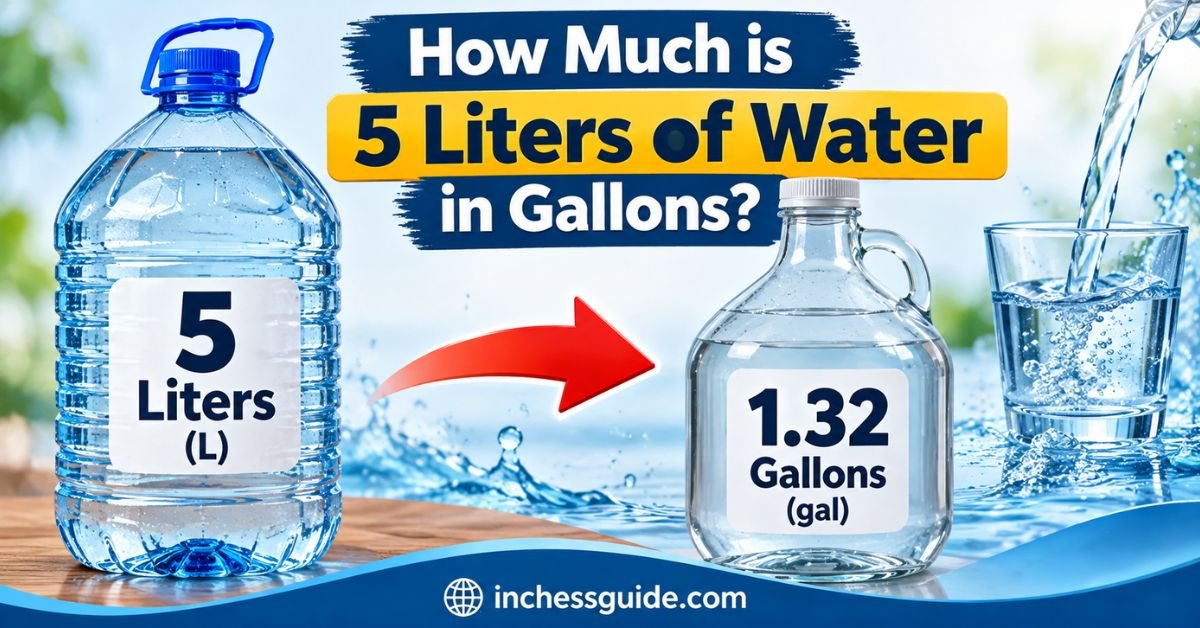
5 liters of water equals about 1.32 US gallons. If you are using imperial (UK) gallons, 5 liters is about 1.10 imperial gallons.
| Unit | 5 liters equals |
|---|---|
| US liquid gallons | 1.3209 gal (rounded) |
| Imperial gallons | 1.0998 gal (rounded) |
The figure is the same whether the liquid is water, milk, or juice, because gallons and liters both measure volume. The type of liquid only matters if you want to know the weight, which is covered further down.
In everyday terms, 5 liters is one US gallon plus roughly another third of a gallon. That is about one gallon, one quart, and 9 fluid ounces.
How to Calculate Liters to Gallons
The conversion rests on one defined value. One US liquid gallon is exactly 3.785411784 liters. To convert, divide the liters by that number:
Gallons = liters ÷ 3.785411784
You can also multiply by the reciprocal, about 0.264172, which many calculators and charts use:
Gallons = liters × 0.264172
Worked example
- Start with 5 L.
- Divide: 5 ÷ 3.785411784 = 1.32086…
- Round to two decimal places: 1.32 US gallons.
Check with the multiplication method: 5 × 0.264172 = 1.32086, the same result.
A quick mental shortcut
When you don’t have a calculator, divide the liters by 4, then add about 6%. For 5 liters:
- 5 ÷ 4 = 1.25
- 6% of 1.25 is about 0.075
- 1.25 + 0.075 ≈ 1.325
That lands within a fraction of a percent of the true value, which is fine for deciding whether a container is big enough. It is not a substitute for the exact factor when precision matters.
US Gallons vs. Imperial Gallons
The word “gallon” refers to more than one unit, and this is the most common source of conversion errors.
- US liquid gallon: exactly 3.785411784 L
- Imperial gallon: exactly 4.54609 L
The imperial gallon is about 20% larger (a ratio of roughly 1.201). So the same 5 liters is a smaller number of imperial gallons:
5 ÷ 4.54609 = 1.09985, or about 1.10 imperial gallons.
The imperial gallon is mostly seen in the United Kingdom, where fuel economy is still often quoted in miles per imperial gallon even though fuel is sold in liters. In the United States, recipes, water jugs, aquarium sizes, and fuel are all measured in US gallons. If your reader is American, use US gallons. If a source or product label does not say which gallon it uses, check before relying on the number.
A third gallon, the US dry gallon (about 4.405 L), exists for dry goods but is almost never used for water. Water and other liquids use the liquid gallon.
Liters to Gallons Conversion Table
This table shows nearby quantities so you can scale the answer up or down. Values are rounded to four decimal places.
| Liters | US gallons | Imperial gallons |
|---|---|---|
| 1 L | 0.2642 | 0.2200 |
| 2 L | 0.5283 | 0.4399 |
| 3 L | 0.7925 | 0.6599 |
| 4 L | 1.0567 | 0.8799 |
| 5 L | 1.3209 | 1.0998 |
| 10 L | 2.6417 | 2.1997 |
| 20 L | 5.2834 | 4.3994 |
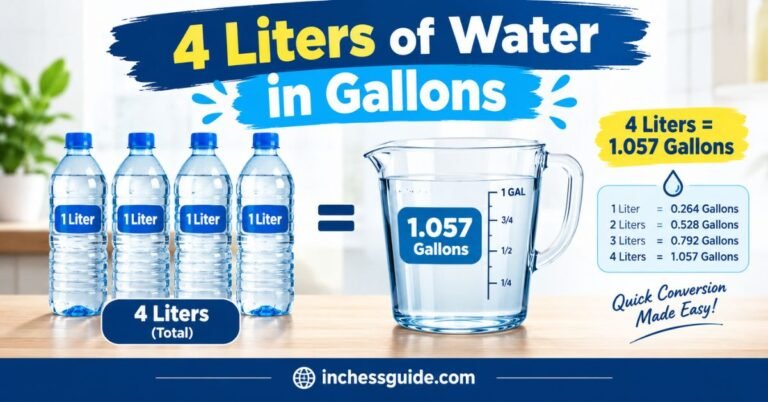
Notice that 4 liters is already slightly more than one US gallon (1.0567 gal). That is a handy anchor: if a task calls for a gallon of water, about 3.8 liters is enough, and 5 liters gives you a comfortable margin.
5 Liters in Smaller US Units
Gallons are a large unit, so it often helps to see the same quantity in smaller ones. These are US customary units, rounded.
| Unit | Amount in 5 L |
|---|---|
| Quarts | 5.28 qt |
| Pints | 10.57 pt |
| US cups | 21.13 cups |
| US fluid ounces | 169.07 fl oz |
These follow from the gallon: 1 gallon is 4 quarts, 8 pints, 16 cups, or 128 fluid ounces. Multiply each by 1.3209 and you get the figures above.
You can also express the result as a mixed amount. The 0.3209 gallon left after the first full gallon is about 1.28 quarts, which is 1 quart plus roughly 9 fluid ounces. This is useful when you only have a quart container or a measuring cup and need a practical way to portion the water.
How to Picture 5 Liters of Water
Numbers like 1.32 gallons are easier to remember when you attach them to familiar containers. The comparisons below use common product sizes. Exact sizes vary by brand and region, so treat them as approximations unless the label states the volume.
- A standard US gallon jug (3.785 L): 5 liters fills one jug and about a third of a second one. A gallon is a defined volume, though the shape of the jug varies by brand.
- 2-liter soda bottles: 5 liters is two and a half of these. Two bottles fall 1 liter short.
- 1-liter bottles: exactly five.
- 500 mL (16.9 fl oz) water bottles: exactly ten. This is a common retail size, and ten of them make 5 liters.
- 12 fl oz (355 mL) drink cans: about 14 cans, since a US 12 oz can holds roughly 355 mL.
- A typical household bucket: many buckets are labeled 10 or 12 liters, so 5 liters would fill about half of a 10-liter bucket. Check your bucket’s printed capacity, because sizes differ.
These comparisons give you a feel for the amount, but they are not measurements. A container that looks like a gallon may hold more or less, and a “5-liter” jug may have a slightly different fill line than its total capacity. For anything where the quantity matters, use a calibrated measuring jug.
How Much Does 5 Liters of Water Weigh?
Readers who search for water volume often want the weight as well. Water is convenient here because of how the metric system was originally built around it. At about 4°C, one liter of water has a mass very close to one kilogram. At room temperature, around 20°C, water is slightly less dense, at about 0.998 kg per liter.
- Mass at room temperature: about 4.99 kg (5 L × 0.998 kg/L)
- In pounds: roughly 11 lb
So 5 liters of water weighs about 5 kg, or just over 11 pounds. That is a heavy load to carry in one hand, which matters for hiking, camping, and moving a filled container.
This 1 kg per liter shortcut is accurate for fresh water at ordinary temperatures. It does not apply to other liquids. Milk, oil, honey, and seawater all have different densities, so 5 liters of each weighs something different. Volume tells you how much space a liquid takes up, and weight depends on what the liquid is.
When This Conversion Is Useful
A few situations where converting 5 liters to gallons comes up in practice:
- Aquariums and small tanks: Tank sizes and water-change volumes are often given in gallons, while bottled or tap-filled containers are measured in liters. A 5-liter water change on a larger tank is about 1.3 gallons.
- Camping and hiking: Water capacity on gear is sometimes listed in liters, while trip planning guides in the US use gallons. Remember the weight, since 5 liters is about 11 lb.
- Pets: Automatic water dispensers and bowls are commonly sold with capacities in liters or gallons.
- Gardening and watering cans: Many cans are marked in liters, but plant-care instructions may be written in gallons.
- Recipes and brewing: Large-batch cooking, soups, and home brewing may mix metric and US units across sources.
Which tool should you use?
For casual tasks, a marked jug or a measuring cup is enough. For anything that depends on accuracy, such as mixing a solution to a specified concentration, use a measuring container with graduated markings in the unit your instructions use. A kitchen scale can also check water volume: set the container on it, zero it, and add water until it reads close to 5 kg (remembering that this is a close approximation at room temperature, not an exact calibration).
Visual estimates are fine for watering a plant, but not for tasks where the amount affects safety or results, like mixing chemicals, dosing, or any process with manufacturer instructions.
5 Common Mistakes to Avoid
Mixing up US and imperial gallons. The same 5 liters is 1.32 US gallons or 1.10 imperial gallons, a difference of about 0.22 gallons. Always confirm which gallon a source uses.
Confusing fluid ounces with weight ounces. A US fluid ounce measures volume (about 29.57 mL). An ounce on a kitchen scale measures weight. One US pint of water is close to 16.7 oz by weight, not 16. Don’t swap them.
Using the dry gallon. The dry gallon (about 4.405 L) is a separate unit and should not be used for liquids such as water.
Rounding too early. If you round 0.264172 to 0.26 before multiplying, 5 liters becomes 1.30 gallons, which is a noticeable error. Keep the full factor until the final step.
Assuming a container’s shape tells you its volume. Two jugs that look the same size can hold different amounts. Rely on printed capacity or a measuring tool.
Accuracy and Rounding
The factor 3.785411784 liters per US gallon is exact by definition, so the true result of 5 ÷ 3.785411784 is 1.32086… with digits that continue. Every decimal value shown here is a rounded representation of that number.
For most uses, 1.32 gallons is accurate enough. If you need greater precision, such as scientific or technical work, use 1.3209 or carry the full calculator result. For cooking and household use, “about 1⅓ gallons” is a reasonable simplification, since 1⅓ is 1.3333, about 1% above the true value.
Temperature also has a small effect. Liquid volume changes slightly with temperature, but the effect on water between ordinary tap and room temperatures is small enough to ignore in everyday conversions.
Frequently Asked Questions
1: Is 5 liters more than a gallon?
Yes. A US gallon is about 3.785 liters, so 5 liters is roughly 1.32 gallons, or about 32% more than a gallon. It is also slightly more than one imperial gallon (4.546 L).
2: How many 16.9-ounce water bottles make 5 liters?
Ten. A 16.9 fl oz bottle holds about 500 mL, and ten of them total 5,000 mL, which is 5 liters.
3: How do I convert gallons back to liters?
Multiply the number of US gallons by 3.785411784. For example, 1.5 gallons × 3.785 = about 5.68 liters. The reverse of this article’s calculation is simply gallons × 3.785.
4: Does the temperature of the water change the answer?
Only by a very small amount. Water expands slightly as it warms, so the same mass takes up marginally more space, but for household conversions the difference is negligible.
5: Why do some sources show a different number of gallons for 5 liters?
They are most likely using imperial gallons (about 1.10) or rounding differently (such as 1.3 or 1.321). Check which gallon is meant and how many decimal places the source keeps.
Explore More Continue Reading Our Guide on: How Much Is 6 Liters of Water in Gallons?
Conclusion
5 liters of water is about 1.32 US gallons, or about 1.10 imperial gallons if you are working in UK units. That is one US gallon plus about a third, and it weighs close to 5 kg (just over 11 lb). When accuracy counts, check which gallon your source uses and measure with a graduated container instead of judging by eye.